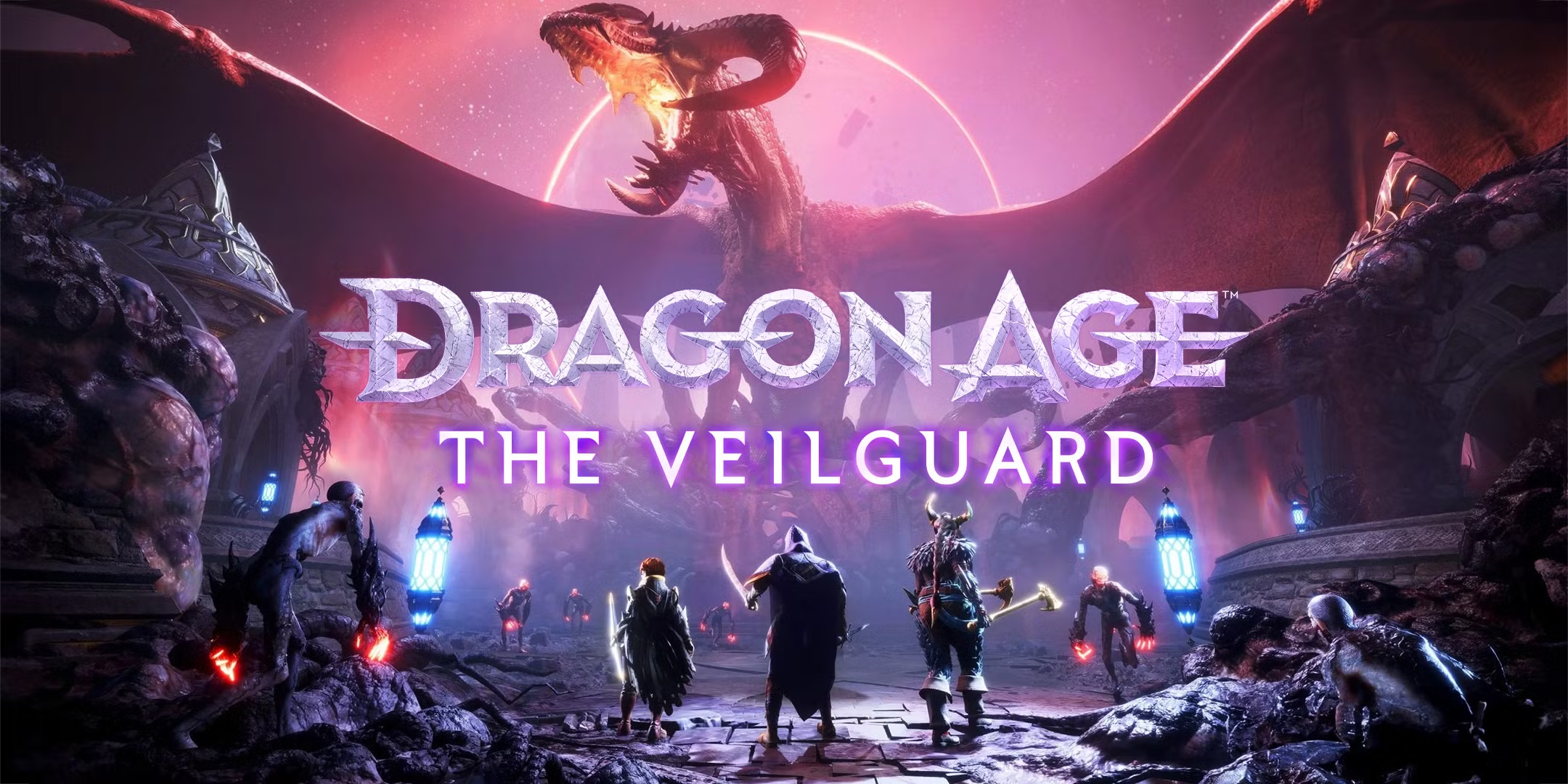
As a long-time fan of the Dragon Age video game series, I previously reviewed the first three entries — Origins (2009), Dragon Age II (2011), and Inquisition (2014) — for the Unicorn Scale at Bi.org. The series has consistently delivered rich storytelling, complex characters, and immersive worlds, making it one of my all-time favorites. Naturally, I eagerly anticipated the release of the latest installment, Dragon Age: The Veilguard (2024), which was in development for nearly a decade.
One notable aspect of the Dragon Age series is that each game offers a distinct experience while maintaining a cohesive narrative thread. Origins introduced players to the fantasy world of Thedas with a traditional role-playing game (RPG) structure, Dragon Age II provided a more focused, character-driven story, and Inquisition expanded into a semi-open world with vast areas to explore. Veilguard returns to a more structured design reminiscent of Origins, which has sparked debate among fans; some appreciated Inquisition’s open-world approach, while others preferred the more contained environments of the earlier titles. Personally, I enjoy both, and was curious to see how Veilguard would balance the two.
Origins has always stood out to me as the best in terms of storytelling (though the entire series has excellent stories). Many critics have recognized Origins on “best of” RPG lists, with some even calling it the best RPG ever made. Part of what made it so compelling was the character development and the organic, high-stakes choices that led to multiple possible endings, each dramatic and satisfying in its own way. The two sequels continued this tradition, but Origins still holds a special place for the way it balanced epic storytelling with meaningful choices.
For the gameplay itself, I’d give the edge to Dragon Age II, which leaned more into action elements, offering a dynamic mix of action and RPG mechanics. Inquisition, on the other hand, excelled in world-building, thanks in part to its open-world sandbox design that made Thedas feel vast, lived-in, and interconnected — an entire universe to explore, rather than a series of isolated levels.
That said, they are all outstanding games. And, crucial to this review, each one set the bar for bi representation in gaming, consistently showcasing some of the best bi characters the industry has to offer. With these similarities and differences in mind, let’s dig into Dragon Age: The Veilguard, which brings its own approach to these core elements while building on the series’ foundation of inclusive representation. Be warned: SPOILERS ahead! If you’d like to see the grading metric we use, read it here, or check out our Bi Media entry on the entire series here.
What I Liked:
While I was initially hoping for another sandbox experience like Inquisition, I ended up appreciating Veilguard’s return to a more classic approach. The designers took a clever route, creating expansive levels that open up as you progress, which combines the best of both worlds: a structured progression system that still manages to feel immersive and grand in scale.
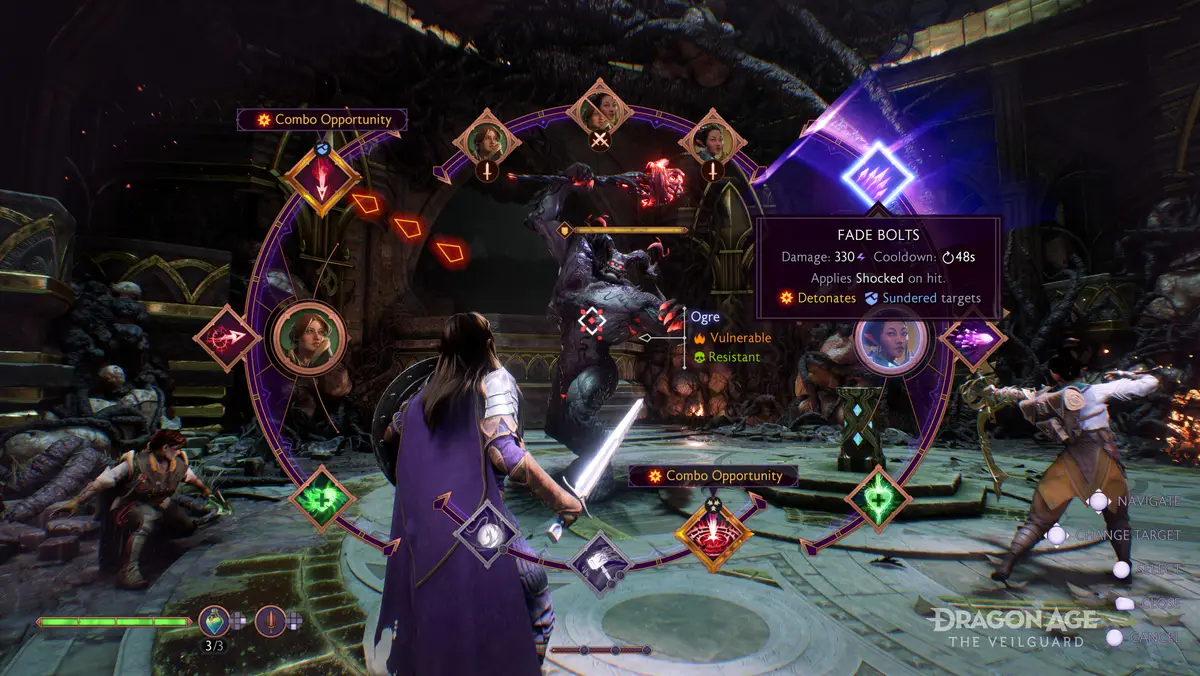
Combat, too, is a major highlight. In fact, I’d say Veilguard surpasses Dragon Age II as the best combat in the series. By evolving the blended action-RPG mechanics from DA II and incorporating new features and advancements, the result is challenging — especially on higher difficulty settings — and delivers a high-energy thrill, whether you’re playing as a mage, rogue, or warrior.
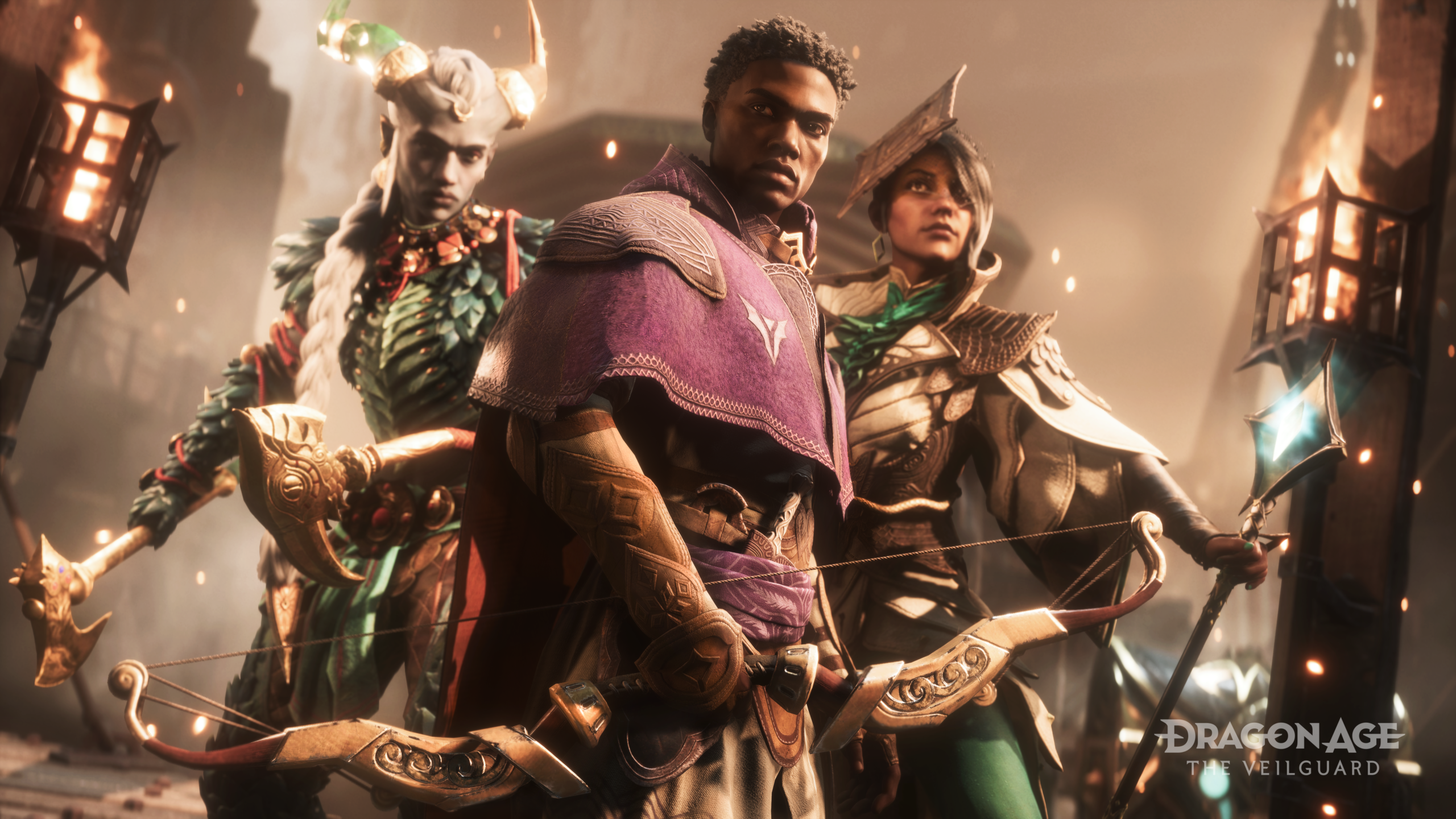
As for storytelling, while Veilguard doesn’t necessarily surpass Origins (which I still consider the pinnacle of the series in that regard), it’s certainly up there. Like Origins, Veilguard gives each character a rich arc with meaningful development, where player choices shape fulfilling and varied outcomes for each character. Without spoiling anything, let’s just say that the range of possible fates runs from the tragic to the beautifully poignant. This narrative depth, combined with the choices players can make, gives the game exceptionally high replay value. And, like Origins, players can choose from a variety of characters, each with their own distinct backstory, which affects dialogue and narrative options throughout the game. This time, however, players don’t get to play out these backstories interactively. Instead, they provide rich context woven through the story as the action unfolds.
On balance, Veilguard feels like a thoughtful mix of what made each of the previous volumes unique. The designers seem to have carefully weighed the strengths and weaknesses of each installment, creating a balance that feels both fresh and true to the series’ roots.
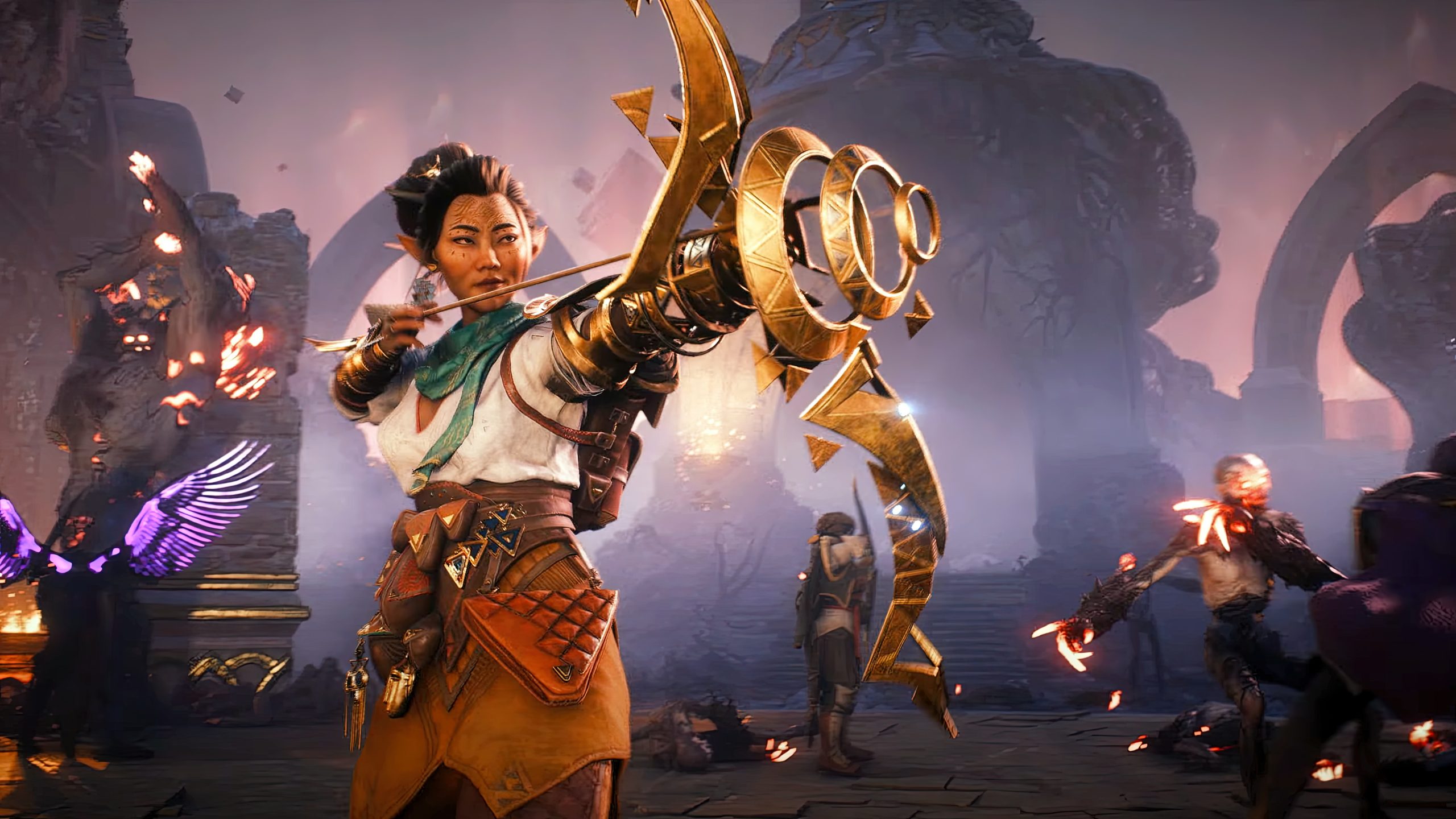
The Dragon Age series has always excelled in art direction and soundtrack, with each game bringing the rich mythology of Thedas to life through detailed visuals and immersive music and soundscapes. Veilguard takes this legacy to new heights. While the art direction is on par with the previous games, it benefits immensely from the enhanced capabilities of modern technology, allowing for stunningly detailed textures and vibrant landscapes that make the world feel even more alive. The soundtrack, composed by the legendary Hans Zimmer — known for iconic scores like Gladiator (2000), The Dark Knight (2008), and Inception (2010) — is the most epic and compelling in the series to date. Zimmer’s orchestration beautifully fuses neoclassical stylings with modern genres like heavy metal and dubstep, creating a postmodern masterpiece that matches the grandeur of Veilguard’s storytelling. This score enhances every moment, making the experience all the more unforgettable.
Now, let’s talk about the bi representation in Veilguard, which is impressive even by Dragon Age standards. Previous entries in the series introduced players to notable bi characters like devoted bard Leliana, hedonistic assassin Zevran, troubled deserter Anders, escaped slave Fenris, pirate captain Isabela, blood mage Merrill, brilliant diplomat Josephine, and Qunari spy Iron Bull, who each brought their own unique perspectives and personalities to the table. Veilguard raises the bar even further with a record eight bi characters, including the main character, Rook. Among the companions, Scout Harding — who was a minor character in Inquisition without a romance option — is now revealed to be bi, as players can romance her regardless of their own character’s sex. This level of inclusivity across the cast adds yet another layer to the game’s storytelling and makes Veilguard the most bi-inclusive Dragon Age title to date.
In Veilguard, I found myself just as captivated by the characters as I was in previous Dragon Age games. Scout Lace Harding, a returning fan favorite from Inquisition, must have really resonated with players because she’s been promoted to a main character here. Harding joins Rook right from the start of the adventure, alongside another returning favorite, Varric, though Varric is not a playable character this time around.
Scout Harding’s role in Veilguard is pivotal, and her journey takes a surprising twist when she unexpectedly gains magical powers. Without spoiling too much, the question of whether these abilities are a blessing or a curse makes for a dramatically charged romance if you choose to pursue her. Harding also represents the Inquisition in Rook’s journey to build alliances, adding weight to her interactions and decisions as they strive to unite forces to face the enemy, two Elven Gods (Elgar’nan and Ghilan’nain) accidentally unleashed at the outset of the game.
Other iconic characters from the Dragon Age series make welcome returns in Veilguard: Morrigan, the enigmatic Witch of the Wilds who has been with us since the very first game, reappears as a wise guide, offering her trademark wit and insights. Additionally, players have the option to recreate the Inquisitor from Inquisition, providing a wonderful sense of continuity for long-time fans. Solas, the Dread Wolf, who served as a companion in the previous game, takes center stage as the driving force behind Veilguard’s storyline. The full arc of his complex character — whose motives and true nature were only hinted at in Inquisition — unfolds in this new entry, hitting exactly the right notes. For fans of the first three games, these returning characters and the layers they bring provide even more depth to the world of Thedas, making Veilguard a rewarding continuation of the series. Even Isabela, the pirate captain from Dragon Age II, and Dorian, the snarky mage from Inquisition, make notable appearances again.
The six new companions introduced in Dragon Age: The Veilguard are all romanceable, regardless of the player character’s sex or gender identity. They include Bellara Lutare, a female elf mage and Veiljumper; Neve Gallus, a female human mage and Shadow Dragon; Lucanis Dellamorte, a male human rogue and assassin for the Antivan Crows; Davrin, a male elf warrior and Grey Warden; Taash, a Qunari warrior allied with the Lords of Fortune; and Emmrich Volkarin, a male human necromancer working for the Mourne Watch.
Each of these new companions brings their own quirks and endearing qualities to Veilguard. Bella, for instance, has a fascination with ancient elven technology, tinkering with it obsessively — even if her curiosity sometimes overrides caution about its risks. Neve is a strong-willed, fiercely loyal character who takes her time to warm up to new allies, but once she does, she’s steadfast. Lucanis, who was imprisoned and tortured alongside a demon that now possesses him, has a tangled family history as the grandson of the godmother of the Antivan Crows. His complex family connections open up plenty of opportunities for intense, dramatic storytelling.
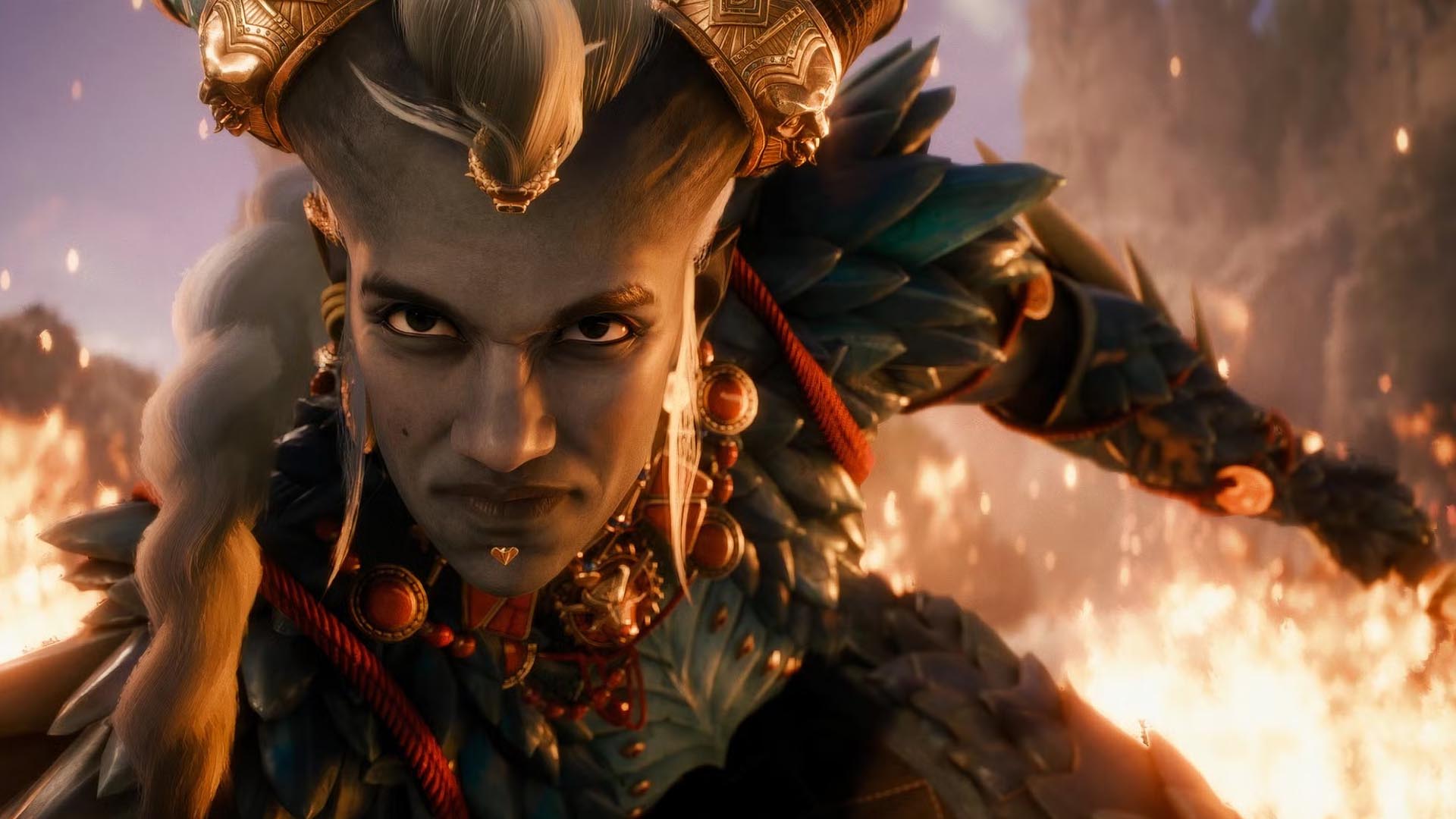
Davrin, a dedicated Grey Warden, is accompanied by a unique pet, a young griffin named Assan, and is determined to protect the endangered griffin species. He’s even willing to go rogue when the First Warden won’t take action. Taash, the series’ first non-binary character, is a fierce fire-breather and an all-around badass. Lastly, Emmrich, inspired by bi horror legend Vincent Price, is an eccentric professor of necromancy with a memorable personality and a hilarious undead butler called Manfred, who adds a dash of dark humor to the game.
While Dragon Age: Inquisition introduced the first trans character in the series — a trans man named Krem, a member of Iron Bull’s squad — Veilguard marks a milestone by making Taash the first trans character to serve as a main companion. Taash’s journey is packed with memorable moments, including a standout scene in which their well-meaning but overbearing mother mentions to Rook that “it’s unusual for [Taash] to be attracted to men.” This adds a layer of scientifically literate bi representation, essentially “outing” Taash as someone who’d score a 5 on the Kinsey Scale, a model developed by researcher Alfred Kinsey in the 1940s in which 0 represents exclusive heterosexuality and 6 represents exclusive homosexuality. Everything in between (1 to 5) scientifically qualifies as bisexuality — one doesn’t have to be a 3 to be considered bi. This portrayal of Taash is significant because it broadens public understanding that human sexuality isn’t only more nuanced than “gay” or “straight”; bisexuality itself also encompasses a range of experiences. This makes Taash’s character a landmark example of bi representation, challenging assumptions and underscoring the diversity within bisexuality.
In addition, Veilguard acknowledges the coexistence of sexuality and gender as harmonious aspects of identity. While sex is a biological construct and gender a cultural one, both interact naturally rather than in opposition. This complexity is thoughtfully represented in Veilguard, as players have the option to choose or discover their character’s gender identity throughout the journey. This feature deepens the game’s portrayal of human sexuality and relationships.
What I Didn’t Like:
In the previous Dragon Age entries, the companions included straight and gay characters who would politely decline if the player character of a different sex tried to romance them. I personally miss this detail, as it added a realistic, grounded element to the romantic experience and had educational value in familiarizing players with the variety of sexualities. Not everyone is going to be into you, and that’s perfectly natural. This small but meaningful feature was lacking in Veilguard.
Some of the dialogue can also feel a bit stilted, especially compared to other contemporary games, though perhaps not much different from earlier entries in the Dragon Age series. However, certain lines around sex and gender occasionally come across as a little too instructional, at times veering into territory that might feel overly didactic to some. While these conversations are well-intentioned, the delivery can risk feeling like an after-school special, which may be off-putting to players who would otherwise be receptive. This is a bit surprising, as I don’t remember the earlier games feeling quite this way — even if, in fairness, some players may have felt they were progressive “for their time.”
Another gameplay change worth noting is the reduction in party size. In previous games, players could bring along three companions, making for a party of four, whereas in Veilguard you’re limited to two companions, which makes for a party of three. I do miss the larger team dynamic that previous games offered. Additionally, Veilguard lacks the option to switch between companions during quests, meaning you’re always controlling your main character, Rook. This limits some of the flexibility in combat and exploration that was present in earlier games.
I also missed Inquisition’s handy search feature, which allowed players to ping their surroundings to quickly spot nearby treasures and hidden items. This was a small but useful mechanic that streamlined gameplay and exploration, and its absence here leaves a gap many fans will feel. While Veilguard still offers a deeply engaging experience, these changes make for a slightly different approach to gameplay that may take some getting used to.
The Rating:
While the party size has shrunk from four to three, Veilguard carries over the witty banter and character interactions that fans loved in previous games. The companions you choose to bring along continue to offer additional, context-specific dialogue options and story choices, enhancing the depth of each quest. Despite the reduction in party size and the absence of direct companion control, the vastly improved combat mechanics don’t suffer. Rook can still issue commands to companions, and the option for party members to collaborate with another in performing complex skills makes for highly enjoyable gameplay. It also means that there’s more to be discovered gameplay-wise in subsequent playthroughs with a different class of character. And while the ping feature from Inquisition is missed, it’s ultimately a positive omission here. Given the more structured level design, automatic discovery of hidden treasures would have reduced the challenge and satisfaction of exploration. The ping feature was, after all, more suited to the open-ended sandbox layout of Inquisition.
I’m not going to hold it against Veilguard that all the companions are bi this time around. As a bi gamer, it was endlessly fun to have the freedom to romance any character I wanted from the team. Plus, players who want to roleplay a character with a monosexual orientation — gay or straight — can still do so with ease, while experiencing the same level of emotional depth and connection.
While previous entries portrayed sexuality in a more varied and “realistic” way by including characters with specific romantic inclinations, the decision to make all companions bisexual/pansexual here allows players of all orientations to have a fully absorbing experience. This approach prioritizes the freedom and enjoyment of the player, which ultimately feels right for a fantasy game that invites players to create and explore a world as their authentic selves. It’s hard to fault Veilguard for choosing to maximize player satisfaction and inclusivity.
That said, the game still maintains a sense of realism and emotional complexity. Players often face difficult choices that involve significant trade-offs, and there are moments when any option risks disappointing one or another character on the team. These decisions can lead to hardening characters against Rook, and in some story paths, this can even result in a heartbreaking rejection from the character the player was attempting to romance. It’s really an incredible level of in-game emotional realism and interpersonal relationships.
As for the occasional dialogue that veers into the educational, I won’t hold this too strongly against the game. These moments are infrequent, and while perhaps a touch more finesse in the writing could have made them more seamless, they don’t significantly detract from the overall storytelling quality that we’ve come to expect from Dragon Age. The narrative remains robust and engaging throughout, and for a new generation of players, this approach may feel relevant and refreshing rather than preachy.
Some may attempt to label the game as “woke,” but I see it more as a reflection of today’s gaming audience, likely composed of younger millennials and Gen Z players who are often exploring Dragon Age for the first time. Veilguard feels attuned to these players’ interests and sensibilities while honoring the legacy of bi inclusion the series is known for.
So, for all these reasons, combined with the fact that Veilguard offers more bi representation than any previous entry, I’m giving it a full four unicorns.