Of all the supernatural creatures depicted in mythology, folklore, fantasy, and horror, there’s something wonderfully bisexual about vampires. It’s easy to blame author Anne Rice for that with her genre-dominating bisexual libertines, but really she was drawing on a much older tradition and translating the subtext into text.
Originating in Eastern Europe and Asia, the original vampires were unrecognizable from the vampires of Western fiction. Flesh-eating, plague-spreading, and frequently missing large chunks of their bodies, the first vampires seemed more like demons or the equally inaccurate horror-movie zombies than the modern version we’re used to. Fascinating and scary, but for the most part wildly unsexy. And if it wasn’t for the intervention of a bunch of disaster bi folks road-tripping across Europe, the image of the vampire would likely have stayed that way.
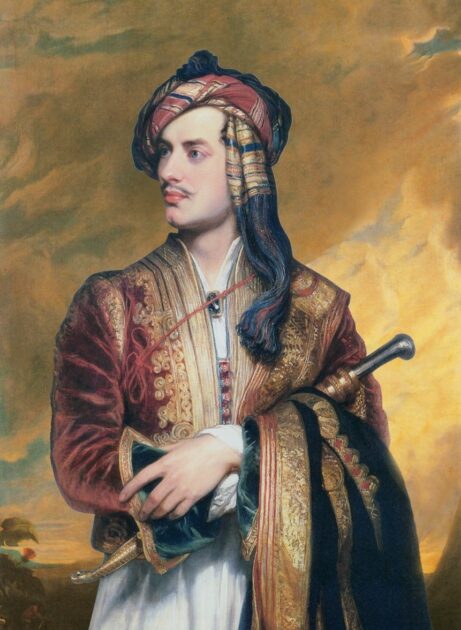
Lord Byron, the original bi bad boy, had to leave England in a hurry due to rumors of sodomy — still a hanging offense at the time. He and his friends/lovers — Percy and Mary Shelley, Claire Clairmont, and his personal physician, Dr. William Polidori — spent a wet summer together in the Italian Villa Diodati, inventing literary genres in between sexcapades. While Mary Shelley birthed sci-fi through Frankenstein, Polidori created the Romantic literary vampire based on Byron himself. Filtering the genuine folklore they’d encountered through the literary conventions of Gothic horror, Polidori’s “vampyre” Lord Ruthven is exactly the destructive bi stereotype we’re all so very tired of — though in Polidori’s defence, he was trapped with the living embodiment of it at the time.
Though a sexual relationship between Lord Ruthven and the unfortunate protagonist, a young Englishman named Aubrey, is never made explicit in the 1819 novel The Vampyre, it’s about as queer as Polidori could make it and still succeed at publication. Ruthven and Aubrey’s relationship is filled with the same miserable obsession and sexual tension that got The Picture of Dorian Grey included in Oscar Wilde’s sodomy trial. The works that came after it were no less full of claustrophobically displaced desire. Carmilla and Laura drip with sexual tension in Sheridan Le Fanu’s Carmilla, while Stoker’s Dracula is a parable about the dangers of sexuality existing outside the bounds of middle-class marital respectability. In all of these, the shadow of Byron looms long; the vampire is a dangerous, corrupting figure, and the hedonistic lifestyle he or she offers is ultimately destructive.
The bi energy of vampires goes deeper than their tendency toward playing the Byronic hero; however, it does share an origin point. This new literary vampire of the 1800s had evolved from a ravening ghoul into a seductor, one whose primary goal was sustenance rather than lust, and yet still approached his victims sensually, regardless of their sex.
Though this archetype stemmed from Polidori’s desire to excoriate his patient/employer through a deliciously thin metaphor, it seeps into the creature’s nature, existing at a more primal level than any personality trait or behavior. Fundamentally, no matter who they are or how they behave, vampires are sex-omnivorous beings for whom food is a form of foreplay, at the very least.
Victorian sexual repression (or rather, the performative respectability they were forced to play in public) lent itself perfectly to this blood drinking as a metaphor for sex, and the necessary ambiguity of it made space for queerness. After all, if we pretend not to recognize that this is what’s going on, it makes perfect sense for men to feed off men — no need to question anything! The Emperor’s New Clothes has often served as a cover for queerness. At the same time, the cultural distaste and distrust of queerness fed the construct of the vampire as bisexual, and this bisexuality became part and parcel of their villainy. We always project the things we fear onto the Other, real or mythical, and the bi vampire was a Victorian double whammy. As it turns out, the only thing more threatening than a queer person is one who might also fuck your wife.
It’s no coincidence that vampires began their rehabilitation as queerness was becoming more acceptable, nor that this redemption arc used kinky fiction that straddled the line between erotica and horror. Though some may prefer to forget it, there’s a long history of LGBTQ people finding safety and acceptance among the kink community before we were given access to the white picket fence.
It’s also no coincidence that as vampires moved into the mainstream they have become straighter and more detached from their subversive origins. The worst of them are the insipid Twilight lot (just be thankful we got this far before mentioning them) who only drink from animals, are strictly heterosexual, and wait to have sex until marriage. Buffy’s “good” vampire Angel isn’t much better, and it’s a little troubling that he seems to become bi while missing his soul (his bisexuality also stays well in the realm of subtext). Even then, there remains a clear erotic charge to feeding when it involves their preferred sex, raising questions about all the other times they’ve fed.
It’s hard to detach sex from an act that involves penetrating an erogenous zone after all, and even with some writers trying to desex feeding or portray the impulse as an entirely heterosexual one, there’s too long a history of vampires behaving otherwise to straightwash the beast.