Oscar Fingal O’Flahertie Wills Wilde was an Irish author, poet, and playwright who rose to the top of the London theater world near the end of the 19th century and has since become a globally celebrated literary icon.
Wilde was born in Dublin, Ireland, in 1854 to notable parents. His father, Sir William Wilde, was Ireland’s leading eye and ear surgeon and served as a medical advisor and assistant commissioner for the Irish census administration. His mother, Jane Wilde, was a poet and Irish nationalist who wrote under the pen name Speranza and helped inspire in young Oscar a love of the written word.
Wilde learned French and German as a child, and excelled in his scholastic studies at school, impressing his peers with inventive and comedic storytelling. As a teenager, Wilde intermittently courted Florence Balcombe for two years, at one point gifting her a delicate gold cross with his name engraved on it — a gesture generally seen at the time as the first step to becoming engaged. Balcombe went on to marry the author Bram Stoker, taking the Stoker name.
At Trinity College and later Oxford, Wilde showed a talent for classicism and became involved in the philosophy of aestheticism. After graduating, he briefly returned to Dublin before making his way to London, where he quickly ascended within fashionable circles. Wilde became a celebrity before anyone knew of his literary prowess. Known for his biting wit, flamboyant dress, and his charms as a conversationalist, Wilde was a larger-than-life personality among the high society crowd.
The opportunity to weave aesthetic styles into larger social themes drew Wilde to write drama. He penned Salome, a play that proved too scandalous to put on due to its erotic portrayals of biblical figures. Unperturbed, Wilde produced four successful society comedies immediately thereafter, which made him one of the most prominent playwrights of late-Victorian London. Lady Windermere’s Fan, A Woman of No Importance, The Importance of Being Earnest, and An Ideal Husband have been repeatedly performed and adapted ever since.
In 1884, Wilde married the writer Constance Lloyd. They spent a fortune buying, renovating, and decorating their home together, had two sons, and seemed to have had a happy marriage for a time. Early on, Wilde spoke often of his love for Constance. Scholars note that Constance suffered from gynecological problems after the birth of their second child, and have suggested that this ended the couple’s sex life.
Wilde was also famous (and infamous) for his dalliances with men. At the height of his fame, Wilde was accused by the Marquess of Queensberry of being a “sodomite” for his love affair with the Marquess’s son, Lord Alfred Douglas. In response, Wilde had the Marquess prosecuted for criminal libel. This move proved to be overzealous and ultimately ruinous. Rumors about his private life were already in circulation, but elevating the matter to a formal legal proceeding forced everything out into the open and onto the official record. The ensuing trial unearthed evidence of Wilde’s same-sex behaviors that caused him to drop his charges and led to his own arrest, trial, and conviction for “gross indecency with men.”
After his conviction, Constance made Wilde give up his parental rights, moved with their sons to continental Europe, and changed their last names.
On May 19, 1897, Wilde was released from prison and immediately sailed for France, never to return to the UK. After his experience behind bars, Wilde wrote and advocated for prison reform. He was briefly reunited with Lord Alfred Douglas, but Douglas’s family and Constance threatened to cut them both off financially if they did not separate. Constance died in 1898 in Italy. Wilde died in France in 1900. He was forty-six.
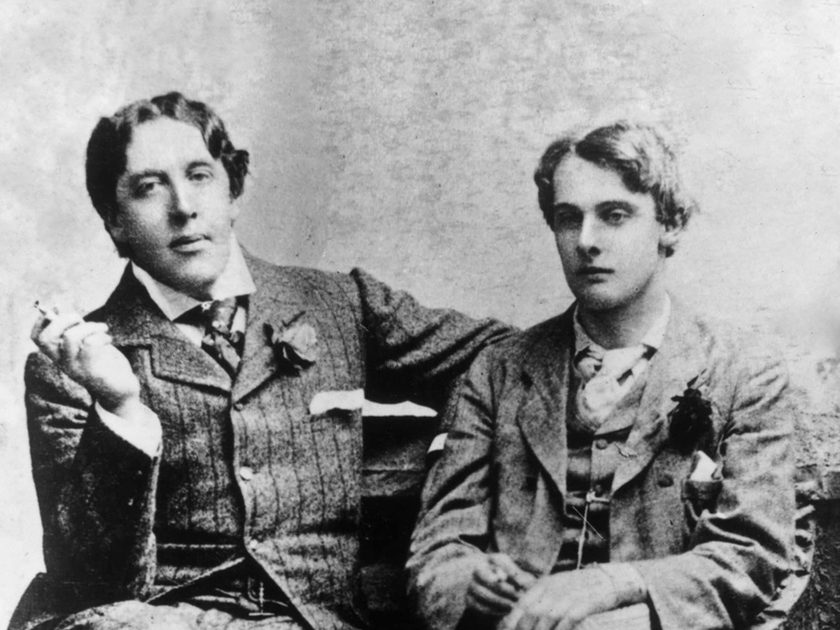
Oscar Wilde’s works remain enormously popular. His novel, The Picture of Dorian Gray, has inspired numerous screen adaptations. Wilde also numbers among the most quoted (and misquoted) authors in the Anglosphere. Not only do his writings continue to be read, performed, and adapted, but they have also inspired characters in other works such as The League of Extraordinary Gentlemen, The Chilling Adventures of Sabrina, and Penny Dreadful.
In 1995, Westminster Abbey unveiled a stained-glass memorial for Wilde in Poets’ Corner, recognizing him as one of the UK’s literary giants.