Lately, there’s been a noticeable rise in stories about LGBT characters navigating sports spaces defined by machismo and homophobia. After the breakout success of Heated Rivalry in 2025, more narratives have started exploring what it means to be queer in environments where masculinity is tightly policed, and where anything outside the norm can feel like a threat.
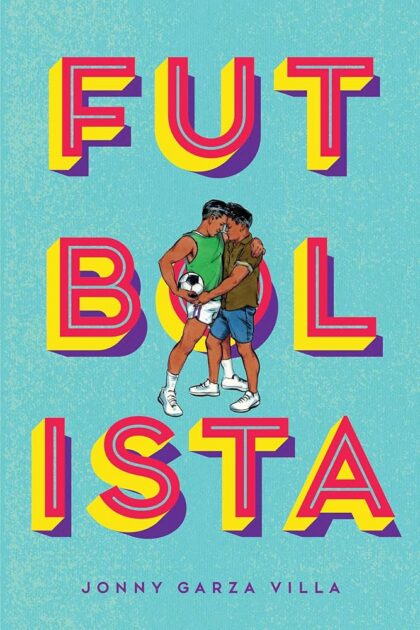
Futbolista, written by Jonny Garza Villa and published in 2025, is part of this contemporary conversation but also stands out for the way it places bisexuality at the center of the story’s conflict. Garza Villa has remarked that he chose soccer as the backdrop because, within Latino and Mexican culture, it is a space so deeply tied to community pride but also to rigid gender norms that can be exclusionary.
Before continuing, I’d like to give you a SPOILER alert since we’ll be diving deeper into the plot and the twists this novel presents.
Futbolista tells the story of Gabriel Piña, known as Gabi, a young college goalkeeper starting his first semester at Texas A&M University in Corpus Christi with a clear future ahead: to stand out in collegiate soccer, keep his reputation intact, and move closer to his dream of playing professionally in Liga MX (Mexico’s association football league), MLS (Major League Soccer), or even representing El Tri (the Mexican National Team). Gabi believes he knows exactly who he is: disciplined, focused, proudly Mexican, and above all, heterosexual. His identity seems as solid as his athletic trajectory, and straying from that path is not an option. In the opening chapters, it becomes quite clear that Gabi’s attraction to women is part of his identity.
However, that certainty begins to waver when Vale, a classmate from his philosophy course, offers to help him as a tutor. Vale isn’t a stranger: they both share the awkward memory of a party where, in a fleeting moment, they kissed during a game of dares.
Although this may feel revealing to the reader, the novel shows how Gabi rationalizes the episode rather than accepting it as part of his desire:
I don’t see any of my roommates, not that it would be the worst thing in the world if they saw me kissing a guy. They’d probably tease me, but I expect they also respect the rules of drinking games enough to know that I’m just helping out.
This kind of encounter shows how ordinary the internal conflict of self-recognition can be, and how real the fear of social consequences is when being perceived as bi in a deeply masculine environment.
For a bi reader, and particularly for someone who loves sports, the moment may feel painfully familiar. Hearing Barrera speak in terms of a “problem”, of the team’s reputation, or using homophobic slurs reflects the experience of hearing those kinds of comments in locker rooms, on fields, in schools, or among groups of friends, even when they’re not explicitly directed at oneself.
Yet he doesn’t remain completely silent; he defends Vale, sets boundaries, and resists accepting the moral hierarchy his captain tries to impose.
Another part that I found quite moving was the moment when Gabi reflects on why it took him so long to recognize that he is bi. Here, the feeling of “having arrived late” to discovering his own identity is palpable, especially when he compares himself to other queer people who seemed to have always known. Gabi describes how there was a mental barrier that prevented him from seeing himself clearly, a wall built by the pressure of the sports environment and the need to survive socially.
There was this big, stubborn wall that wouldn’t let me see myself clearly until it was too hard to ignore.
But there is also the chance to recognize that this delay doesn’t make him any less bi; rather, it may have been a survival mechanism in a context where he didn’t feel safe enough to explore himself. The dialogue also illustrates an experience closely tied to being bi: the tendency to compartmentalize, to feel attraction to both men and women, and yet convince oneself for years that one is heterosexual. The central conflict then becomes very clear: Gabi can accept himself in private, but he fears what it would mean to live his identity openly outside that safe space.
As a whole, the novel succeeds particularly well in its emotional exploration of Gabi and in showing how heavily the sports context weighs on his identity. A key example is the moment when he reads about the coming out of a professional Australian soccer player, who receives support from fans, the press, and his team. That experience allows Gabi to imagine a different future.
Eventually, he decides to speak directly to the camera on his social media. He presents himself as a young Mexican American proud of his roots and states clearly that he is bi. In his message, he acknowledges that waiting for culture to change is not an option and that he must become a visible reference point.
After uploading the video to Instagram, Gabriel meets with his father, who runs to embrace him as soon as he sees him.
Nothing you do, nothing about who you are could make me ashamed of you. Never.
In an interview published on April 15, 2025, Garza Villa explained that Futbolista is, above all, a coming-of-age story, centered on falling in love, fighting for dreams, and learning to be brave. He also mentioned that the novel combines romance, from classmates to lovers, with philosophical reflections and a more explicit exploration of intimacy, marking its shift toward an adult audience.
For some readers, the narration may feel overly explicit in its sexual content, which could give the impression that the driving force behind Gabi’s conflict is physical desire.
Even so, the novel stands out for its honesty in portraying fear, pressure, and anger. Living authentically while continuing to do what one loves should never be an impossible choice.