Wayward is a Netflix mystery-thriller limited series created by Mae Martin. Set in 2003, the show takes place in the ominous, fictional small town of Tall Pines, Vermont, where two teens trapped in a wayward school and home for troubled youth join forces with the new-in-town police officer to uncover the truth about the town and Tall Pines Academy.
Reform academy for wayward children…or cult? After two kids from Toronto end up at Tall Pines Academy, they realize things aren’t what they seem. Their original mission is to break out and be free, then it slowly shifts into staying alive and avoiding being brainwashed and broken. But what’s really going on to zap these kids’ brains? To help them crack the case, they work with a new detective who recently moved to Tall Pines with his very pregnant wife, who happens to be a Tall Pines Academy alum and is clearly hiding something gargantuan and sinister from her past.
This show, while focused on a crazy lady leading an insane cult and traumatizing an entire town into her submission, manages to also throw in a massive middle finger to bi erasure, without making it a major plot point or scandal (no more scandalized than any other teenage love side plot). We get this with the main character, Leila.
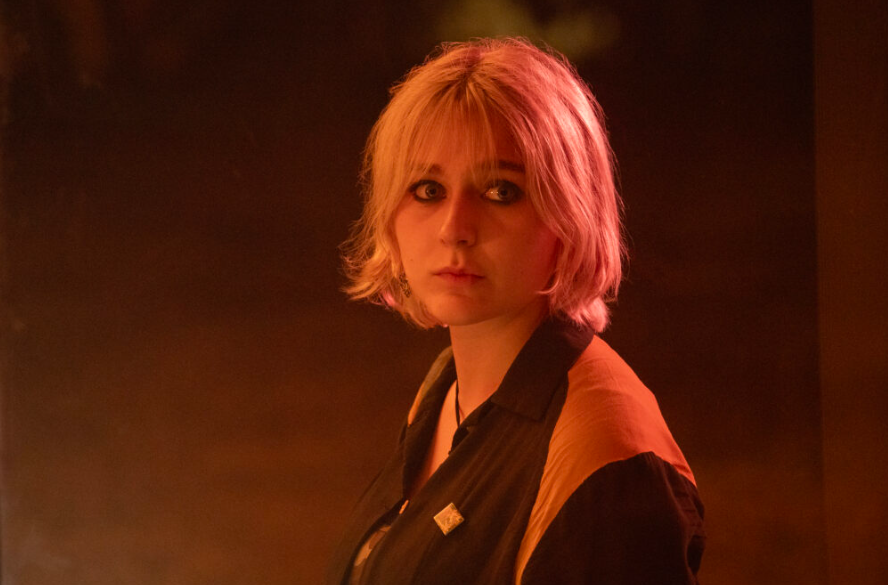
Leila is the poster child for a troubled teen. If there is a wrong decision to make, she’ll be making it. Even in the first episode, we see her with a much older boyfriend; she shouldn’t be with him for more reasons than there are grains of sand. So we know she definitely likes dudes. Then later, when trapped in the group confessional games, someone tries to insult her by calling her a lesbian, to which she retorts that she is bi, making their insult null and void. It comes up again later in the series, and Leila clarifies that she is bi. It is refreshing to see a character claim it without shame, and also identify their bisexuality so clearly and without hesitation.
This show is unique because it gives us a lot of queer visibility, but most of the focus is on Mae Martin’s character being trans rather than the main character being bi. The bisexuality has been overshadowed, and it is less of a big deal in terms of representation.
However, there is bisexuality undeniably. And it is shown through the main character, Leila, where media often leaves audiences making assumptions or digging for crumbs to confirm a character’s bi track. While you don’t need an active history to prove your bi street cred, it makes it easier for viewers to know when the proof is ready and available on screen.
The writers did drop another form of confirmation by having Leila audibly announce that she is specifically bisexual. This is a big deal since the more common approach with bisexuality in media is to sneakily have the character say they don’t do labels, that is, if they even discuss it at all! It is uncommon for bi content to directly be called and named for what it is. Or, depending on the context, bisexuality gets hijacked by another identity label, is gay-washed, or even misdefined.
We get additional bisexuality confirmation later in the show when Leila and her roommate run off to go make out in the warden’s office during a riot. Not that anyone has to have proof by having a history with both a male and a female to earn official bi status; it was nice to see that Leila was open to something with a girl, despite it being a horrible choice and an incredibly bad idea.
…And Netflix mentions it on their character guide for the show.
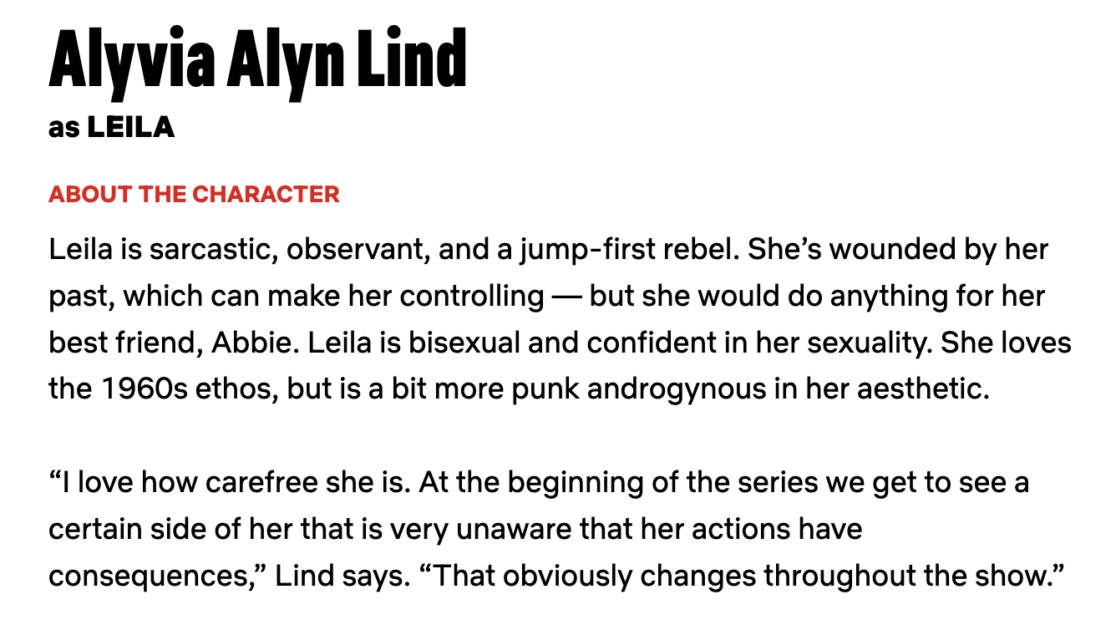
Of note is Netflix’ explanation, as they made it a point to mention Leila’s sexual orientation. The mention is positioned to contrast sharply with the rest of her bio, which makes her seem unstable because of her broken past and her teenage rebellion against the world. They lock in on the one part of her that she is confident about, which is her bisexuality. This is one aspect of her the writers wanted front and center, which is rare in modern media. It is difficult to quickly and casually frame a character’s sexuality without giving it some grand and dramatic arc or plotline. This show wove it in nonchalantly in a way that certainly sat well with the audience.
Another issue with bi media is getting it across without derailing the plot and turning it into a dramatic love triangle where the bi character gets the short end of the stick because the writers made the plot messy and couldn’t find a way to make the character bi without a whole scene. The other option is we get a lame pause where the characters go full PBS and explain sexual orientation for us all. So often we have very limited options for decent on-screen representation without it sounding like an afterschool special where we get educated, or a full telenovela.
The show was created and written by Mae Martin, who also starred as the trans man deputy. Mae is bi and nonbinary. Mae has been outspoken about their queerness for many years, and felt this story was worth telling. They were inspired by their friend from high school who had been sent to a similar school and always told “insane stories” about the school’s unconventional and aggressive treatment. Martin’s friend even consulted on the series.
Despite this story being based on a freaky cult, the cult is rather accepting, or at least equally tolerant of, queer relationships. Many cults find themselves strengthening their herd by bigoted rhetoric, and at least this incredibly toxic and dubious cult is not spreading hate about bi people and the general queer community. We see an example of this with Evelyn (Tall Pines Academy’s director) when she is nonchalantly accused of doing something for homophobic reasons, and quickly scoffs it off to reveal her true reasoning and intentions.
The only true biphobia we do see is when the kids are trying to use queerness as an insult, to which Leila shrugs it off and shoots back to correct that she isn’t a lesbian, but bisexual. Overall, nobody in Tall Pines cares about who is attracted to whom. And the academy only cares about brainwashing children and getting them to conform to the groupthink and indoctrination specific to their cult’s mission. They have bigger fish to fry than boring, bigoted ideas.
This show does a great job of exposing common biphobia, then turning around and slapping the bi erasure in the face with some good old-fashioned teen sass.