Hey there, my badass bi bibliophiles! Question: What’s your favorite position? Reading position, I mean. Personally, I love to either take up a spot on my grandfather’s reading chair or lie out on my couch and set my feet up on the coffee table. Not proper, I know, but it’s my table, and I keep it clean and, hey, I’m a creature of comfort.
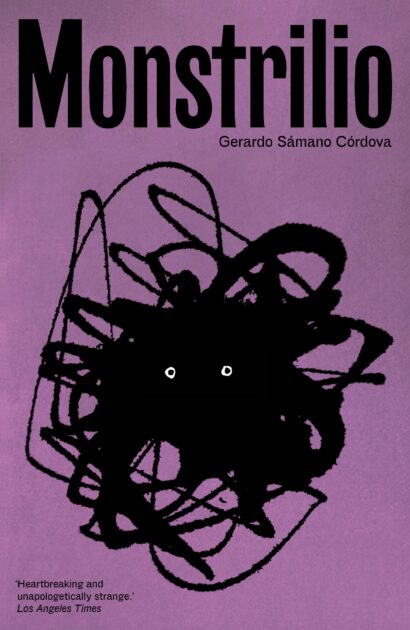
What is the nature of grief? The truth is, no one gets out of this life alive, and most of us will lose someone we love dearly before we ourselves shuffle off this mortal coil. And I think it’s safe to say that anyone who has lived through a profound loss knows that none of them take on the same path with the same person — even within families. Most of the time, the adage goes, “there’s no wrong way to grieve”. But after reading Monstrilio (2023) by Gerardo Sámano Córdova, we may want to revisit that phrase.
First and foremost, I should note that there will be SPOILERS in my review of this 2023 debut novel. I should also note that it should come with some content warnings, as we will discuss some rather squeamish themes, including, but not limited to: child death, grief, dismemberment of corpses, cannibalism, attempted manslaughter, and murder — and that’s just the jarring themes I can remember offhand.
So, safe to say this book is not for the faint of heart.
All good? Then let’s sink our teeth in.
Monstrilio is a horror novel involving parents Magos and Joseph, whose 11-year-old son, Santiago, dies after a life struggling with just one lung. Wild with grief, Magos cuts out and preserves a piece of her dead son’s lung and, fed by delusion and some precarious family folklore, she begins to feed the organ, which grows into a new sort of creature she names Monstrilio. But when these parents and others in their circle attempt to give this humanlike creature a second chance at life, its carnivorous urges threaten to topple their entire world.
Well, first and foremost, we have the main character, Joseph. The tragedy is told from four perspectives throughout the novel — Magos, their friend and confidante Lena, Joseph, and ultimately “M” (Monstrilio) himself. We learn from the first half of the novel that Joseph is attracted to his wife, though often numbed with grief over the loss of his son. But after divorcing her, we are brought into his perspective a few years later, amidst a marriage proposal from his new fiancée, Peter.
There’s no hitch in the narrative; no character is pulled up short by this development. It just…is. While it does take time for Joseph to tell other members of the family about his engagement, it’s not out of hesitation of bringing home a boyfriend; it’s because of the deeply unusual nature of the world around Monstrilio, and how that new added family member will soon have to know about his nature and how they work to protect the world from his hunting nature. In chapter 24, when Joseph asks his Uncle Peter for his blessing, even though the man basically grunts as a form of communication, he gives it to him wholeheartedly.
But this isn’t the only space where queerness and questioning come up in the narrative. Within the first quarter of the book, when Magos heads home to Mexico City, her mother, Jackie, notes that Magos’ longtime friend, Lena, is in love with her, and doesn’t dissuade her from the idea of striking something up with her. (Indeed, Lena does reveal in chapter six from her perspective that she loves and is attracted to Magos.) Magos also reveals that in the past, the two former roommates did once share a kiss. However, Magos claims she admired being loved by someone like Lena more than actually feeling attraction to her. Still, even Jackie admits that, if she were a young woman these days, she would have been interested in also pursuing someone like Lena, that “life is something to be explored”.
OK, so all this talk of exploration. Does Joseph — or anyone, really — use the term “bi” for him? Sadly, no, though his attractions are very clear to both the reader and the cast of characters. It just feels like a missed opportunity for a modern book, especially one with plenty of queer characters, to not actually use the term.
However, this isn’t to say that Joseph is without his foibles. Of all of the characters, he is the one who (at first) probably reacts the most realistically to Magos’ heinous act of extracting a piece of the lung and tries to mourn the death of Santiago in a more traditional form, condemning that Magos has “destroyed” their son. But when the creature begins to grow and even starts calling Joseph “papi”, his resolve begins to melt. This isn’t as sweet as it sounds, as this whole family unit (plus Lena) strives to enable this creature that may have come from his son but is very much a predator that feeds on flesh, and enjoys human flesh the most. Although the whole narrative is a commentary on the dangers of denial and of not confronting one’s deep grief — most of us can understand some reckless behavior in the depths of this particular despair. However, preserving a predator that actually ends up maiming multiple people and killing one is a bit too much.
With all that said, Monstrilio is a gripping tale of tragic grief and of the family that struggles to move through it. One review noted that there is no English word for a person who has lost a child — we have orphan for the other way around, or widow/er for loss of a spouse. But if something is so piercing that words can fail to reach it, can we always expect people to operate rationally within its sphere? Here we have a bi male lead in the depths of a profound sorrow, struggling to both manage something unimaginable as well as get on with his life to find happiness — or something like it.
I definitely recommend this one. Though Monstrilio is a horror novel, it’s not just its savage passages of mayhem that bear sharp teeth.