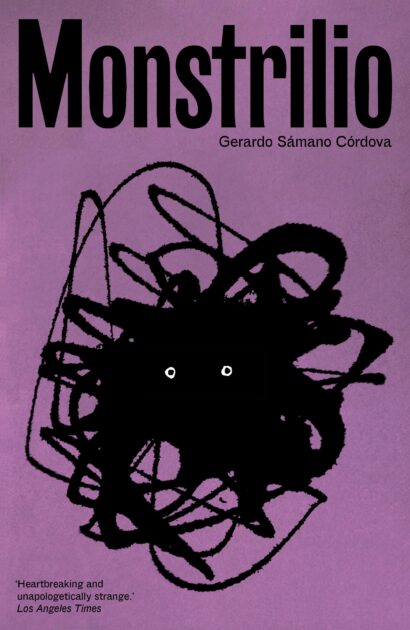
Monstrilio (2023) is the horror debut English-language novel of Mexican author Gerardo Sámano Córdova.
After the death of her 11-year-old son, Santiago, Magos cuts out a piece of his sole lung in an episode of deep grief. But when she begins to feed it, and it starts to develop into a terrifying sentient creature, she names Monstrilio, the entire family becomes involved in trying to raise this monster born from her son’s flesh — and to keep it from giving in to its cannibalistic urges, which threaten to topple their world.
This entry is going to focus on one of the four main characters, Joseph, Monstrilio’s father. Monstrilio is told in four parts, from the perspective of all four main characters — Magos, Lena (Magos’ longtime friend and confidante), Joseph, and Monstrilio, or “M”, himself. In the first half of the novel, which is told by Magos and Lena, we learn that Joseph is a kindhearted, logical man numbed by the deep grief of losing his son. Though Magos is motivated by some dubious family folklore about keeping her son alive by feeding the lung, Joseph acts the most rational of the group, saying that Magos has “destroyed” their son. He has the most difficulty accepting this idea of preserving the lung until he finally sees the sentient creature that has emerged from it, and his resolve to destroy it melts when it begins to call him “papi” (daddy).
When Joseph takes over the narrative, the story picks up a few years later. Joseph has divorced Magos, and we are dropped into the middle of him receiving a marriage proposal from a new suitor — a man named Peter. In this world, Joseph’s bisexuality is not explained; it just … exists. He receives a family blessing when he asks for it, and he only hesitates to introduce Peter to the unconventional family unit, not out of fear of rejection, but because he will then need to inform Peter of Monstrliio’s true nature. Still, Joseph is not perfect — though he acts as a good father figure to Monstrilio, he still enables this humanlike creature who causes real harm to people in its vicinity, even going so far as to help “M” escape after he nearly murders a victim or two.
In an interview with FrictionLit, Cordova explained that queerness was not only at the heart of Monstrilio’s conception, but that queer representation in the story was crucial to him:
What was the origin of the idea behind Monstrilio? Is there a particular experience or event that influenced your decision to write this book?
GSC: There isn’t a specific event, but rather a question we all have, particularly queer people: Am I going to be loved no matter what? I wanted to see how far love could be stretched. I wondered if it could break. I decided to explore a family’s love if they had to love something monstrous.
Monstrilio also explores themes of queerness, not just for young M but for almost every character in the novel. How important was it for you to write a story so representative of queer identities?
GSC: Extremely important. I had two goals: one, to have queer characters exist in a world without prejudice, acceptance, or the need for explanation; two, to tell a story in a queer way, challenging what we think traditional narrative should be.
Monstrilio was a critical hit, appearing on esteemed favorites lists including NPR, Goodreads, Barnes and Noble, and Shondaland, among many others. In 2024, it also won the Balcones Fiction Prize.
Monstrilio does what many good horror stories do, exploring big themes like unimaginable grief, what we will do to avoid processing such deep emotions, and the boundaries of love. Doing so while having a bi man as a lead character is unusual, and as such, makes this debut novel a standout for bi representation in modern horror fiction.