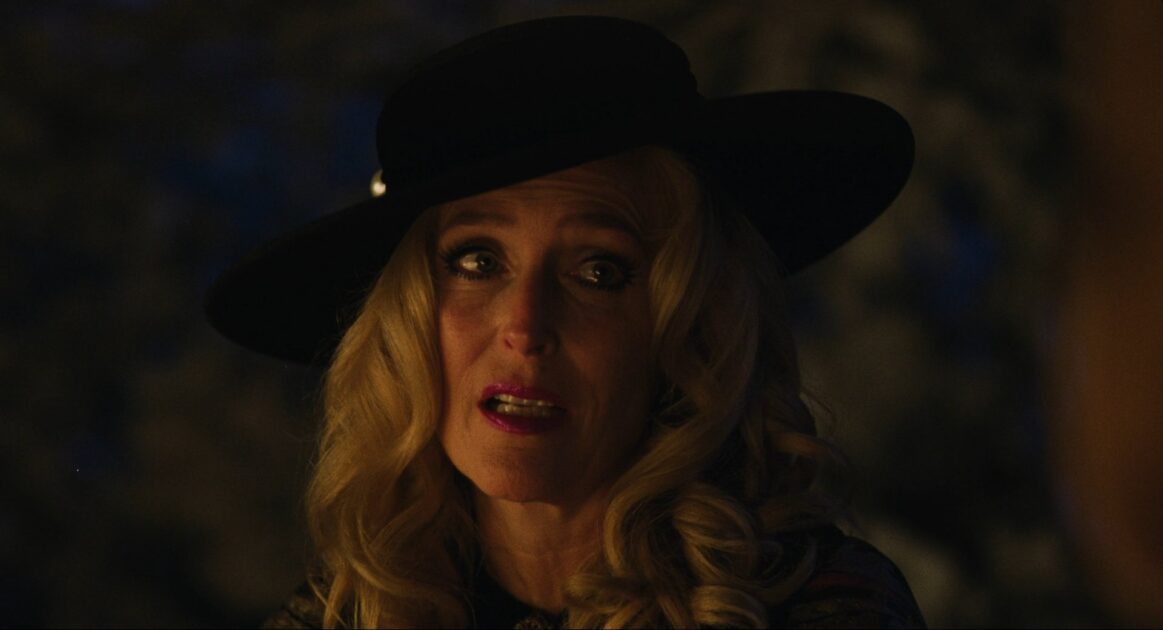
Billy Presley (Gillian Anderson) is one of the main characters in Teenage Sex and Death at Camp Miasma, a 2026 queer horror-comedy written and directed by Jane Schoenbrun. She’s the original final girl of the fictional Camp Miasma horror franchise. After starring in the first film as a teenager, Billy refused to return for its sequels and disappeared from the public eye. Decades later, she lives in isolation at the remote campground where the original movie was filmed, surrounded by memories of the role that made her famous. To read more about the film, check out our Bi Media entry here.
Kris Williams (Hannah Einbinder), a queer filmmaker hired to reboot the Camp Miasma franchise, tracks Billy down while researching the original movie. Kris initially approaches her as an important piece of horror history, but their relationship quickly becomes much more personal. Their connection develops into a romantic and sexual relationship, making Billy both the subject of Kris’s cinematic obsession and an important part of her own sexual awakening.
Billy has a complicated relationship with the original Camp Miasma. She repeatedly watches a 35mm print of the movie she starred in and lives in the abandoned location where it was filmed, suggesting she has never fully separated herself from the character or the experience of making it. When Kris watches the film with her, she points out that the franchise’s origin story for Little Death is transphobic. Billy’s response makes clear that, despite understanding the darkness surrounding the film, she remains deeply attached to the world it created.
Her relationship with sexuality is similarly complicated. In the original film, Billy’s character has a sexual encounter with a male character, but Billy later explains to Kris that she learned to experience pleasure by incorporating Little Death into her fantasies. The character who was supposed to represent terror becomes intertwined with her understanding of desire, creating a connection between sex, fear, fantasy, and death that continues decades later.
This becomes especially significant when Billy and Kris become intimate. Billy encourages Kris to stop intellectualizing her sexuality and instead allow herself to experience her fantasies. Their sexual relationship ultimately becomes part of the film’s larger exploration of queer desire and liberation, with Little Death’s presence blurring the boundaries between horror and erotic fantasy.
Billy is never given a specific label for her sexuality. However, her attraction and fantasies are not presented as being limited to one gender, which places her under the bi umbrella. Her relationship with a man in the original film, her experience of pleasure through Little Death, and her later romantic and sexual relationship with Kris both form part of a sexuality that the movie deliberately refuses to define more narrowly.
That lack of a label fits Billy’s role in the film. She represents someone who has already stopped worrying about whether desire needs to be explained or categorized. Gillian Anderson described Billy as existing between strength and vulnerability, which reflects the character’s ability to appear completely self-possessed while carrying the lasting effects of her experiences as a teenage final girl. By sharing her memories, fantasies, and relationship with Kris, she is able to reclaim parts of an experience that once defined her.
In Teenage Sex and Death at Camp Miasma, Billy is a character who has learned to find pleasure within the very imagery that once frightened her. Her relationship with Kris turns the final girl archetype into something more intimate, queer, and self-directed, while her open-ended sexuality reinforces the film’s larger idea that desire doesn’t always need a label to be real.