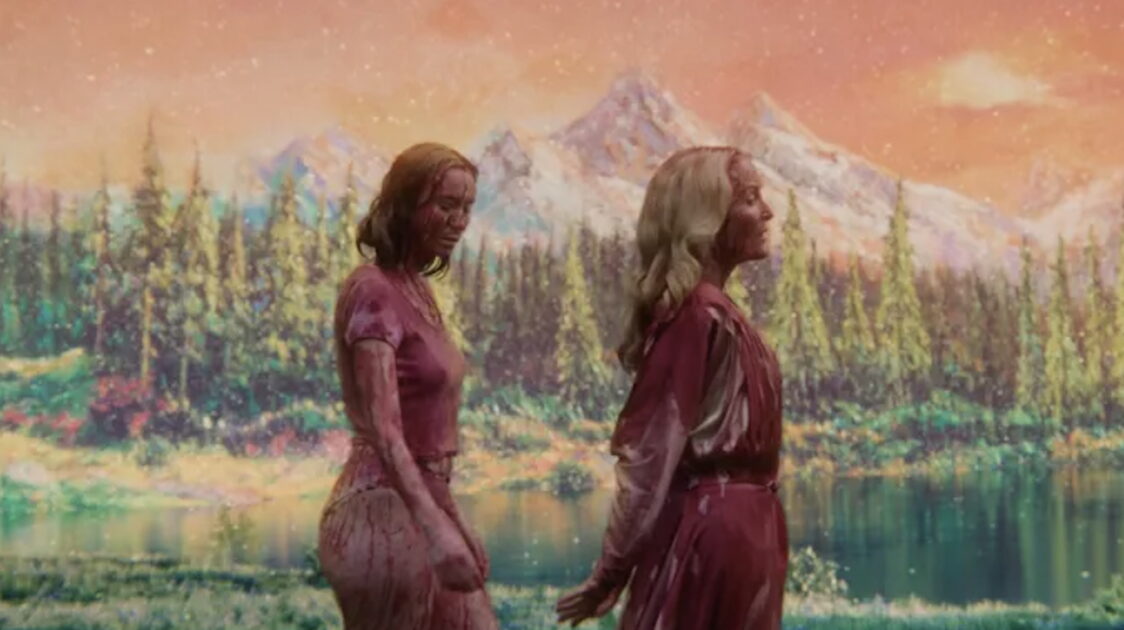
I’m way too anxious to watch horror movies. I almost never watch them. I saw a few in college for assignments and a couple of others that friends forced me to watch, but if I’m picking a movie, I will never pick a horror movie. They make me incredibly anxious and put me on edge. But when I saw that iconic bis Hannah Einbinder (who played Ava, my absolute crush from Hacks, and one of the characters I’ve identified with the most in a TV series) and Gillian Anderson were starring in a queer slasher movie, I didn’t think twice before running to see it in theaters. And wow, Teenage, Sex, and Death at Camp Miasma is an absolute GEM of cinema and queer representation.
First of all, this article will contain MAJOR SPOILERS for Teenage, Sex, and Death at Camp Miasma, including its ending. The movie is rated R in the United States for bloody violence, gore, sexual content, graphic nudity, drug use, and language. It also deals with themes of sexual assault, trauma, sexuality, and desire. In this review, we’ll be discussing the movie’s bi representation. If you want a quick refresher on how we rate things, I recommend checking out this link. You can also see our Bi Media entry for the movie here.
Written and directed by Jane Schoenbrun, Teenage, Sex, and Death at Camp Miasma follows Kris (Hannah Einbinder), a queer filmmaker hired to revive the long-running Camp Miasma horror franchise, a series of movies about a summer camp for teenagers haunted by Little Death (Jack Haven), the ghost of a teenager who was supposedly raised as both a boy and a girl by their parents. After being drowned by hateful campers, Little Death periodically emerges from the lake bordering Camp Miasma and uses a spear to massacre anyone they encounter. Although the original installments were successful, they gradually declined in quality and aged poorly, leaving the franchise in limbo. Kris has been obsessed with the movies since childhood, but she has a particular fascination with Billy Presley (Gillian Anderson), who played the final girl in the original movie and disappeared from public life shortly afterward.
Kris travels to the abandoned camp where the movies were filmed and finds Billy living there. What begins as a professional meeting quickly becomes something much more intimate as the two connect through Camp Miasma, sex, fantasies, and the complicated emotions the franchise awakens in them.
What I liked:
The movie is many things at once: a slasher, a love story, a satire of horror fandom, an exploration of trauma, and, above all, a deeply queer movie about desire. Underneath all of that is a particularly interesting question from a bi perspective: What happens when desire matters more than gender?
What does it get right in terms of bi representation?
Kris is in a polyamorous relationship with Mari (Jasmin Savoy Brown), who is bi and is also dating Thor (Aren Buchholz), a man who explicitly identifies as bi. This makes bisexuality particularly visible from the very beginning. The movie has no problem using the word “bi” when talking about them. However, Kris never uses that label, and neither does Billy.
Kris openly identifies as queer, and her relationship with Mari is part of an established polyamorous dynamic. She talks about her relationships and her struggles with navigating sex without defining her attraction around a specific gender. Her story isn’t about discovering whether she likes women. It’s about learning to experience desire instead of analyzing it from a safe distance.
In the original Camp Miasma movie, Billy has sex with a man, but that experience becomes connected to her fascination with Little Death. She talks about fantasizing about the sensation of being killed by Little Death, a fairly androgynous character (who is intentionally a very poor representation of a trans person).
Years later, when Billy and Kris finally have sex, that same fantasy returns. Little Death’s presence becomes part of their erotic experience and transforms the recurring connection between sex, fear, death, and pleasure.
Neither of them needs to say, “I’m bi.” But both can comfortably be read under the bi umbrella.
The movie isn’t secretly revealing that Kris and Billy are bi while refusing to say the word. Instead, it presents queer characters whose attractions aren’t organized around a rigid, gender-based rule. Their sexuality can exist without them having to completely explain it.
And this is where Camp Miasma becomes particularly fascinating from a bi perspective. The movie constantly asks its characters to stop intellectualizing desire and simply experience it. Kris spends much of the movie trying to understand sex, gender, horror, and fantasy through theory. Billy pushes her in the opposite direction: to feel it, live it, and allow herself to desire without knowing what that desire means.
Little Death becomes the ultimate embodiment of this idea. Their name comes from la petite mort, the French expression associated with orgasm, and Schoenbrun has described the character as a kind of “eternal embodiment of desire.”
This makes the final sequence between Kris and Billy especially important. Little Death has always represented something terrifying and fascinating to Kris: the possibility of experiencing something so intense that the boundaries between fear, death, fantasy, sex, and pleasure disappear.
As a child, Kris couldn’t understand why watching the Camp Miasma final girl face death caused such a profound reaction in her. As an adult, she still can’t recreate that feeling through conventional sex until Billy helps her.
When Kris and Billy have sex while imagining Little Death approaching them, the movie isn’t simply turning violence into an erotic spectacle. It is completing its central metaphor: Kris finally allows herself to experience desire without observing herself from the outside and analyzing what that desire says about her. The two of them don’t ask whether their attraction is acceptable, what category it belongs to, or what it says about their identities. They simply experience it.
And that reading can be deeply resonant with bisexuality.
Historically, bisexuality has been forced to exist within a framework that demands choosing between seemingly opposite categories: straight or gay, men or women, one side or the other. Camp Miasma is interested in what happens when we reject that framework entirely.
This reading also works because the movie is deeply connected to the queer history of horror. Schoenbrun has spoken about growing up watching horror movies that portrayed trans or queer characters as monsters, specifically referencing movies such as Psycho, The Silence of the Lambs, and Sleepaway Camp. Camp Miasma turns that history on its head.
Rather than simply rejecting those movies, it asks why queer people were so fascinated by them in the first place, even when they offered deeply harmful representations of themselves.
As The Conversation points out, the movie moves away from simply psychoanalyzing horror and toward the pleasures of the queer viewing experience: the ways LGBTQ audiences can find meaning, desire, identification, and even freedom in genres that historically tried to turn difference into something monstrous.
That is particularly important for Kris. Her childhood fascination with Camp Miasma isn’t something she needs to overcome. She needs to understand what that fascination was trying to tell her. The lack of a specifically bi label for the protagonists is also recognizable within a younger queer culture where “queer” can function as a deliberately broad identity, and where some people simply choose not to use a more specific label. That doesn’t mean those people aren’t under the bi umbrella.
The movie isn’t saying labels are bad. In fact, it has no problem calling Thor bi. What it suggests is that a label doesn’t have to be the destination for every queer character. Their attraction can simply exist.
“Flesh and fluids.”
For me, the most exciting thing about Teenage, Sex, and Death at Camp Miasma is that its representation doesn’t completely depend on a character saying the word “bi.” Not all good bi representation has to be as explicit as Nick Nelson in Heartstopper, or Ava Daniels from Hacks herself.
However, we still get a LOT of great representation in this movie. And having two bicons in the cast, playing two queer characters who fall under the bi umbrella, is absolutely beautiful.
Hannah Einbinder even spoke about how much she identified with Kris’ emotional journey. In an interview with The Independent, Einbinder described Kris’s journey from discomfort to shame and, finally, liberation as something she strongly related to.
Kris and Billy don’t need to stop and define exactly what they are. And that can be a bi experience, too. Camp Miasma is fundamentally about escaping the idea that every desire has to be explained, categorized, or justified before it can be enjoyed.
What I didn’t like:
If I could ask for one more thing, it would be a little more explicit bisexuality from Kris or Billy. The movie clearly isn’t afraid of the word. Thor is explicitly bi, and Mari is too. So it’s fair to wonder why that language never reaches the two protagonists.
At the same time, I’m not convinced that Camp Miasma would necessarily be better if it stopped to explain it. In fact, I think the absence of the label is part of what makes the movie so interesting and why so many queer people have loved it. This is a movie about desire that constantly asks its characters to stop explaining themselves. Demanding that Kris or Billy use a label they might not want could even go against the movie’s central idea.
And Kris does talk about being queer. While the word “queer” does not exclusively define people under the bi umbrella, it does include them.
The Rating:
Teenage, Sex, and Death at Camp Miasma is an extraordinarily queer movie, and its bi representation is much more complicated than what we’re used to seeing in cinema.
We have explicitly bi characters. We have a polyamorous relationship that includes attraction between people of different genders. We have two queer protagonists whose attractions aren’t presented as dependent on gender. We have a central romance between two women whose sexual awakening is tied to leaving behind the rules they have imposed on themselves. And we have a genderqueer embodiment of desire literally waiting beneath the surface.
Above all, the movie refuses to treat desire as something that has to fit perfectly into a category.
For bi people, that can feel incredibly familiar. Sometimes attraction isn’t about choosing between two doors. Sometimes there are more doors. Sometimes there isn’t even a door. Sometimes you just follow what you feel and what you desire.