I LOVE sitcoms. They’re my comfort shows. My favorite series, the ones I’ve watched all the way through about 15 times (probably more), is How I Met Your Mother. I found myself wondering: if Gen X had Friends and Millennials had New Girl, when would someone finally make the Gen Z sitcom? Well, we have it now, and it’s called Adults.
But first, I have to warn you: this review will contain SPOILERS for the first two seasons of Adults. So if you don’t want any plot twists ruined, I recommend watching the show first. Likewise, if you’re not familiar with The Unicorn Scale, check out our rating metric here or read more in our Bi Media section.
Adults is an FX comedy created by Ben Kronengold and Rebecca Shaw. It follows five twenty-something-year-olds — Samir (Malik Elassal), whose parent are traveling during their retirement which made it possible for everyone to live in their house; Billie (Lucy Freyer), Samir’s childhood best friend; Anton (Owen Thiele), the gay friend who befriends everyone he meets; Issa (Amita Rao), a very loud and passionate college friend of Samir; and Paul Baker (Jack Innanen) a Candian trying to find a place he can call home in the U.S. They all live together in Queens as they try to figure out how this whole being-an-adult thing is supposed to work while navigating love, work, friendship, and family.
But what particularly interests me about Adults is that, out of its five main characters, Samir seems to be the only one who identifies as straight. In fact, in the second season, he describes himself as “Paul Baker’s straight friend.” And I think that tiny bit of dialogue says so much about what makes this show so fun from a queer perspective: here, being queer isn’t the exception that needs an explanation. It’s simply part of who these characters are.
What I Liked:
“HE IS FLUID!”
Let’s start with Paul Baker, because nobody on this show is willing to let us forget that his sexuality is fluid or that it’s always Paul Baker, never just Paul. Paul Baker starts out as one of Issa’s hookups, but after getting along so well with her whole friend circle, he ends up joining the group and moving into the house. Paul Baker never explicitly identifies as bi. Instead, he uses “fluid” to describe his sexuality, a term that falls under the bi umbrella and that the series treats as a completely normal part of who he is. In the first season, Issa describes him as a “sexually-fluid delight”, and in another episode, when someone uses a homophobic term to refer to him, Paul Baker responds that he prefers the term “fluid.” When the other person doesn’t seem convinced, he even tries to get Samir to confirm that he sleeps with men. And then there’s that glorious moment when Anton practically screams, “HE IS FLUID!” Through this and many other moments like it, the series turns what might feel like an awkward explanation or a solemn coming-out scene on another show into a recurring joke.
Paul Baker isn’t hiding his sexuality, but he also doesn’t feel the need to turn it into some grand statement about his identity. His friends simply know he’s fluid. And every so often, it has to be explained all over again to someone who doesn’t get it.
It’s especially funny because it reflects a very real experience for people under the bi umbrella: constantly having to clarify their sexuality. Adults turns that experience into part of the comedy without turning the character into the joke, which is a different and refreshing approach to a very common issue.
The second season proves this fluidity wasn’t simply a funny character trait. Paul Baker begins the series in a relationship with Issa and eventually develops a romantic relationship with Anton, his openly gay friend. The first season ends with the two getting married to help Paul Baker remain in the United States and sharing an unexpectedly passionate kiss. The second season takes that possibility and finally turns it into a real relationship. In Episode 4, “Raccoon”, we even see Paul Baker, Anton, and Issa nearly get involved in a threesome — with a raccoon watching, of course — making the complicated relationship between the three of them even more obvious. And at the end of the season, Anton runs home to confess his feelings to Paul Baker. The two end up kissing as balloons fall around them, in a scene that Adults builds up as the season’s big romantic moment.
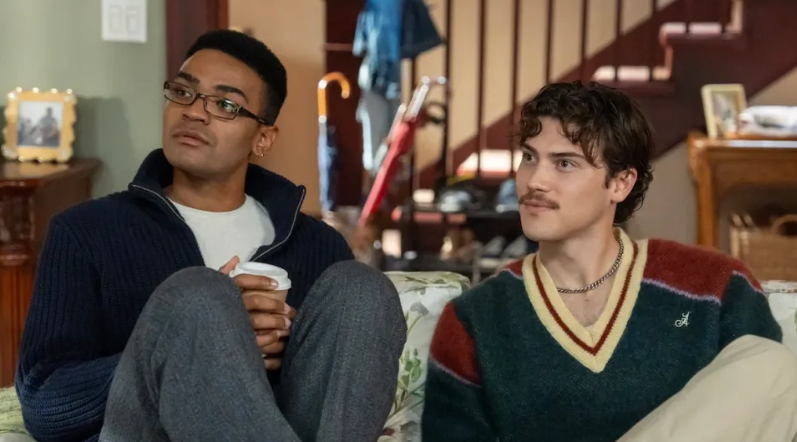
What I especially like is that Paul Baker doesn’t have to “discover” that he’s bi for this story to work. There’s no “Oh, so I guess I like men too” moment. He already knew who he was. The series simply allows his life and relationships to evolve.
Jack Innanen, who plays Paul Baker, has also talked about how uncommon it is to see fluid characters like him on television, and about how the character having a relationship with a woman and later with a man doesn’t feel like a label or a representation gimmick, but rather an organic part of his character´s relationships.
But Paul Baker isn’t the only queer character in this group. On this show, everyone is queer, and nobody makes a big deal about it. And this is where Adults really won me over.
Anton is gay. Billie, who spends much of the series having relationships with men, has also shown bi attraction. And in the second season, Issa finally has a romantic experience with a woman: after ending her relationship with Paul Baker, she has an adorable encounter with a girl and ends up sneaking her back into the house. I find Issa’s development especially interesting because it’s another example of how the show allows bisexuality to exist without turning it into a “discovery” storyline. There were already hints in the first season: Issa mentioned having threesomes, although up until then we had mainly seen her involved with men. In the second season, after ending her relationship with Paul Baker, we finally see that her attraction to women can become romantic as well.
For a very long time, ensemble sitcoms operated under a pretty simple rule: everyone was straight until proven otherwise. If a queer character appeared, their sexuality usually had to be explained, turned into a joke, or used as a “very special episode” storyline. Adults does almost exactly the opposite. Here, it feels like everyone is queer until proven otherwise. In fact, when Paul Baker’s straight friends show up, they’re the ones who become exaggerated caricatures of straight masculinity. Paul Baker can move from that group of men to his queer friend group and still remain the same character, even if he’s performing different versions of himself. The show doesn’t present heterosexuality as the norm and queerness as the deviation. It presents a group of friends where sexual diversity is simply part of the environment.
The queer representation in Adults goes beyond simply putting queer characters in a room. It lets them fall in love, make mistakes, have sex, end relationships, start new ones, get jealous, do stupid things, and have ridiculously cheesy romantic endings. In other words: it lets them be fully-realized characters.
What I Didn’t Like:
Honestly, I have very little to say here.
One thing I noticed is that the series seems to deliberately avoid the word “bi.” And while I don’t think this invalidates the representation, I would like for one of these characters to eventually be able to simply say, “I’m bi,” without it changing absolutely anything. The series makes it clear that its characters’ sexuality can be fluid, but I only noticed the label being used once in passing.
And I completely understand why that works. People don’t have to use the word to fall under the bi umbrella, and part of what makes this representation so good is precisely that the characters are able to define their sexuality in their own way. The series also reflects Gen Z, a generation that is increasingly less likely to use a specific label for their sexuality.
It still would have been nice to hear the word “bi” at some point, simply because there’s value in showing how many different ways bisexuality can look. But aside from that, the series avoids the usual stereotypes around cheating, confusion, indecision, or bisexuality being “just a phase.” Paul Baker can love Issa and later fall in love with Anton without either relationship being treated as less real.
The Rating:
Four unicorns out of four. I’d give it five if I could.
Adults has some of the most natural bi representation I’ve seen recently in a comedy. Not because its characters are constantly talking about bisexuality, but because the show understands something much more important: bi people can simply exist.
Paul Baker isn’t a bi character because the plot needed a twist. He’s fluid because that’s simply who the character is. Issa doesn’t need to justify being attracted to a woman after having been with a man. Billie can explore her sexuality without the series having to stop and explain which label she should use.
That level of normalcy is one of the representation’s greatest strengths.
Would I have liked to hear the word “bi” a little more? Yes. Do I think that ruins what Adults is doing? Not at all.
In fact, maybe the most beautiful thing about the show is that it seems to understand something television took a very long time to learn: queer representation doesn’t always have to be a story about coming out. Sometimes it can simply be a story about five friends trying to survive their twenties who, incidentally, happen to include three bi people.