Adults is an FX sitcom created by Ben Kronengold and Rebecca Shaw that follows five friends in their twenties as they navigate work, relationships, sex, money, and the general chaos of trying to become functioning adults in Queens, New York. The series premiered in 2025 and was renewed for a second season, establishing itself as a Gen Z take on the traditional hangout sitcom.
The premise may sound familiar — a group of young friends living together and making questionable decisions — but Adults uses that framework to explore a generation for whom traditional ideas about relationships, identity, and adulthood are increasingly fluid. Critics have compared the series to shows such as Friends, Girls, Broad City, and New Girl, while noting its focus on the particular social and cultural anxieties of Gen Z.
Variety, for example, described the series as an attempt to become a defining “time capsule” for its generation, although the review questioned whether the show had yet developed a strong enough identity of its own.
That openness extends to sexuality. Adults doesn’t treat queerness as something that needs to be explained to its characters or turned into a dramatic revelation. Instead, queer identities and sexual fluidity are simply part of the social world these friends inhabit. Anton is openly gay, Paul Baker repeatedly describes himself as “fluid,” a term that falls under the bi umbrella without forcing him into a label he doesn’t personally use; Issa gives us a hint in season one that she’s queer, and we see her start dating a girl she met at a library in the season two finale; and Billie shows us in season one that she has bi attractions.

Paul’s sexuality is introduced casually throughout the season. In the third episode, Issa refers to him as a “sexually-fluid delight,” while in the fourth episode, after a stranger uses a homophobic slur to question his sexuality, Paul corrects him by saying that he prefers the term “fluid.” When the man remains unconvinced, Paul even tries to get his friend to confirm that he sleeps with men. The joke is funny, but the important part is how little drama surrounds the revelation: Paul is not discovering his sexuality, coming out, or defending his right to exist. His friends already know who he is. Nobody in the friend group treats Paul’s attraction to men as incompatible with his relationships with women, and the same openness extends to the other characters. This becomes even more significant in the season finale, “The Mail.” Paul Baker, who is Canadian, faces deportation when his visa expires, prompting Issa, his girlfriend, to propose a green-card marriage. After a series of increasingly chaotic attempts to solve the problem, Anton ultimately marries Paul. During the celebration afterward, their friends jokingly encourage the newlyweds to kiss. What begins as a joke turns into a surprisingly passionate kiss between Anton and Paul, a plotline we see develop in season two.
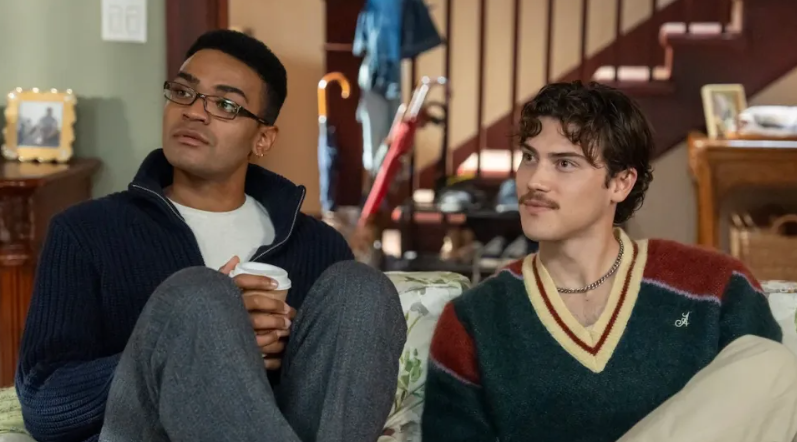
The series also creates an environment where sexuality appears remarkably unremarkable. Billie, for example, is shown primarily dating men, but one episode shows her act on an attraction to a couple looking for a threesome. The show does not turn this into a declaration about her sexuality, but it further establishes a world where attraction does not necessarily have to fit neatly into a single category. Issa talks about having threesomes in the past in the first season, and we see her develop her bisexuality in the second season when she has a really cute meet-cute scene with a librarian who she later sneaks into the house. A scene that is just treated as a plot in the sense that she is dating a new person, not as a revelation of her sexuality.
Autostraddle also highlighted the show’s natural approach to queer representation, noting how the characters’ sexualities are revealed as an organic part of their lives rather than something that needs to become a major storyline. The publication pointed to Anton being gay, Paul Baker’s fluid sexuality, and the second season’s more explicit exploration of Issa’s queerness. Rather than sensationalizing their identities, Adults lets its queer characters navigate dating, relationships, and friendship, allowing them to develop fully.
Adults has already created a remarkably accepting social environment in which bisexuality and sexual fluidity can exist without becoming a character’s entire story. For now, Adults offers something bi representation often struggles to achieve: sexual fluidity that is neither a punchline nor a problem to solve.