Gaius Julius Caesar, born in Rome, was a Roman general and statesman.
He was a member of the First Triumvirate of the Roman Republic, a political alliance, alongside Gnaeus Pompeius Magnus and Marcus Licinius Crassus.
Having led the Roman armies in the Gallic Wars between 58 BC and 50 BC against the peoples of Gaul (present-day France, Belgium, and some parts of Germany), Caesar became the dictator of Rome from 49 BC until his assassination in 44 BC. He played a major role in the events that led to the transformation of the Roman Republic into the Roman Empire.
Caesar rose to prominence as a key figure in Roman politics, largely attributed to his military triumphs that notably expanded Roman territory. Among his notable feats during this period were his successful campaigns in Britain and the construction of a bridge spanning the Rhine River.
After defying the Senate’s directives to halt military actions and return to Rome, Caesar emerged victorious in the ensuing civil war, granting him absolute authority and sway over Rome in 45 BC.
Caesar then made some social and governmental reforms, created the Julian calendar, gave citizenship to many, and was eventually called “dictator for life” (dictator perpetuo). The elites were angered by his reforms and started to plot against him. On the Ides of March (15 March), 44 BC, Caesar was assassinated by a group of defiant senators led by Brutus and Cassius, who famously stabbed him to death.
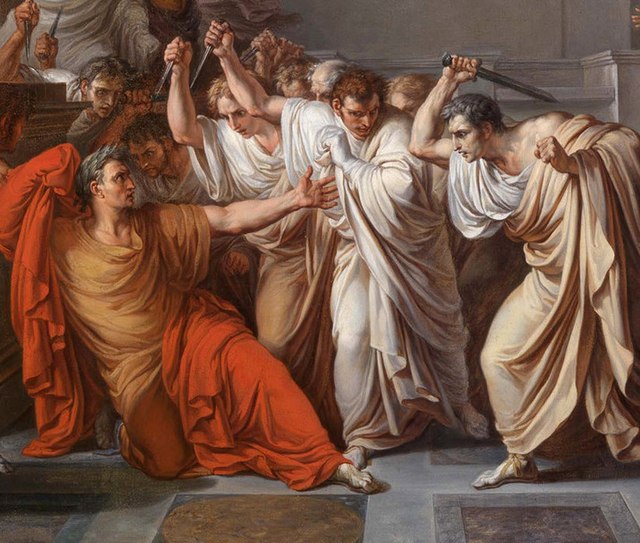
More civil wars followed, and the constitutional government of the Republic was never fully restored. Caesar’s great-nephew and adopted heir Octavian, later known as Augustus, took sole power after defeating his opponents in the final civil war of the Roman Republic. Octavian increased his power, and the era of the Roman Empire began.
During his life, Caesar was not only a powerful statesman but also a talented author and historian; much of his life is known from his own accounts of his military campaigns.
Other contemporary sources include the letters and speeches of Cicero and the writings of Sallust. Later biographies of Caesar by Suetonius and Plutarch are also important sources.
Caesar remains esteemed as one of history’s most formidable military leaders. His name became synonymous with “Emperor,” with the title “Caesar” widely utilized across the Roman Empire, giving rise to modern equivalents like Kaiser in German and Tsar in Russian. Caesar’s enduring legacy is evident in his frequent portrayal in literature and art. Furthermore, his political ideology, Caesarism, remains a source of inspiration for contemporary politicians.
He was married three times: first to Cornelia (Cinnilla), from 84 BC until her death in 69 or 68 BC, then to Pompeia, from 67 BC until he divorced her around 61 BC (following the Bona Dea scandal, in which the Roman politician Publius Clodius Pulcher tried to seduce her), and finally to Calpurnia, from 59 BC until Caesar’s death.
Caesar also had lovers, including Cleopatra VII, Servilia, and Eunoë, queen of Mauretania and wife of Bogudes.
By his wives and lovers, Caesar had a number of children: Julia (by Cornelia), born in 83 or 82 BC, Caesarion (by Cleopatra VII), born in 47 BC, and killed at age 17 by Caesar’s adopted son Octavianus, and his posthumously adopted son, Gaius Julius Caesar Octavianus, his great-nephew by blood (grandson of Julia, his sister), who later became Emperor Augustus.
He was also suspected of fathering Marcus Junius Brutus (born 85 BC): the historian Plutarch notes that Caesar believed Brutus to have been his illegitimate son, as his mother Servilia had been Caesar’s lover during their youth (Caesar would have been 15 years old when Brutus was born), and Junia Tertia (born around 60s BC), the daughter of Caesar’s lover Servilia was believed by Cicero among other contemporaries, to be Caesar’s natural daughter, and Decimus Junius Brutus Albinus (born around 85–81 BC) — Caesar often expressed how he loved Decimus Brutus like a son. Brutus was also named an heir of Caesar in case Octavius died before the latter.
There were many rumors about Caesar’s sexuality: because Roman society thought of the passive role (regardless of gender) during sexual activity as submissive, the Roman historian Suetonius says that in Caesar’s Gallic success, his soldiers sang, “Caesar may have conquered the Gauls, but Nicomedes conquered Caesar.”
This refers to Nicomedes IV of Bithynia, with whom, according to Cicero, Bibulus, Gaius Memmius, and others, Caesar had an affair.
The stories were repeated, referring to Caesar as the “Queen of Bithynia” by some Roman politicians to humiliate him.
Caesar denied the accusations repeatedly, and according to the historian and senator Cassius Dio, even under oath on one occasion.
However, the poet Catullus wrote two poems suggesting that Caesar and his engineer and military officer, Mamurra, were lovers, but later apologized.
The Roman politician and general Mark Antony claimed that Octavian had earned his adoption by Caesar through sexual favors. Suetonius described Antony’s accusation of an affair with Octavian as political slander. Octavian eventually became the first Roman Emperor as Augustus.