Octopuses are among nature’s most marvelous animals. With eight tentacled arms, built-in jet propulsion, the ability to change color, remarkably human-like eyes, and the highest intelligence of any invertebrate (they have nine brains!), these fascinating cephalopods seem like creatures from another epoch or world. Their bi mating habits are no exception.
One of the most alien features of octopus sex is that males don’t have penises. Instead, one of their arms, called the hectocotylus, has a specialized ability to “taste” female hormones and deposit a packet of sperm known as spermatophores into a female’s mantle cavity. They can do this even without being able to see their mate. Both males and females also die shortly after mating. For males, this is because their sexual maturity occurs near the end of their short lives (octopuses live on average for only one to two years, though some species can live up to five). Once females become impregnated, they become so focused on the welfare and survival of their eggs that they engage in self-destructive and ultimately fatal behavior that involves starving themselves, eating parts of their own limbs, or self-mutilation. In the end, octopuses do not survive to see their young. Scientists believe that female octopuses, who could otherwise live months longer, end their own lives in this way so that they won’t have the opportunity to eat their offspring — a gruesome act of self-sacrifice.
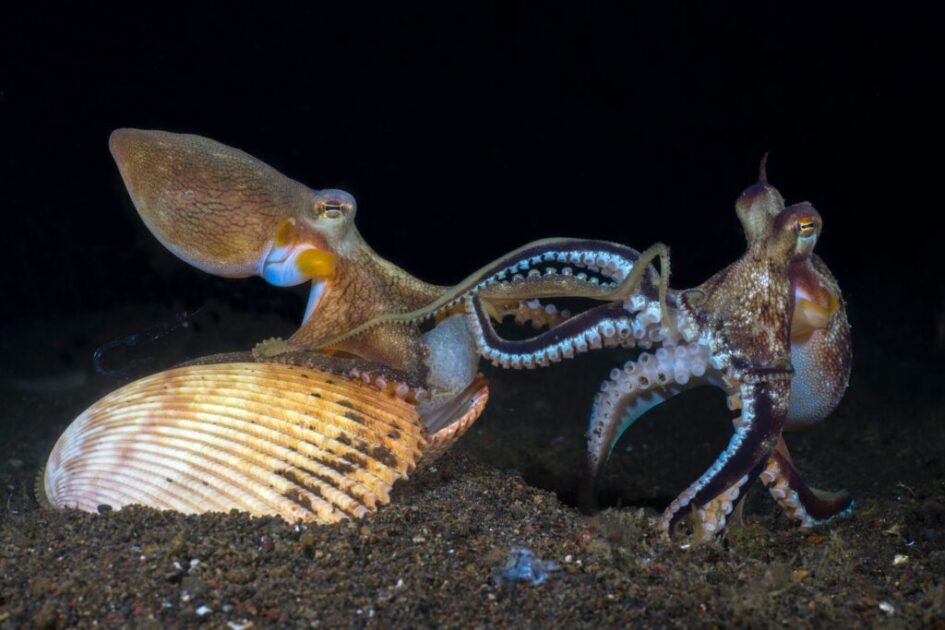
Males, for their part, may not kill themselves in a blaze of paternal devotion; they have been widely documented to engage in bisexual behavior, including mounting other males and inserting their hectocotylus into the receiving males’ mantle cavities. While some studies show that same-sex mating happens but is rare, others have found it to be quite common (one study found over 100 same-sex encounters during a span of 675 minutes). For many years, this behavior was believed to be a quirk that octopuses only developed in captivity. Then, in 1994, it was observed in the wild. Scientists at the time believed that males mated with other males due to a lack of available female mates. In the years since, researchers have gained a clearer understanding.
One study from the University of California in Berkeley found that male octopuses did not distinguish between males and females and mated with both equally. Interestingly, although males copulated with both sexes, they only deposited sperm packets in females, never males. The researchers ruled out several explanations typically offered for octopus same-sex behavior. These were not dominance displays: the recipient males were passive and accepting, and the males took turns mounting each other. Similarly, males were not mating with one another because they were sex-starved and desperate, given that the males in the study had all recently mated with females. The researchers concluded that males may be unable to determine the sex of potential partners, possibly because their short lifespans prime them to attempt to mate at every possible opportunity.
What’s striking is that although males appear unable to determine another octopus’s sex before mating, they can still detect female hormones — absent in other males — and, once mating begins with a male, they do not release their spermatophores. Male octopuses cannot replenish their sperm the way many other species (including all mammals) do, which may explain why they are so eager to mate but more cautious about spending their limited spermatophore supply.
The Brazilian zoologist Piter Kehoma Boll has speculated that this may not be a case of simple mistaken identity:
In male-male pairings, one of the males always put its hectocotylus into the other male’s mantle and there was no attempt from the receptive male to avoid the act. The only difference between males mating with females or with other males was that they only delivered sperm to females and never to males. What can we conclude? Have octopuses found an efficient way to be bisexual creatures by having fun with other males while still able to keep their sperm to give it to females? The diversity of life always fascinates us!
Whether male octopuses have indeed found a way to “have fun” with other males without sacrificing reproduction remains a matter of speculation. But given how short and tragic octopuses’ wondrous lives are, I for one hope that’s the case. Eight arms, nine brains, and two years to live? A little bi fun isn’t asking for too much.