In the past few years, a meme arose from asking men on social media, “How often do you think about the Roman Empire?” While many answered that they thought about the era surprisingly often, the question birthed a new phrase: “my Roman Empire” — meaning something one spends far too much time obsessively thinking about. This, of course, can mean anything from the burning of the Library of Alexandria to romance series like Heated Rivalry. But what may surprise many casual Rome stans is the irrefutable evidence that the actual ancient Rome was in fact a lot more bi than you think.
To be clear, the Roman Empire is far too vast to cover in full here, so we’ll have to narrow things down. Not every element or figure we cover spanned the whole history of ancient Rome, but enough examples occurred over the course of centuries to paint a clear pattern that makes it fair to say that the Roman Empire was more bi-friendly (at least toward men in the elite classes) than most modern people may believe.
Firstly, ancient Rome extended over the course of 1,200 years for its major arcs, from the classical founding of Rome in 753 BCE to its fall in 476 CE. Secondly, much of Rome’s culture, attitudes, and norms came from and catered to the higher castes of society, but that’s not to say queer dealings were only something that happened among the rich and powerful. Bisexuality was recorded among Roman citizens, and, as we will see, also in countryside regions like Pompeii.
In order to better understand queerness in ancient Rome, one must understand the Roman citizens’ relationship to sex. Sex work was fully legal, and brothels were common, accepted, and profitable. By the year 300 CE, the city of Rome had 45 brothels on its own. At one point during this era, according to sex historian Esmé James in her book Kinky History, a Roman census showed over 32,000 active sex workers paying taxes — both men and women — throughout the empire. Sex was just another business to be taxed and even regulated, without our modern stigmas. As such, Rome became known as the ancient capital of sex work. In fact, brothels were so popular that magistrates often had to ban them from operating during the daytime — otherwise, too many people wouldn’t show up for work.
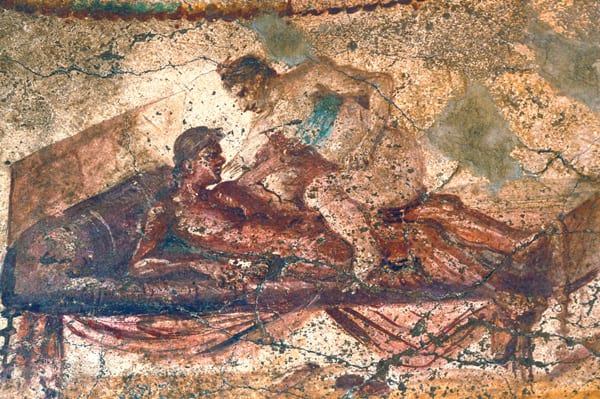
In Pompeii, the city famous for having been buried by a volcanic eruption of Mount Vesuvius in 79 CE, queerness and sex work were so common that we can even see them preserved in the city’s remains. Recovered frescoes and friezes of Pompeiian brothels depicted bi threesomes and other same-sex acts right on the walls (likely to arouse the customers) along with names of workers who specialized in particular acts. To wit, frequenting these houses was considered a social norm for men, and, in some rare cases, according to James, wealthier women as well.
It should be noted, however, that many of the people who worked in these brothels were slaves (both men and women), with a minority being freed slaves or simply women in poverty. That said, the industry was a lucrative one, with Emperor Caligula implementing what’s known as the “imperial tax” on sex work in the first century of the common era. A later ruler, Severus Alexander, took the pooled funds and directed them toward the maintenance of public buildings. Rome may not have been built in a day, but it was built by queer sex!
It’s important to recognize in this era that bi or gay relations — particularly among men in this male-dominant culture — were accepted, but only under specific conditions. The Roman ethos stressed the importance of men being dominant: there was nothing wrong with a red-blooded Roman man penetrating and “dominating” another man, but being penetrated — that was considered feminine and submissive and risked ridicule (more on this later).
This is not to say that sapphic Roman women were unheard of or shunned. According to Bernadette J. Brooten in her book, Love Between Women: Early Christian Responses to Female Homoeroticism, although references to bi or lesbian women were rarer in the earlier centuries of ancient Rome, literary sources from the Roman Empire (27 BCE to 467 BCE) record sapphic attractions in love spells, medical writing, dream interpretations, and astrology texts. (Kind of makes a modern queer woman feel an ancient connection to her love of astrology.)
Bisexuality was not just accepted among the Roman citizens and the elite, but among its most powerful rulers. Caligula, the brief-reigning and notorious Roman emperor, had four wives but also reportedly took male lovers. These included his sister’s husband as well as a dancer named Mnester, whose performances for Caligula were not to be disturbed on pain of severe punishment. Even coughing audience members drew the emperor’s wrath. Likewise, Julius Caesar not only had wives and affairs with Cleopatra but also was rumored to have had a submissive relationship with King Nicomedes of Bithynia (in modern-day Turkey). It became the subject of ridicule both among political rivals and soldiers alike, who referred to Caesar as the “Queen of Bithynia”. Even Elagabalus, a teenage Roman emperor and possibly one of the earliest trans figures in modern history, expressed bi attractions throughout his brief life.
With the fall of Rome and the rise of Christianity, as well as other influences, queerness became less openly prevalent and accepted in Europe for well over a thousand years. But for more than a millennium prior, bisexuality was seen as a normal part of life in ancient Rome.