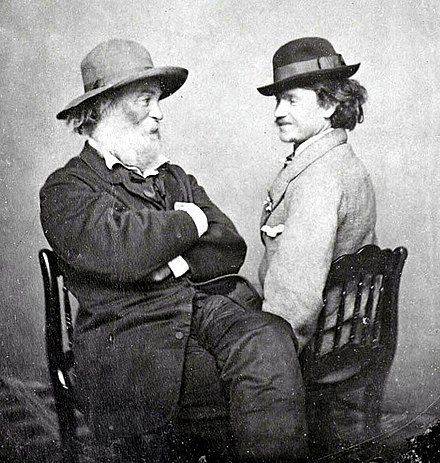
Walt Whitman was an American poet, writer, and journalist widely considered the country’s most influential national poet and often called the father of free verse.
Whitman was born in 1819 in Huntington, New York, the second eldest of nine children to Quaker parents of English and Dutch descent. When he was four, the Whitmans moved to Brooklyn, moving around the borough frequently as a result of poor financial decisions. These money problems contributed to a childhood Whitman described as restless and unhappy. One bright spot occurred in 1825 when young Walt, then about six, was lifted into the air and kissed on the cheek by the French and American war hero Marquis de Lafayette after setting the cornerstone of the Brooklyn Apprentices’ Library, commemorating its completion.
Whitman’s formal education ended at age 11, at which point he joined the labor force to help his struggling family. He worked running errands for law offices, apprenticing for newspapers and printers, as an assistant librarian in the Brooklyn Apprentices’ Library, as a typesetter, and eventually as a teacher in his late teens. It was during these years that Whitman became acquainted with and interested in writing and publishing, specifically poetry. Around the age of 16, he had some of his earliest poetry anonymously published in the influential newspaper the New-York Mirror.
Moving back to Huntington as a young man, Whitman founded the Long-Islander, a newspaper he operated almost single-handedly, serving as the publisher, editor, printer, and distributor, including personally delivering papers to subscribers’ homes. He sold the publication after just 10 months, and bounced between newspaper, teaching, and editorial jobs for some years. In the 1840s and early 1850s, Whitman wrote freelance fiction and poetry that was published in various periodicals. He also wrote several novellas: Franklin Evans, The Half-Breed, and The Adventures of Jack Engle, which was serialized in six installments in New York’s The Sunday Dispatch. In 1858, he even wrote a 47,000-word advice series under the pen name Mose Velsor titled Manly Health and Training, recommending men to grow beards, take daily baths in cold water, and sunbathe nude, among other things.
The work for which Whitman is most known is Leaves of Grass, the groundbreaking poetry collection first published in 1855, but expanded over the course of his life over seven additions through 1891. Informed by his travels around the country, the many fields he worked in, his experiences as a volunteer nurse during the American Civil War, and of course his fluid sexuality, Leaves reads like virtually no other work of poetry that came before it. Breaking the confines of traditional poetry with a prose-like free verse form, Leaves of Grass’s freewheeling and animated style captured the spirit of 19th-century America: the open expanses, the dynamic population movements, the throngs of bodies and dreams in rapidly growing cities, and the sense of boundless possibility. It was an ode to America of a sort the public had never seen before, and one charged with an almost explicitly bisexual energy prominent in poems such as “I Sing the Body Electric.”
At the time, Leaves of Grass was extremely controversial and became especially targeted because of its overt sexuality involving both women and men. While some critics complained that his poetry was vulgar and obscene, many, including Ralph Waldo Emerson, praised his revolutionary writing style. Over time, the reception of Leaves improved considerably — so much so, in fact, that Whitman rose in stature to the status of America’s national bard. His visage has been immortalized on postage stamps, and numerous American streets and schools have been named after Whitman, including Philadelphia’s Walt Whitman Bridge. There’s even a crater on the planet Mercury — Whitman — named after him.
In addition to Leaves of Grass, Whitman penned other prose, poetry, and writings including Drum-Taps, Democratic Vistas, Memoranda During the War, and Specimen Days. He died in 1892 in Camden, New Jersey, at the age of 72 after years of declining health.
Walt Whitman’s precise sexuality remains somewhat opaque. Many of his writings explore overtly homoerotic themes, while others depict direct heterosexual desire. It is often inferred from his poetry that he is bisexual, and details from his personal life support this. Though he never married, Whitman had a romantic relationship with the actress Ellen Grey in 1862, and claimed in an 1890 letter to have fathered six children with different unnamed women over the course of his life, though no records of these children have been found.
Similarly, there is evidence that Whitman was same-sex attracted. Oscar Wilde, for example, met Whitman in America in 1882 and told the homosexual-rights activist George Cecil Ives that Whitman’s sexual orientation was beyond question — “I have the kiss of Walt Whitman still on my lips.” Many biographers also believe that Whitman was in a relationship with a bus conductor named Peter Doyle. The two were inseparable for many years, and in an 1895 interview, Doyle once said, “We were familiar at once — I put my hand on his knee — we understood. He did not get out at the end of the trip — in fact, went all the way back with me.” Whitman is believed to have had other male lovers, including Bill Duckett and Harry Stafford. Whitman gave Stafford a ring, which, over the course of their tempestuous relationship, was repeatedly returned and re-given. Referring to the ring, Stafford once wrote to Whitman: “You know when you put it on there was but one thing to part it from me, and that was death.”