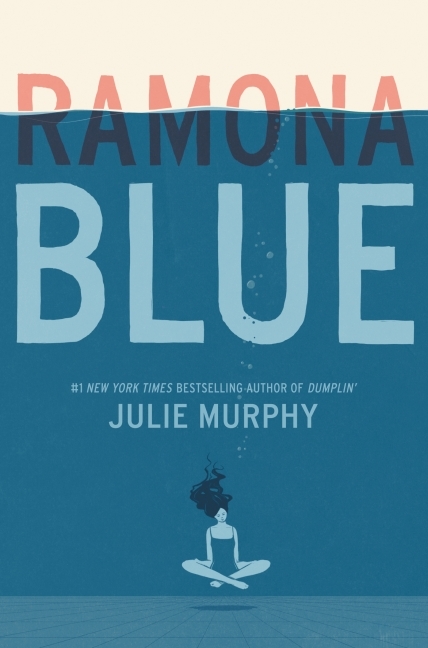
Ramona Blue by Julie Murphy is a heartfelt young adult novel that intimately explores identity, family, and the complicated, often fluid nature of love. Set against the backdrop of a small, hurricane-ravaged town on the Gulf Coast of Mississippi, the story follows 17-year-old Ramona Leroux, whose life has been shaped by a series of defining roles. She sees herself as a talented swimmer, a devoted caregiver to her pregnant older sister Hattie, and a steady presence for her father, who struggles with addiction.
Ramona’s world is a tight, confining one — her family’s financial struggles, her obligations at home, and the limited opportunities in her economically depressed town all weigh heavily on her. Yet she finds purpose and identity in these responsibilities, as well as in her close-knit group of friends and her clear understanding of her sexuality, up until now, identifying proudly as a lesbian.
The novel takes a pivotal turn when Freddie, Ramona’s childhood best friend, moves back to town. As they reconnect, Ramona finds herself drawn to him in ways that surprise and unsettle her. Her deepening feelings for Freddie challenge the certainty she once felt about her sexual orientation and force her to reckon with the broader, messier truths about attraction and identity. Importantly, Murphy portrays this inner conflict with sensitivity and nuance, avoiding clichés and affirming that questioning and change are not signs of weakness, but rather signs of growth. Ramona also must learn to navigate the broader challenges of her environment: the persistent poverty that threatens her family’s future, the racial dynamics of her largely white town (as one of its few biracial residents), and the looming question of whether she can ever pursue her dreams beyond the borders of her hometown.
Murphy masterfully weaves together themes of love, loyalty, identity, and resilience throughout the story. She paints Ramona’s evolving understanding of her sexuality not as a betrayal of her past self, but as an expansion of who she has always been — a young woman learning that identity is rarely as simple or static as it first seems. While Ramona never explicitly labels herself as bi, her romantic attraction to Freddie alongside her longstanding attraction to women places her firmly within the bi umbrella.
Ultimately, Ramona Blue offers a compelling, compassionate portrait of a young person embracing the complexity of her truth. It’s a powerful reminder that becoming who you truly are isn’t like checking a box or seeking validation in others. Instead, we’re invited to see it more like a landscape we have permission to explore on our terms, and for the rest of our lives.