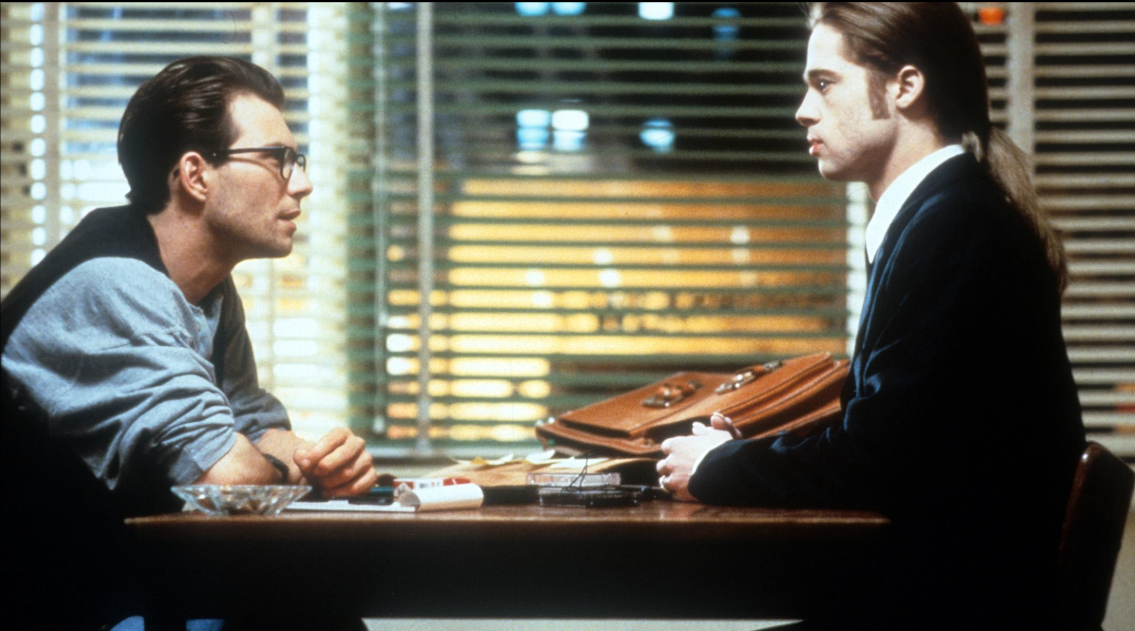
Interview With the Vampire (1994) is a horror-drama film starring Brad Pitt as Louis, Tom Cruise as Lestat, Antonio Banderas as Armand, and Kirsten Dunst (in her breakout role) as Claudia. Christian Slater plays Daniel Malloy, the modern-day writer interviewing Louis as he retells his life story after he was “born to darkness” (turned into an immortal vampire) in 1700s New Orleans. The film is based on the 1976 novel of the same name by Anne Rice, who also penned the screenplay.
Both Louis and Lestat wear luxurious, period-appropriate attire. They keep their hair long and often pull it back in ponytails (Louis’s is dark brown, Lestat’s is blond with some curl). Their nails are long, like subtle claws. Both have pale, transparent pallors with unnaturally bright eyes (blue for Lestat, green for Louis).
While it becomes much more explicit in the later 2022 AMC adaptation that Lestat is bisexual, there are some hints of it in the 1994 version as well. His obsession with Louis’s soul and beauty is homoerotic, and he does enjoy the seduction of both men and women in his hunts. At the same time, this could be explained away as a vampire merely playing with his food.
Louis, on the other hand, is a more straightforward example of vampiric bisexuality in this adaptation. The film makes sure to start off showing how deeply human Louis mourns the loss of his wife (and child), and he goes to drown his sorrows in the arms of a female sex worker. And while there’s definitely an argument to be made that Louis is attracted to Lestat (which is made unmistakable in the 2022 show), one could almost bat away his fascination and gaze at Lestat as a sort of reverence for his maker and otherworldly mentor.
However, Louis’s obsession with and attraction to Armand is harder to dismiss. (Touching faces and other forms of intimate body contact also factor in here.) No, he never says outright he is attracted to Armand, but his behavior is crystal clear. Still, it would have been great to hear the term “bi” in the film, at least in the framing device of the interview, since by then, the term has been in the lexicon for a century. Rice also spoke in her introduction to the VHS copies of the film about how stories are often about ourselves and how vampires are outsiders. Considering the metaphor of the vampire — someone who has one foot in each world it has to inhabit but not belonging to either — this seems like an apt metaphor for bisexuality itself, in many ways.
Rice herself has confirmed that her characters are queer and considered them “the first vampire same-sex parents.” From an interview with Gizmodo:
[Interviewer]: That’s the way that it seems to be shown; it’s very much ‘she’s our daughter now.’ So I can say they’re a same-sex couple with children?
Anne Rice: Absolutely!
At any rate, Interview is rich with bi coding and queer subtext that is difficult to ignore. Is it an outright example of bisexuality in a supernatural genre? Not necessarily. Is it campy, fun, and thought-provoking? Absolutely. We fall short of calling it outright biphobic, but the film is an important stepping stone from bringing queer subtext closer to bold queer text in films in the late-20th century.