Arthur’s Whisky is a British fantasy comedy following three women—recent widow Joan (Patricia Hodge), revenge-driven American, Linda (Diane Keaton), and never-married free spirit Susan (Lulu) — who discover a miraculous youth elixir invented by Joan’s late husband and set on adventures with their rediscovered youthful selves. Set in a quiet English village, the film opens with Joan and Arthur’s retired life: she tends her garden while he tinkers in his shed. When Arthur perfects his whisky-infused de-aging formula, his triumphant celebration is cut short — he’s struck by lightning in the garden moments later, leaving Joan widowed with his extraordinary invention.
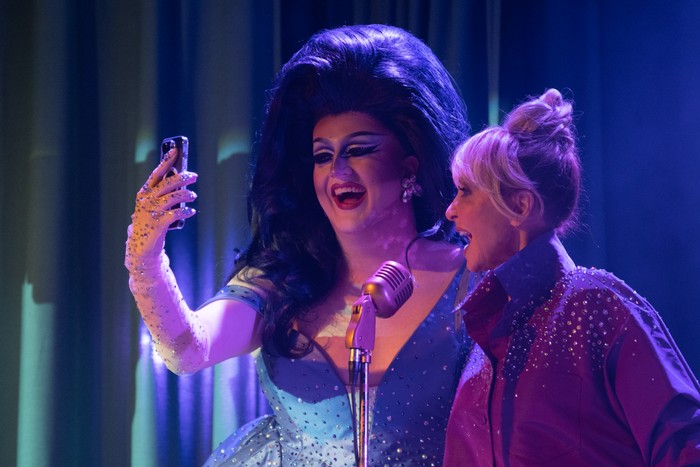
After the funeral, Joan shares the elixir with Linda and Susan. They awake as their 20-something selves (played by Esme Lonsdale, Genevieve Gaunt, and Hannah Howland), reacting with equal parts horror and delight. Once they realize the transformation lasts only six hours, they lean into the absurdity: Linda repeatedly tests her pain-free mobility by rising from a chair, while Susan flirts with a middle-aged food truck owner and Linda taunts her ex-husband about his 70th birthday. Their adventures culminate in a Vegas trip featuring drag queens and a Boy George tribute before the magic wears off.
Although an initial review by The Guardian dubbed the film “viciously anodyne but not entirely unamusing“, the film’s gentle take on the body-swap trope thrives on its cast’s incredible chemistry. While some supporting roles feel hastily cast, the central trio’s charm carries the story.
Regarding bi representation, this film excels at it. Joan’s bisexuality is revealed organically during a conversation about marriage. When Linda quips that Joan at least married a good man, Joan responds plainly:
I did love Arthur… but if life had been different, I’d have chosen a woman instead.
This understated confession reflects a lifetime of quiet longing, presented without melodrama, and thankfully, the film never reduces Joan to her sexuality either.
Beneath its lighthearted surface, the film grapples with aging and autonomy. Joan’s storyline — her happy-but-incomplete marriage, her wistful “what if” — contrasts with Susan’s unabashed singlehood and Linda’s defiance. Critics were divided: some applauded Lulu’s comedic timing and Gaunt’s pitch-perfect young Keaton, while others found the plot too thin. The elixir’s arbitrary rules and the trio’s vague backstory require suspension of disbelief, but the film’s restraint works in its favor, especially in handling Joan’s sexuality with nuance.
In a genre crowded with heteronormative tropes, it’s refreshing to witness a story where older women get to be more than cliches about regret and how unpleasant ageing can be. Besides, Joan’s bisexuality is neither a punchline nor a tragedy; it’s a quiet truth she finally voices. For viewers craving a breezy comedy with a side of substance, it’s a charming toast to second chances.