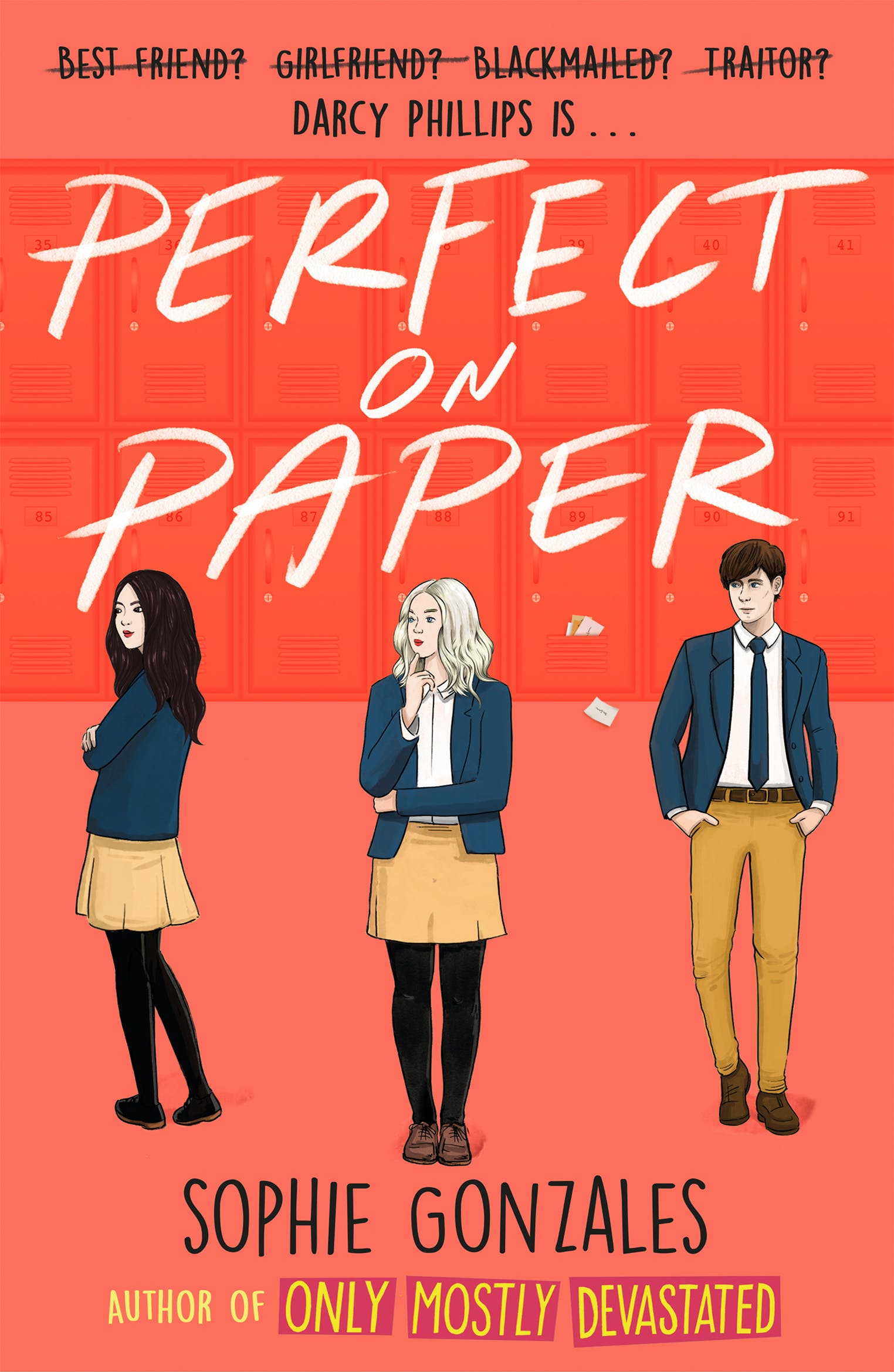
Darcy Phillips is a fictional high school junior who provides anonymous love advice to her classmates via the unused school locker number 89. She’s the protagonist of Sophie Gonzales’s queer YA romance Perfect on Paper, published in 2021.
Things are going pretty well for Darcy until a senior named Alexander Brougham accidentally discovers that she’s the mastermind behind locker 89. Though the two don’t know each other, Brougham offers Darcy a deal: If she helps him win back his ex-girlfriend Winona, he won’t tell anyone that Darcy runs the locker.
Furious as she is about being blackmailed, Darcy accepts because she doesn’t have a choice: she’s in love with her best friend Brooke Nguyen, and she once used the locker to sabotage Brooke’s almost-relationship with a queer classmate named Jaz. Brooke can never find out what Darcy did, so she agrees to Brougham’s terms. Cue the rom-com-style chaos of Perfect on Paper.
Though Darcy’s relationship advice service is a secret, her sexuality is not: she is publicly out as bi from chapter one, where she mentions that she’s part of an LGBT school club called the Queer and Questioning Club (Q&Q). At the start of chapter three, Darcy says that she’s known about her bisexuality since she was 12, after crushing on a female character from a kids’ show:
My stomach fluttered whenever she was on-screen, and I used to think about her when I fell asleep.
A few lines later, she says that she,
Still definitely gets crushes on guys, too.
Overall, Darcy is comfortable being bi. That said, as she starts to spend more time with Brougham, her struggles with internalized biphobia and bi erasure increase. Darcy might even be falling for him a little, as he’s kinder than he initially seems. As she gets to know both him and his ex, Darcy wonders if Brougham deserves better than Winona, who doesn’t seem to care about him all that much, only to feel once again ridden with guilt over how she sabotaged Brooke and Jaz. Darcy wonders if she could be sabotaging Brougham and Winona.
Beyond these fears of sabotage, Darcy also starts to wonder: what happens to her status as bi person if she dates a boy instead of Brooke after a year pursuing her? Darcy has been so focused on Brooke that she hasn’t considered what will happen if she pursues Brougham instead. Without naming names, Darcy brings these fears to a Q&Q Club meeting. She admits that she’s scared. If she dates a boy, can she still call herself bi or queer? Will she still belong at Q&Q if her relationship is straight-presenting?
In a touching moment of queer joy and connection, the club reassures Darcy that her bisexuality is authentic regardless of her dating status. It’s a turning point in the novel’s overall coming-of-age plotline but also a turning point for Darcy herself, who’s learning to communicate more openly with the people she cares about.
Beyond issues of bi erasure and biphobia, Darcy must reckon with the fact that she sabotaged one of Brooke’s earlier crushes and that she’s been hiding that fact for years. This coming-of-age conflict allows her to explore who she’d like to be in the future. And she ultimately decides that she would rather communicate more openly and honestly to create healthier relationships.