Hi, fellow unicorns! As the colder months claim my outdoor life and my couch reclaims me like a long-lost lover, I’ve been diving deep into the kind of films that make you feel something in your bones. And in my search for a cozy yet devastating emotional spiral (my favorite hobby), I stumbled into We Live in Time — a romance told in shards, where memory, love, grief, and the unexpected queerness of a life fully lived weave themselves into one non-linear tapestry.
So sit back, relax, grab your warm beverage of choice, and let me walk you through the beautiful, messy, heart-wrenching layers of this film. And yes, my unicorns — SPOILERS abound, so consider this your official warning!
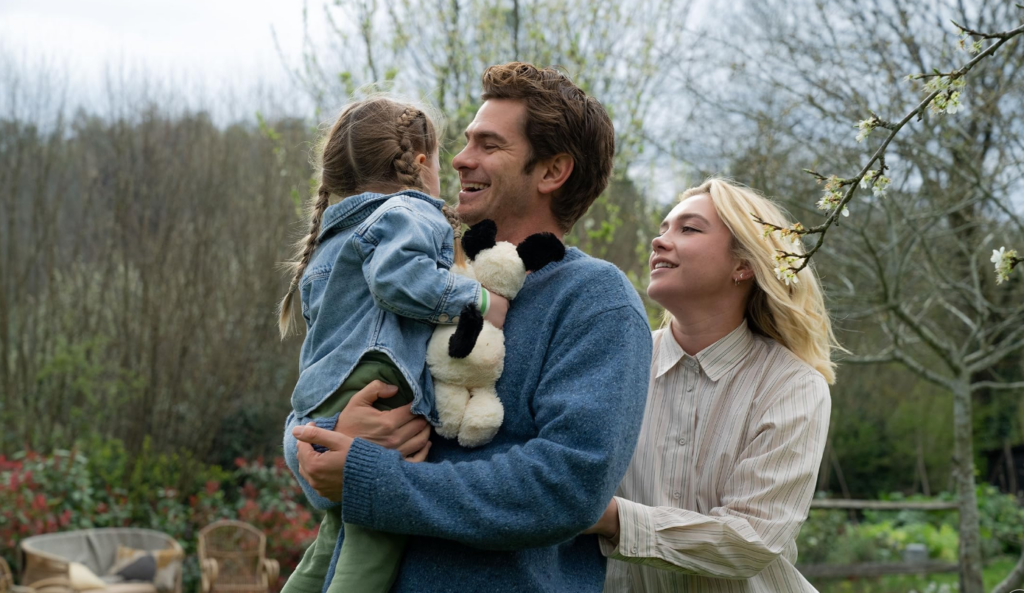
We Live in Time follows the decade-spanning love story of Almut Brühl (Florence Pugh), a successful chef with a Michelin star, and Tobias (Andrew Garfield), a man whose life becomes beautifully entangled with hers after a meet-cute collision that literally sends him to the hospital. From there, the film jumps back and forth through time: their early spark, their years growing together, the daughter they raise, and ultimately, Almut’s terminal illness that reframes their entire shared timeline.
What emerges is a portrait of a relationship textured by joy, humor, compromise, and tragedy — the kind that feels both ordinary and monumental all at the same time.
And at the center of this? A detail the general audience might overlook, but we unicorns absolutely will not: Almut is bi, with a past that matters deeply to who she is.
Almut isn’t just bi “between the lines” — she is presented as someone who has loved more than “just guys”. Her past relationship with Adrienne is referenced in several scenes, and it wasn’t casual or treated as a youthful phase. It was a deep, formative love — one that Almut ended only because Adrienne wanted children at a time when Almut believed that taking that next step was something that wasn’t in the cards for her, as she wanted to put her career first.
The film never erases this. It never undercuts it. Which props to the screenwriter, I liked.
Instead, it folds Almut’s bi-ness into her character the same way it folds in her ambition, her fears, her dreams, and eventually, her illness: with emotional honesty. This is the kind of representation that may fly quietly under the radar, but it matters — and it deserves to be centered.
What I Liked:
One of the most refreshing things about We Live in Time is how casually and confidently it handles Almut’s bisexuality. When she tells Tobias about Adrienne — not as a confession, but as part of the natural unfolding when they are getting to know each other after their first one-night stand — the movie treats it as something serious, and a step in Almut tearing down her walls and showing her vulnerability with Tobias. She shares the story of the woman she once loved with the same tone someone might use to talk about an old apartment, or a trip that shaped them. The emotional weight is felt, especially since they were together for a long time, and Adrienne was considering children as the next big step in their lives.
Tobias’s reaction is beautifully understated — not shock, not discomfort, but curiosity about someone who mattered to the woman he loves. It’s a small but powerful moment where the film signals that queerness is woven into Almut’s past without being framed as an obstacle in her present. The movie’s nonlinear structure and its emphasis on layered identity, simultaneous timelines, and the refusal to flatten a person into one singular narrative resonate deeply with those of us who are sensitive. Bi people often talk about the “multiple lives” we carry: loves we’ve had with people of different genders, families we fit into and out of, choices that look different depending on which part of our past you’re looking at. We Live in Time feels unintentionally but unmistakably aligned with that emotional experience.
And then, of course, there’s the ending — when Almut is diagnosed with stage 4 ovarian cancer, the story reframes itself around time: the moments they get to keep, the ones they’re forced to surrender, and the ones that suddenly matter more. And then we understand the weight of her decisions and her drive. Watching Tobias care for her through the slow, heartbreaking decline of her health could have been manipulative, but the film handles it with an emotional intelligence that never feels cheap. One of the most striking late scenes has Almut reflecting not just on her life with Tobias, but on the life she didn’t choose with Adrienne, acknowledging that different choices might have led her elsewhere but wouldn’t have given her this daughter, this love, or this fleeting, imperfect, wonderful time. It’s an explicitly queer reflection on multiplicity: the idea that loving more than one person across a lifetime doesn’t invalidate any of those loves — it simply expands the shape of a person’s story.
By the time the film reaches its final moments, with Tobias reading Almut’s cookbook notes and seeing the life she preserved in recipes, memories, and scraps of handwriting, her bisexuality, which was introduced earlier, transforms from a “fact about her” into a lens for understanding her. Almut’s life is full of loves, full of choices, full of timelines she might have followed — and the film treats all of that delicately.

What I Didn’t Like:
My only critique — and I say this with love — is that the film introduces Almut’s bisexuality and then treats it like a supporting detail rather than a thread with room to grow. The scenes that mention Adrienne are well-handled and emotionally grounded, but they are sparse. For a character whose relationship with queerness clearly shaped major life decisions (especially her decision not to have children until much later), the film could have allowed more space for that part of her identity to breathe.
There’s also a missed opportunity in the way the narrative leaps through time. We see Almut and Tobias at various points in their life, but we rarely see how Almut’s understanding of herself — including her bisexuality — evolves across those years. Given that becoming a parent does change her perspective on wanting a family, it would have been compelling to explore whether she also reflects differently on the life she left behind with Adrienne, even if she never regrets her choices.
Similarly, Tobias’s acceptance is admirably calm, but the film treats the conversation almost too lightly. It would have been great to see a follow-up moment where the two discuss former relationships more openly, as it could have enriched their connection and given us bi viewers something to hold onto beyond the initial acknowledgment. Discussing past partners, especially when only one person is bi in the relationship, can be a bit of a sticky conversation to have. It would have been great to see that represented as well.
None of this diminishes the representation that is there, but it does leave you wishing the film took one or two more steps forward. It’s tender, it’s respectful, but it stops just shy of becoming fully dimensional bi storytelling, especially with the rest of Almut’s life being so full and complex.
The Rating:
When everything is taken into account, We Live in Time earns 3 out of 4 unicorns, delivering a refreshing, grounded portrayal of a bi woman whose queerness is woven into her story with honesty rather than spectacle. The film gives us a protagonist whose past relationship with Adrienne is treated as emotionally real and narratively significant, and it handles her bisexuality with the kind of normalcy we rarely see in heterosexual-centered love stories.
What keeps it from tipping into the “perfect” territory isn’t a flaw so much as a longing for just a bit more time spent exploring how Almut’s queerness shapes her growth over the years; the film introduces that part of her beautifully, then lets it settle quietly into the background. Even so, the representation it does offer is heartfelt, earnest, and firmly integrated into the story’s emotional core — making We Live in Time an easy three-unicorn experience and a quietly luminous entry on the scale.