Taleen Voskuni’s Lavash at First Sight (2024), is a refreshing romance that tells the story of two bi women navigating love, family, and career. Both women are confidently out to their families, allowing the novel to focus on the warmth and exhilaration of a budding romance. When we meet Nazeli “Ellie” Gregorian, she’s managing a high-stakes job at a Bay Area startup, only for her boyfriend and coworker to break up with her moments before a crucial presentation. Despite the presentation’s success, her boss’s reaction leaves her eager for a change of scenery. A trip to Chicago for PakCon, a packaged food expo where her parents hope to grow their business, Hagop’s Fine Armenian Foods, promises just that. Nazeli’s journey to support her family — and perhaps find a new kind of love — unfolds with humor and heart.
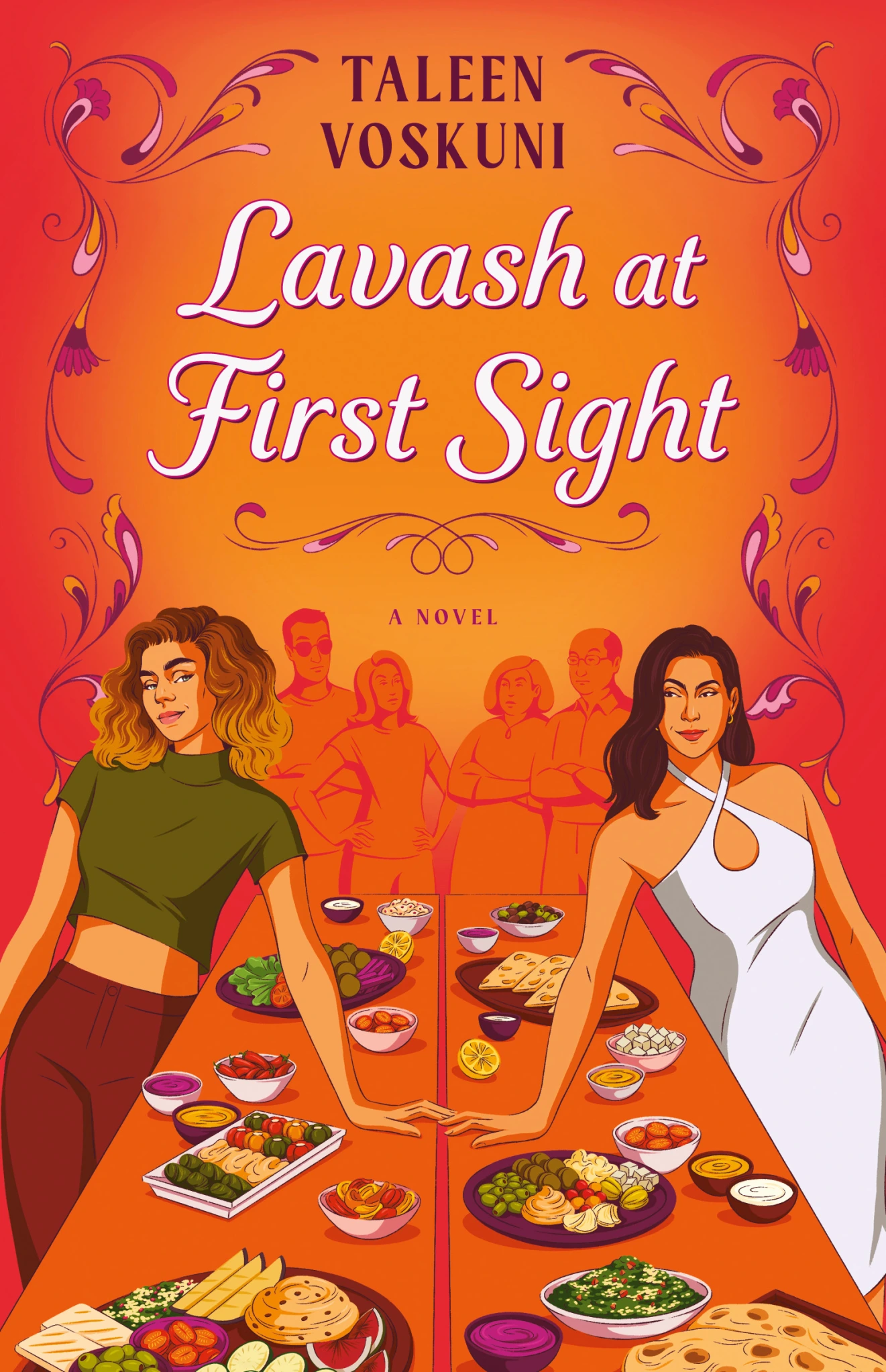
At the conference, she meets Vanya. Like her, a twenty-something Armenian Lebanese from the Bay Area. Nazeli is bi and Vanya is, as she says in the book, “bi, pan, somewhere in that zone”.
Lavash at First Sight is more than just a love story; it’s a celebration of food, family, and culture. The novel explores how food isn’t merely sustenance — it’s a source of comfort, tradition, and connection. For Nazeli, making dishes like sini kufte with her parents goes beyond eating; it’s a meaningful ritual. Vanya’s fond memories of Friday night pizza-making with her father reflect similar layers of intimacy and warmth. Food in this novel is a sensual, immersive experience, rich with personal and cultural significance. And for those unfamiliar with Armenian cuisine, “lavash” is a type of flatbread — imagine an Armenian twist on pita or naan. So, if this love story between two bi women wasn’t enticing enough, the title doubles as a clever pun!
Of course, it couldn’t be as simple as meeting and falling in love because Vanya is also at the conference with her parents and it turns out that their parents used to know each other. And though it takes the women a while to get their parents to open up about what happened and why exactly they’re behaving this way, Nazeli’s mother has an immediate reaction to seeing the two together: “You will not date her. Anyone but her.”
In other words, their parents have no problem with them being bi and seeing people of the same gender, the problem is something else. Nazeli described her parents’ reaction as “not exactly heartwarming” but as she and Vanya trade stories about coming out, Nazeli realizes that “as religious as my parents are, they… well, they seemed to care more about keeping me around, keeping our relationship the same, than what Orthodox Christianity teaches, I guess.”
Their queerness is treated in a very matter-of-fact manner. With a casualness and a lack of justification that’s relaxing and refreshing. No angst over who they are or questioning their identity. No coming out. The obstacles they face have nothing to do with their sexuality. Just a romance story between two bi people, which is so ordinary and deeply comforting.
The conference brings its own set of challenges, with Nazeli and Vanya competing for attention amid hectic schedules. Between long work hours and occasional late-night meetings with her team, Nazeli, and Vanya still find time for the kind of dates we all dream of — filled with deep conversation, laughter, and late-night adventures they keep hidden from their parents. This secrecy, however, leads Nazeli to miss an important meeting with her family, and she’s also falling behind at work due to her boss’s last-minute demands and complaints about her absence.
Their parents’ feud isn’t melodramatic but is rooted in long-held, simmering tensions. Years ago, Nazeli’s family lost an opportunity for an industrial kitchen to Vanya’s parents, and Nazeli’s father later blocked Vanya’s father from a church board position. It’s the kind of community-based rivalry where limited opportunities breed lasting grudges.
By the end, Nazlie seems to have screwed up her relationship with Vanya, even as she helps bring their parents together to find a detente. Time helped, but they needed someone else to be the catalyst that would make it possible. In a similar way, one of the conference’s charming but toxic personalities is the one who tells Nazeli that he’s surprised she doesn’t work for her parents because he could feel the passion. That it didn’t feel like she was there grudgingly helping out for a weekend and she should think about working for them.
It’s no spoiler to say that the parents ultimately reconcile and that Nazeli and Vanya end up together — anything else would have been heartbreaking. If the novel has a flaw, it’s that the ending feels a bit rushed, though satisfying. Perhaps that’s just a testament to how much more I wanted. The main characters are so vividly drawn that it would be wonderful to see them navigating the everyday corners of the Bay Area, building found families, embracing their blood families, and becoming role models for the queer Armenian community to whom Voskuni dedicates her story.