Dream On, Ramona Riley is a feel-good romantic comedy novel written by Ashley Herring Blake, and it truly does make you feel good.
When I started reading Dream On, Ramona Riley, I treated it like any other romantic novel and had no idea how brilliant the book was. Bi readers who are looking for a well-written, psychologically accurate, and absolutely unique cast of bi characters would like this book. It’s a novel you should read when you feel like the world doesn’t accept you as a bi person, or when you’re tired of stereotypical portrayals of bi people. The characters feel sweet and incredibly human; bisexuality is naturally woven into the plot and often openly discussed.
Now, beware of SPOILERS, because we’re going to discuss the plot.
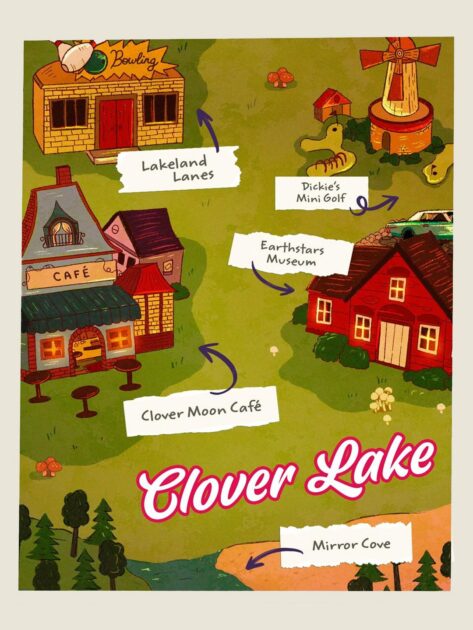
What if your teenage crush became a notorious and scandalous Hollywood actress? This is exactly what happened to Ramona Riley. Ramona is a young bi woman from Clover Lake, a small town in New Hampshire, who had to leave university and give up her dream of becoming a costume designer after her father had an accident. Ramona is left having to care for her little sister, Olive. Abandoned by her mother and forced to take on too many responsibilities from a young age, Ramona cherishes just a few good memories, including the day when she was thirteen and met a mysterious girl near the local lake. It was the day when Ramona allowed herself to have fun, and the day when she finally realised that she was bi.
Years passed, and just when life seemed as boring as it could be, Clover Lake was chosen as the filming location for a queer rom-com. And the girl from Ramona’s teenage memories came back — as the lead actress, Dylan Monroe, who also, apparently, happens to be bi.
At first glance, Ramona and Dylan seem very different, but they share the same sense of humour, similarly difficult childhoods, and the experience of realising that they were bi at a very young age. Of course, they end up together despite all the problems they face throughout the novel, which is admittedly a bit of a cliché — but it’s a romantic comedy, so what else would you expect?
Now, let’s talk about the bi representation. The novel not only has two bi lead characters, Ramona Riley and Dylan Monroe, but also three supporting characters under the bi umbrella: Ramona’s sister Olive, Dylan’s colleague Blair Emmanuel, and Ramona’s best friend April. April identifies as pansexual. Many pan people also consider themselves part of the bi community, and Bi.org places pansexuality under the bi umbrella, so we will also count her as a bi character.
There are many aspects of bisexuality and pansexuality explored in this book.
We learn that Ramona and April are bi in the first chapter, and this revelation feels very natural, just part of a storyline where characters discuss a queer movie that will be filmed in their town:
Ramona and April — bisexual and pansexual, respectively — shared a look, though Marion had a point. Plus, in a small town like Clover Lake, where minds could be, admittedly, a wee bit small, a queer movie taking over the streets for the summer was a pretty big deal.
The revelation that Dylan and her colleague Blair Emmanuel are bi is also made in a similar casual manner. It’s mentioned in Dylan’s first chapter, in the context of Dylan’s and Blair’s work relationship and their roles in the show Spellbound, which had a large queer fandom:
Blair Emmanuel was gorgeous and talented and bisexual just like Dylan, and she had played Cressida, a much-beloved witch hell-bent on Dylan’s own vampiric character’s destruction for six straight seasons of Spellbound.
The book doesn’t sensationalize bi representation. When I started reading Dream On, Ramona Riley, I was also surprised by how LGBT-friendly all the characters are. Even people from a small town, Clover Lake, are bi-friendly — and, more broadly, queer-friendly. They are excited to meet Hollywood stars who are bi, and even accepting towards their own bi and gay community members. We don’t get a single scene where April, Dylan, or Ramona face discrimination or everyday biphobia.
Actually, the bi positivity of Clover Lake may be especially interesting for rural bi folks who are tired of small towns and villages often being portrayed as conservative and retrogressive in mass culture.
It’s also worth noting that Dream On, Ramona Riley is part of the Clover Lake book series, and the story of Ramona’s best friend April continues in her own novel, Get Over It, April Evans.
Another interesting moment in the novel is the fact that we see how, even in progressive towns, queer people — including bi people — are often building their own communities and culture. Ramona, April, and some other bi and queer students were friends at school and stayed friends later in life. They joked about bisexuality, supported each other since childhood, shared stories about dates and sex, discussed politics, and even named cats after drag queens. They also guessed that Ramona’s little sister Olive might be bi before Olive realised it herself. Even in a supportive environment, they still need their own bi culture and are often better at understanding queer culture in general.
At the same time, in the novel, just like in real life, being bi doesn’t automatically mean understanding other bi people. Dylan Monroe spent years as a rival to her colleague, fellow bi actress Blair Emmanuel, and the two did not get along for years.
It took Dylan and Blair a lot of time and self-reflection to find peace and learn to work together. Their bisexuality may play a small role in that, as well as the fact that they played lovers in a rom-com titled As If You Didn’t Know.
But despite general bi-friendliness, bisexuality is not just a label in the story. It is important to all the bi characters because they mention and discuss it often. They may not face much biphobia, but all of them struggled with self-acceptance as teenagers — well, maybe except Blair, because we do not get much of her backstory, but other bi characters question themselves as teens.
It’s also interesting to note that the novel deals with the characters’ vulnerability and emotional depth without making everything about bisexuality. Olive and Ramona may struggle to accept themselves when they are young, but their main emotional problem is connected to the fact that their mother abandoned them when they were children, not to their bisexuality.
Blair is bi, and the media fully accepts her sexuality. She is a public figure whose bisexuality is treated with respect. However, her main emotional distress comes from the fact that despite being loved by audiences, she has to spend much more time and effort to reach her career goals because she doesn’t have famous parents/connections like Dylan.
Finally, Dylan is the most vivid and compelling character in the story. At least, I related to her more than to any of the other characters.
She has mental health issues and insecurities connected to the fact that she is the daughter of rock music icons who, despite being worshipped by fans, were very neglectful parents. The world sees Dylan as a spoiled brat who grew up in a rich family, whereas she remembers a childhood in which her parents often forgot to feed her because they were too drunk. Dylan’s parents sobered up, and they accepted her as bi, but she is still struggling because of them. I like how the author discussed the fact that if the family accepts a child for being bi, it doesn’t automatically mean that the family is perfect, because that is something often missed in queer novels.
Anyway, for me, Dream On, Ramona Riley is a brilliant example of a modern bi rom-com because it is very sincere, demonstrates that all bi people are different, and treats bi characters with respect, representing their deeper emotions and fears. It’s easy to write about a bi character who is struggling with coming out and facing biphobia. Or about a family that is obsessed with a kid’s coming out and has no other problems. But writing about a bi person who is dealing with complex childhood trauma unrelated to their bisexuality, while at the same time making the story unapologetically bi, is an art that Ashley Herring Blake — a bi author — succeeds in doing magnificently.