George Washington Carver was an American agricultural scientist and inventor who left a lasting impact on the agricultural industry. Known as the “Peanut Man,” Carver is credited with creating and developing hundreds of products using peanuts, sweet potatoes, and soybeans.
Carver was born into slavery toward the end of the American Civil War in 1864 in Diamond Grove, Missouri. A week after his birth, he was kidnapped along with his mother and sister from the plantation where they were enslaved by night raiders from Arkansas. Moses Carver, who owned the plantation, was able to negotiate the return of George but not his mother or sister, whom he never saw again. After the war and the end of slavery, Moses and his wife opted to raise the infant Carver as their own, later teaching him to read and write. As a boy, Carver became fascinated with flora and soon gained a reputation for saving dying plants. Locals came from the surrounding area to take their ailing plants to the “plant doctor” before George even knew what botany was.
As black people were not allowed to attend the local public school in Diamond Grove, George had to walk three hours to a school for black children. Later, he was accepted into Highland University in Kansas, but when he arrived, the school refused to let him attend because of his race. In 1890, Carver studied at Simpson College in Iowa and was encouraged to pursue botany after one of his teachers recognized his talent. In 1891, he entered Iowa State Agricultural College as their first-ever black student and went on to earn a bachelor’s and master’s degree. After establishing himself as an esteemed botanist, he returned to teach as the first black faculty member at Iowa State.
In 1896, Carver was invited by Booker T. Washington to head up the agricultural department at the Tuskegee Institute (now Tuskegee University), where he taught for nearly five decades, instructing generations of black students about farming for self-sustainability, the importance of crop rotation, and other agricultural techniques that are still in use today.
While a professor at Tuskegee Institute, Carver developed techniques to improve soils depleted by repeated plantings of cotton. He wanted poor farmers to grow other crops, such as peanuts and sweet potatoes, as a source of their own food and to improve their quality of life.
Aware that many of these sharecroppers and farmers might have poor literacy or be unable to travel to the institute, Carver invented the Jesup wagon — a mobile classroom that could go from farm to farm to teach about different crops and soil samples. To increase access, he also made sure to offer night classes and abbreviated agricultural conferences during quiet seasons.
Not only did Carter teach and spread this information, but he was also unparalleled in finding new uses for many of these crops. Most notably, he found over 300 uses for peanuts as well as over a hundred uses for sweet potatoes. Ironically, the one invention Carver is most associated with is the one he didn’t create: peanut butter. The “Peanut Man” found hundreds of uses for the nut-like legumes, but peanut butter wasn’t one of them.
Carver’s discoveries and education efforts were especially helpful in staving off starvation and economic ruin during the Dust Bowl. And not just the inventions, but the advice and recipes he developed, which he made easily available (Carver rarely pursued patents, both because it was an arduous process and because he wanted his discoveries to be freely available).
Carver’s work did not go unnoticed. Over the course of his career, he became a well-respected and widely recognized scientist, consulted by presidents, Congress, and industrialists alike. He was one of very few Americans of his day to be inducted into the Royal Society of Arts in England.

Carver was featured on US 1948 commemorative stamps. From 1951 to 1954, he appeared on the commemorative Carver-Washington half-dollar coin with Booker T. Washington.
In 1990, Carver was inducted into the National Inventors Hall of Fame. In 2005, the American Chemical Society designated his research at the Tuskegee Institute as a National Historic Chemical Landmark. In addition, many museums, gardens, and schools have been named after him.
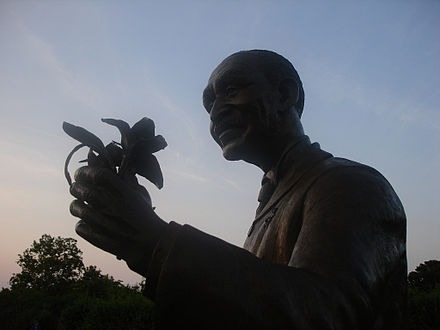
Carver was a lifelong bachelor who never married or had children. At Tuskegee, he rejected the matchmaking attempts of his friends, though he had a love life on his own terms. At age 40, Carver dated school teacher Sarah L. Hunt for three years, but the relationship ended when she moved to California. He also formed a series of long-lasting friendships with his male students, wrote them very affectionate (although not sexually explicit) letters, and had a number of close relationships with other men that biographer Christina Vella, writing in George Washington Carver: A Life, described as genuine romantic love and evidence of his bisexuality.
Later in life, Carver became very close with the scientist Austin W. Curtis Jr. From 1934 until his death in 1943, the two were inseparable, often seen strolling the Tuskegee campus arm-in-arm to check on their experiments. Carver left all of his assets to Curtis upon his death.