In a rapid review of European history, you’ll read that the European Renaissance originated in Italy and extended across the 15th and 16th centuries (or somewhere from the 13th to the 17th — historians can’t reach a consensus). “Renaissance” means rebirth in French and references the renewed interest and revival of all things classical — in particular, classical Greco-Roman philosophy, art, and sexual mores.
It all started in Florence, a wealthy city in Tuscany (in modern-day Italy). There were many factors that contributed to the Renaissance and many theories as to why this particular confluence of events led to an explosion of investment in art, culture, and science. The plague, the wealth of the Italian cities, the Little Ice Age, Byzantine scholars fleeing Ottoman invaders, the Crusades, and Marco Polo’s voyages have all been given partial credit for the Renaissance.
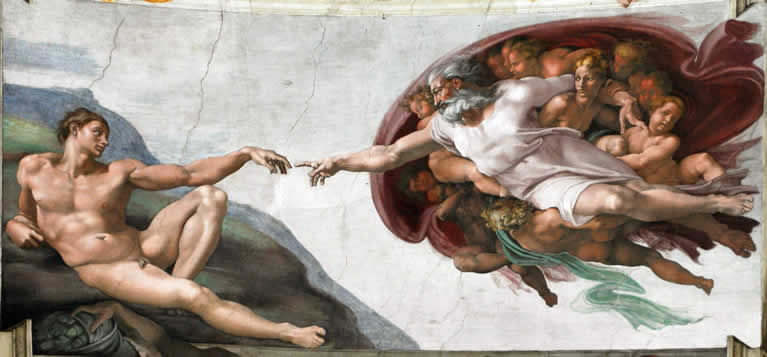
We are all familiar with the art of the period. Artists like Leonardo da Vinci, Michelangelo, Raphael, and Donatello have all become household names (and ninja turtles). All of them painted, sketched, or sculpted beautiful nude male figures in imitation of older Greco-Roman art. But it was more than aesthetic imitation, they were influenced by Neoplatonist thought, a reinterpretation of Plato that created a framework to explore same-sex love among men.
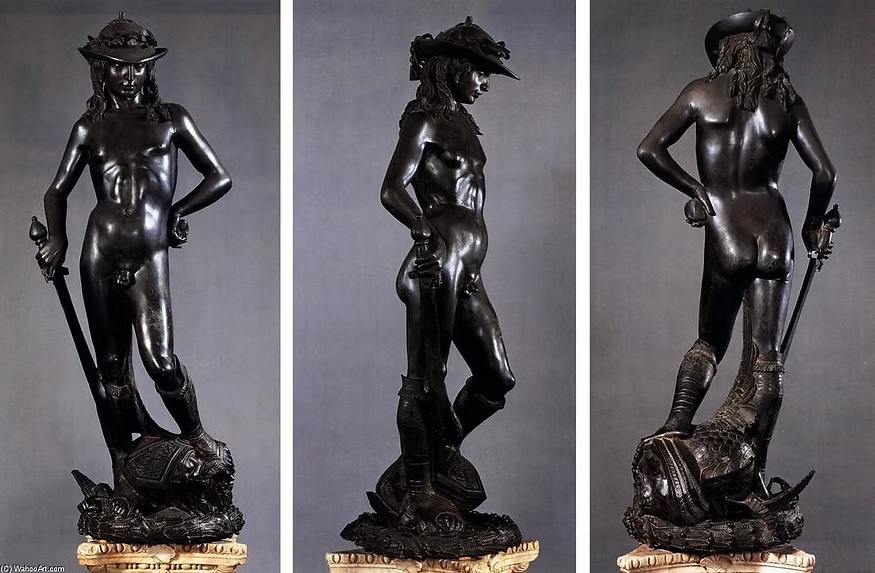
The man most associated with the Neoplatonists of the time was Marisilio Ficino, who translated and commented on 36 of Plato’s dialogues in the 15th century. He sought to combine ancient philosophy with contemporary Christian faith, instead of achieving total unity with a metaphysical “One”, where a person seeks to achieve unity with the Christian God. Ficino proposed that the highest form of love is an intense spiritual love between two men, as men were seen as more spiritual than women. Though it probably wasn’t what Ficino had in mind, many artists and intellectuals used this logic to justify a physical love between men as well.
In his book, Forbidden Friendships: Homosexuality and Male Culture in Renaissance Florence (1996), Michael Rocke estimates that two-thirds of men in Florence had participated in some kind of same-sex romance by the age of 40. This wasn’t a well-kept secret, either. In fact, in Germany at the time, “Florenzer” came to mean sodomite. Rocke’s book depicts male sexual relationships not as the exception or subculture, but as an integrated part of Florentine culture at the time.
If we look at modern rates of homosexuality, it is estimated that 3% of the population is strictly homosexual. Combine this with the fact that the population of Florence didn’t absolutely plummet during the Renaissance, and it’s safe to assume that if two-thirds of Florentine men had participated in same-sex behavior, many of them were bisexual.
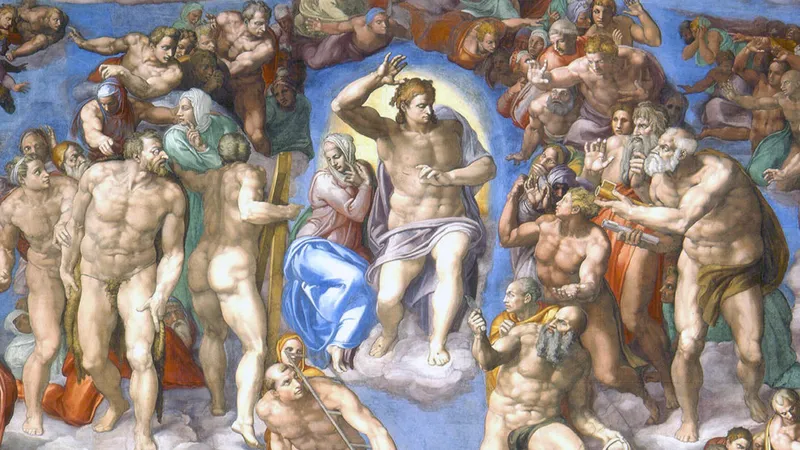
Not everyone was happy about this state of affairs. Homosexuality was illegal and forbidden by the Church, but this didn’t stop Michelangelo from covering the Sistine Chapel with the naked male form. When “The Last Judgement” was unveiled, Pope Paul III was outraged at all the exposed male bodies and commissioned Daniele da Volterra to add some fig leaves to the masterpiece.
Funny enough, one reason we know so much about the sex lives of Florentine men of the Renaissance is because sodomy was illegal. In 1432, it was seen as such an issue of concern that the Office of the Night was created to regulate sodomy and homosexual acts. It failed, but it did keep copious records. Those records show that in the last 40 years of the agency’s existence, 17,000 men were incriminated for sodomy (out of a total population of around 40,000!). In 1476, a 24-year-old Leonardo da Vinci was accused of engaging a male sex worker. But while many men were arrested by the Office of the Night, the punishments tended to be light. Although repeat offenders could be sentenced to death, this was relatively rare. For the most part, they issued fines and let the men go, having no real impact on the bi and gay goings-on of Florence.
Combing through the limited historical records, it is impossible to determine the sexual orientation of many Renaissance figures, given the sparse information we have. It has certainly been speculated that many of the great artists of Florence were bisexual. Michelangelo wrote love poetry to the young nobleman Tommaso dei Cavaliere as well as to the poet Vittoria Colonna. Botticelli was found in the records of the Office of the Night and also asked to be buried at the feet of his muse Simonetta Vespucci, whom he painted as Venus 10 years after her death. But for the most part, we are left to conjecture and speculation.
But what about the women? As is often the case with European history, the sexual lives of Renaissance women remain much harder to decipher. While the Florentine authorities kept near-obsessive records of male homosexual behaviors, the private lives of women are largely absent from the record. Even within the context of the time, Florence was perceived as being very conservative, keeping women cloistered and controlled more than many other European cities. Florentine women were largely seen as property to be handed from father to husband. There were very few ways a woman could support herself and women were mostly kept out of public spaces. It seems unlikely that they were having the same bi renaissance as their husbands, fathers, and brothers.