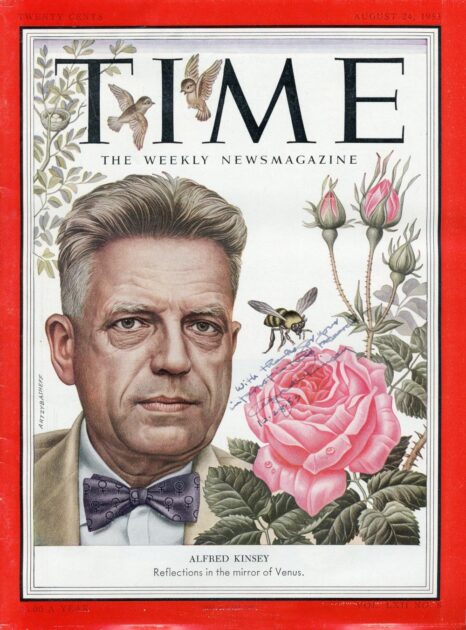
Alfred Kinsey
Famous BisAlfred Charles Kinsey was an American biologist, professor, and sexologist best known for his research on human sexuality. His work, culminating in the enormously influential Kinsey Reports and the Kinsey scale, changed public perceptions about sex and sexuality and paved the way for future generations of sex researchers.
Born in Hoboken, New Jersey, in 1984, Kinsey grew up in a very unusual household. Kinsey’s upbringing was one of poverty (his family often could not afford medical care for Kinsey, who was a sickly child), science (his father was a professor of mechanical engineering), and strict religiosity (his parents were devout Methodists). When young Alfred expressed an interest in science, his father pressured him to follow in his footsteps by pursuing engineering in college. Kinsey did so, but found that the field did not suit him, and eventually switched to biology. A year after earning his Ph.D. from Harvard, Kinsey arrived at Indiana University in 1920 to embark on a career in academia.
For the next 20 years, Kinsey studied gall wasps, specializing in taxonomy and individual variation. As unsexy as this work may have seemed compared to what Kinsey would go on to do, the grounding this zoological work gave him deeply influenced his approach to more human-related subject matter.
In 1938, his life took a turn when he began teaching a course for senior married students called “Marriage and Family”. He soon realized not only that the public understanding of sex was poor, but that there was also very little scientific data about human sex and sexuality. His students, he noticed, knew more about animal mating than human sex.
Identifying this gap in knowledge, Kinsey began researching human sexuality and collecting sexual histories and interviews. In 1947, he created the Institute for Sex Research, known as the Kinsey Institute since 1981, the first university-based sex research institute in the US (and still operating today).
A year later, Kinsey published his first book, Sexual Behavior in the Human Male (1948), an amalgamation of thousands of interviews he and his team had conducted with men regarding their sexual histories. This book also introduced the “Heterosexual-Homosexual Rating Scale” — more commonly referred to as the “Kinsey scale” — as a way to conceptualize sexuality as a spectrum with heterosexuality represented as 0, homosexuality represented as 6, and 1–5 representing bisexuality. In 1953, he published Sexual Behavior in the Human Female. Together, these works are known as the Kinsey Reports. Kinsey and his team ended up collecting over 18,000 interviews.

Kinsey’s research has been the subject of considerable controversy ever since the publication of the Kinsey Reports. Immediate best-sellers, Kinsey’s books fascinated, shocked, and scandalized Americans who were, in many cases, learning about the sexual habits of other people for the first time during an era when sexuality was a taboo subject. The Kinsey Reports also revealed a level of same-sex behavior many times higher than most people imagined, fueling the homophobic offshoot of the Second Red Scare known as the Lavender Scare. As a result, Kinsey and his team encountered many obstacles as they pursued their work, including a loss of funding, a lawsuit by the US Customs, and anti-communist investigations.
The controversy also made Kinsey a celebrity. He was on the cover of Time Magazine, appeared on television programs, and was referenced in the Cole Porter song “Too Darn Hot.”
Kinsey remains a contentious figure among many to this day, owing to the Kinsey Reports’ inclusion of several pages containing information obtained from interviews with sex criminals, as well as the Kinsey Institute’s continued study of some of the darker sides of human sexual behavior.
But as Kinsey said, “We are the recorders and reporters of facts — not the judges of the behaviors we describe.”
Alfred Kinsey himself was openly bi and had an open marriage with his wife, Clara. They both had many partners throughout their marriage. Clara knew about Kinsey’s bisexuality and supported his numerous relationships with men. He believed that openness about sexual matters led to healthier outcomes for society and that repressing or delaying one’s sexual behaviors was harmful. More than anything, Kinsey was motivated to remedy the public ignorance about sex and sexuality.
Kinsey died on August 25th, 1956, at age 62, owing to a heart condition and a bad bout of pneumonia.
Kinsey’s life has inspired many media projects, including Theatre of NOTE’s 2005 off-Broadway play, Fucking Wasps, the 2004 biopic Kinsey starring Liam Neeson, PBS’s 2005 documentary Kinsey in cooperation with the Kinsey Institute, the novel The Inner Circle (2004), and even a radio play.
Kinsey’s work continues to be celebrated for furthering our understanding of the broad range of human sexuality and in helping to make sex research a legitimate field of study, which his Institute carries on. The Kinsey scale, in particular, greatly improved the conceptual understanding of bisexuality and remains one of the most useful tools for visualizing the diversity of bi people’s attraction patterns.
In 1953, Time quoted two of Kinsey’s supporters as saying, “Kinsey […] has done for sex what Columbus did for geography.” His trailblazing research — and the reaction to it — is also believed by many to have helped to lay the groundwork for the Sexual Revolution of the 1960s and 70s.
In 2012, Kinsey was inducted into the Legacy Walk in Chicago, celebrating LGBT history and people. In 2019, he was named one of the original 50 “pioneers, trailblazers, and heroes” memorialized on the National LGBT Wall of Honor inside the Stonewall National Monument at the Stonewall Inn in New York.