Freddie Mercury (born Farrokh Bulsara) was the lead vocalist and songwriter of the rock band Queen. Regarded as one of the greatest lead singers in the history of rock music, he was known for his flamboyant stage persona and four-octave vocal range.
Mercury had a highly unusual childhood for someone who would go on to front one of the most dominant rock bands in UK history. Born to Parsi Indian parents in the then-British protectorate of Zanzibar just off the east-African coast, Mercury spent his childhood split between Zanzibar and British boarding schools in India. He came from an exceedingly small diaspora community of ethnically Parsi Zoroastrians whose ancestors had fled from Persia to India (and eventually to Zanzibar) to escape persecution and seek greater religious freedom. In 1964, when Mercury was seventeen, his family fled once again amid the Zanzibar Revolution and its racial violence, relocating to Middlesex, England.
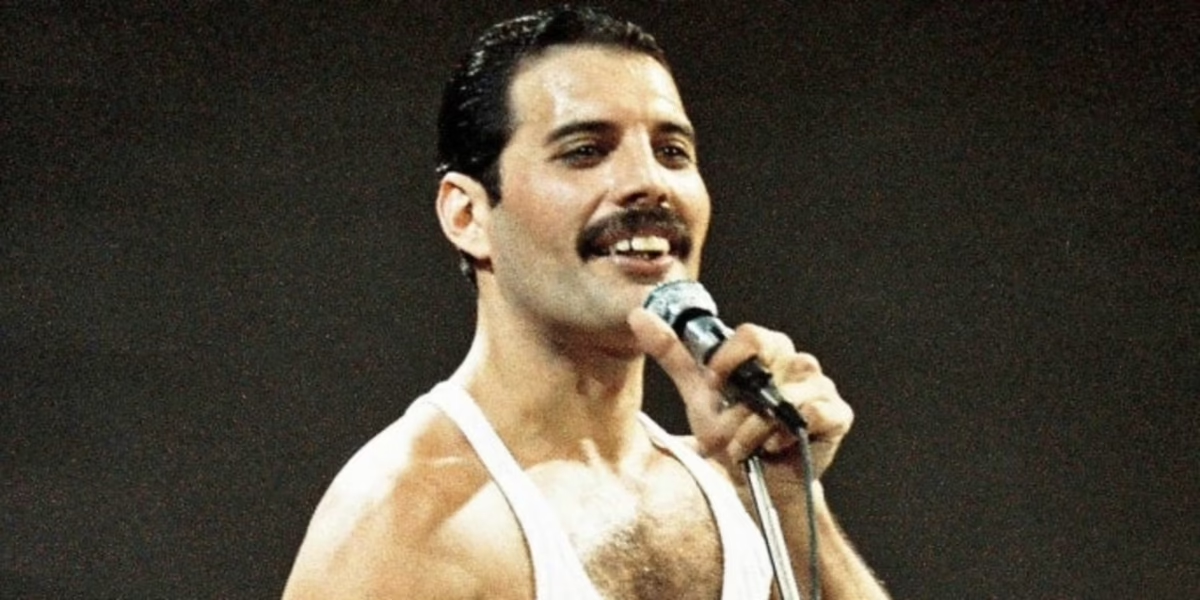
As a boy, Mercury became obsessed with Western pop music and formed a band while in school that performed covers of classic artists including Little Richard. As an undergrad studying graphic design at Ealing Art College, Mercury lived with his girlfriend Mary Austin and held down jobs working at secondhand clothing stores as well as handling baggage at Heathrow Airport.
During these years, Mercury moved from one band to the next, never quite finding the right fit for his unique singing ability. Mercury had hyperdontia, a rare dental condition that caused him to have four extra incisor teeth, which he believed helped him achieve his incredible vocal range. He chose not to have it corrected out of fear that it would change the shape of his mouth and inhibit his singing.
In the spring of 1970, Mercury met guitarist (and future astrophysicist!) Brian May and drummer Roger Taylor. Together, the trio formed a band called Smile, with Mercury as the lead singer. The following year, bassist John Deacon joined the group, Mercury legally changed his name from Farrokh Bulsara to Freddie Mercury, and the new band was named Queen.
Mercury wrote a number of genre-spanning hits including “Killer Queen”, “Bohemian Rhapsody”, “Somebody to Love”, “We Are the Champions”, “Don’t Stop Me Now”, and “Crazy Little Thing Called Love”. He became well known not only for his stellar voice but also for his charismatic stage presence, defying the conventions of a rock frontman with his highly theatrical style, influencing the artistic direction of Queen, and becoming one of the great live rock performers of all time. Mercury often used the mic stand as a stage prop and had a remarkable ability to connect with seemingly every member of the audience, no matter how large the venue. Queen’s performance at the first Live Aid in 1985 is still remembered as one of the best shows in musical history.
Although both Freddie Mercury and Queen actively avoided publicly labeling his sexuality lest it negatively impact their careers, Freddie Mercury’s attractions and behavior were openly bi. His relationships with women included Mary Austin, to whom he willed his home and the royalties from his music, and about whom he wrote the song “Love of my Life”. Later, Mercury was involved with actress Barbara Valentin, who is featured in the video for “It’s a Hard Life”.
Mercury also had relationships with men, including Kenny Everett, a flamboyant DJ who helped create a buzz about “Bohemian Rhapsody” during his program. In 1985, he began a relationship with hairdresser Jim Hutton that lasted until Mercury’s death from bronchial pneumonia resulting from AIDS in 1991. Lesley-Ann Jones, the author of two biographies on Freddie Mercury, spoke with Them about the topic of Mercury’s sexuality:
“It is still fascinating to me, after all these years, that Queen’s management spent decades trying to convince the world that Freddie was heterosexual while he was alive, but then conceded to his homosexuality after he had died. They would not, however, allow for his bisexuality — even though they embraced and promoted Mary Austin (Mercury’s longtime girlfriend) as his one true love! All their efforts to preserve Freddie in memory as, effectively, a straight man who was in love with one woman — his soulmate Mary — but who was ‘corrupted’ by factions of the music industry (and wasn’t really gay) are ridiculous to me, he was clearly bisexual.”
Mercury’s bisexuality has been a frequent facet of his life that has been downplayed, papered over, or outright erased. For example, many people were disappointed to see this bi-erasure continue in the 2018 biopic Bohemian Rhapsody.
As a member of Queen, Mercury was posthumously inducted into the Rock and Roll Hall of Fame in 2001, the Songwriters Hall of Fame in 2003, and the UK Music Hall of Fame in 2004. In 1990, he and the other Queen members were awarded the Brit Award for Outstanding Contribution to British Music, and one year after his death, Mercury was awarded it individually.