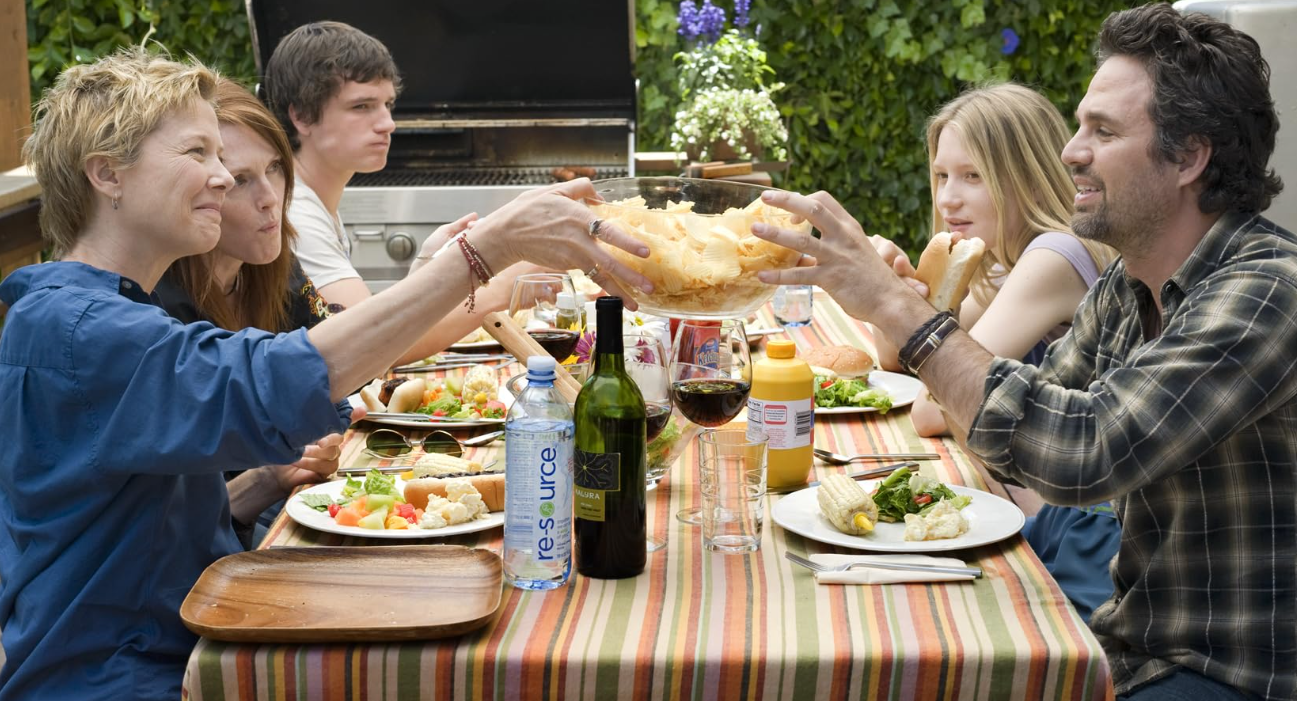
The Kids Are All Right (2010) is an American independent comedy-drama film written and directed by Lisa Cholodenko. The full-length feature stars Annette Bening and Julianne Moore as a same-sex couple in Los Angeles with two children conceived through an anonymous sperm donor named Paul (Mark Ruffalo). When the oldest of the two kids turns 18 and the younger brother pressures his older sister to find out the identity of their donor father, Paul becomes entangled in the family’s lives in complicated ways.
This entry will focus on the character of Jules (Moore), a landscape designer with a bohemian aesthetic who often wears her red hair down past her shoulders.
Overall, Jules is a satisfying, three-dimensional queer character. She’s a good mother and does her best to be a good partner to Nic (Bening), and has enough hippie sensibilities to be interesting. She has strengths and failings, hopes and dreams and fears, and makes mistakes just like any other partner or parent, and seems to overall have a pretty good sense of herself (though that does get shaken on a few fronts at different points in the story).
We see her loving Nic but also having trouble at times connecting or reconnecting with her, which the two of them attempt to tackle like adults. Like any adult couple, they come across bumps in the road, but Jules remains deeply attracted to Nic and tries to make their marriage work, especially in the first half of the movie. When Paul enters the picture and the two have an affair, their sexual encounters show her attraction to him and her delight in their tryst. She especially responds to his appreciation of her skill in her landscape design work, which seems to have been overlooked by her perfectionist partner, Nic. However, when the shit hits the fan, Jules tells Paul she’s “gay” and begins to retreat to her marriage and work on making it up to Nic.
We wish she’d used the term “bi” or “queer” to describe her obvious attraction to both sexes. And it’s regrettable to yet again see a bi character be a cheater (and for their adultery to be the crux of the entire plot). But then again, The Kids is smart enough not to let her suffer and lose her family in some form of a pat, modern morality tale. We see Jules ask for forgiveness and get a redemption arc, and the film is smart enough to see that people can make mistakes from time to time and can apologize through changed behavior — the best form of apology.
Ultimately, while Jules is a well-drawn character with strengths and flaws and plenty of emotions (especially as the heart of the family), her attraction to men is seen as a slip-up rather than an expression of her bisexuality. In reality, it can be both. Jules is a good example of a messy bi character in modern film — not a paragon or a role model of queerness, but still also deeply human.