Quality sex education is rare. Sex education that’s inclusive of LGBTI identities is even rarer. Netflix’s Sex, Explained
(2020) does a fairly decent job at both. Narrated by the iconic Janelle Monáe, who identifies as pansexual and non-binary, I was actually expecting the series to be inclusive of queer issues, or at least mention LGBTI identities. The show did indeed reference queer issues and history, as well as included a diverse cast. Not only that, I found the series to be informative and enjoyable to watch.
The limited series includes 5 short (around 20 minute) episodes that can be watched in any order, but I watched each one right after another. Each episode explains the science and history behind different aspects of human sexuality: fantasies, attraction, birth control, fertility, and childbirth. While each topic is in itself very complex, the program keeps things simple and straightforward. Complex science is explained well by experts in the field, and video graphics help visual learners.
Overall, the show struck a good balance of sex-positive and pragmatic, which I believe is important in sex education. So let’s dive in. As this isn’t a narrative show, there won’t be spoilers, but I will be describing parts of the episodes. As always, if you want to know more about our rating system, check out this breakdown of The Unicorn Scale.
What I Liked:
The episodes aren’t just science and facts, but also include stories about real people, which help viewers connect to the content. While the issues affecting LGBTI people have often been historically ignored, or worse, demonized, it’s refreshing to watch a program on a mainstream network about sex that includes how the topics affect LGBTI people. I really appreciated how queer issues and identities where incorporated into each topic, instead of setting us apart as some kind of fringe outsiders. Most issues that affect straight-cis people effect LGBTI people as well, and vice versa.
In addition to experts, the episodes also feature interviews with average people, all of whom are diverse in ages, races, orientations, and gender identities. The topics of each episode are not abstract, but rather have a real and profound impact on nearly everyone. Seeing a diverse group of people, several of whom we can infer are bi (when their identities are not explicitly stated) can both help more viewers connect to the content and normalize these identities.
Right from the get-go, in the “Fantasies” episode we see a variety of same-sex couples.
Studies by the sex researcher Justin Lehmiller included people of various orientations and gender identities. In the past, LGBTI people may not have been included in the data set at all. Something that is not only discriminatory, but bad science. According to a survey, the threesome is by-far the most popular favorite fantasy of all time. Which probably explains why one of the first question bi folks usually get when we come out to others is if we’re down for threesomes. Apparently, it features prominently in most people’s imaginations. Bi comedian Margaret Cho gives a lot of the explanations in this episode. We learn a history lesson on the gay leather scene, and Cho describes the role kink played in the aftermath of the AIDS epidemic.
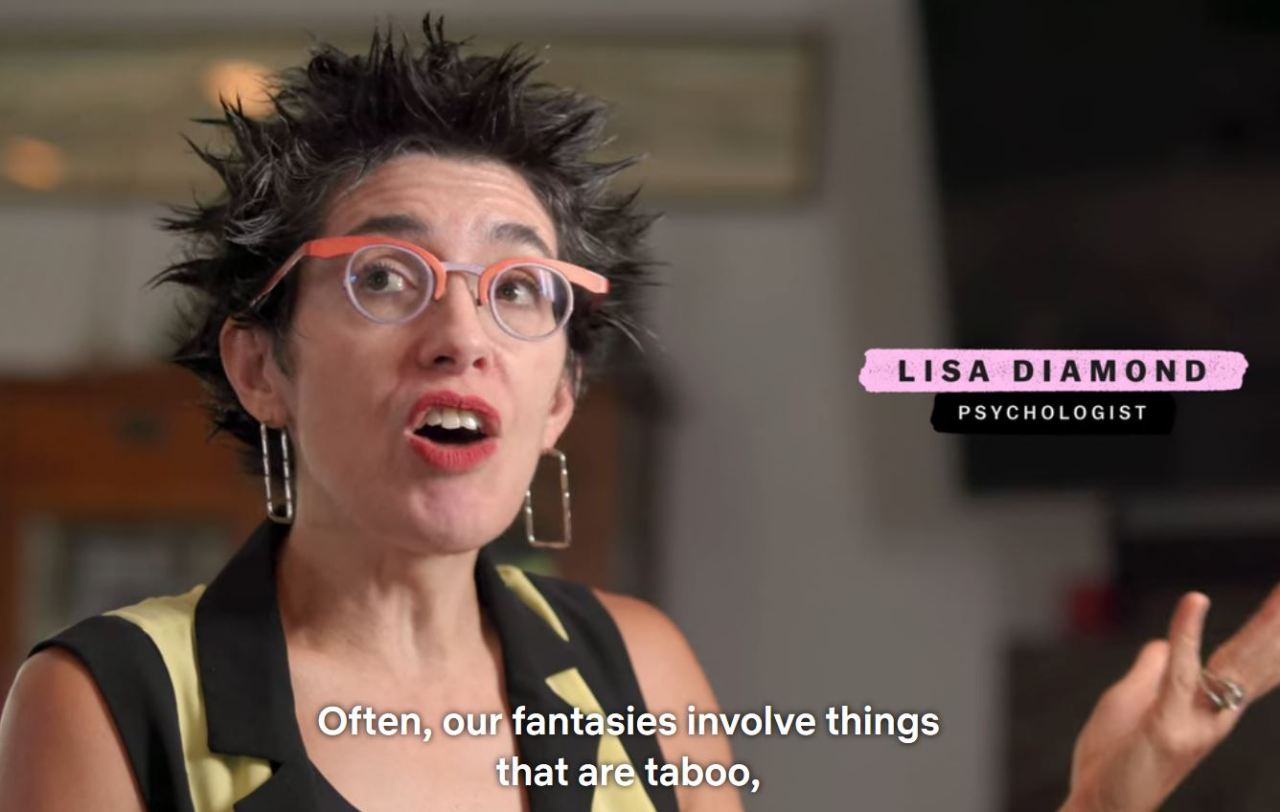
The episode also introduces us to the new web series Mercy Mistress, created by BDSM educator and practitioner Yin Q. The series is based on Q’s experiences as a queer, Asian American dominatrix, and is also produced by Cho. Sex, Explained also emphasizes that having certain fantasies does not mean that one wants to actually engage in those behaviors, such as forced sex. Psychologist Lisa Diamond, known for her work on sexual fluidity, reassures viewers that even if you fantasize about being raped that doesn’t mean you want to be raped in real life.
The “Attraction” episode again starts off queer-inclusive, suggesting people could be attracted to both boys and girls. The causes and varieties of sexual orientations were explained, as you might have expected in an episode about attraction. Diamond explains the various hypotheses for what might make someone attracted to particular gender(s). Gender is just another “type” Monáe tells us, and Diamond explains (in an acknowledgment of bisexuality) that some people are more attracted to particular genders than others, while others are more attracted to the individual.
A study showed that straight women tend to be more flexible in whether they are aroused by men or women. A concept that I drive home in my own sex-ed classes is that while sex is the means of reproduction, reproduction is by no means the only reason to engage in sex. Sex serves multiple functions, Diamond tells us, such as forming social alliance and stress-reduction.
The “Birth Control” episode focused on male-female couples avoiding unplanned pregnancy. The “Fertility” episode mentions intersex, without actually using the word, when it describes how an embryo usually picks a lane during gender development. That “usually” is important because with intersex people, they may go “off-roading” (if I stick with their analogy) and have a gender that’s not completely male or female. There was also a segment that mentioned the struggles same-sex couples face when trying to conceive. The show never felt sterile or impersonal. This is very much about the human experience. The powerful final scene of the “Childbirth” episode features a woman delivering her baby and, absorbed in empathy for her, it brought me to tears.
What I Didn’t Like:
They definitely could have gone into more depth on the various topics, but at least the representations of queer people were positive. In terms of bi representation, this show at least mentioned that we exist, although they never outright used the term “bisexual” or “bi”.
The Rating:
With the dearth of representation for bi folks, we often get excited for any scrap of representation. I was excited to watch an educational program about sexuality that acknowledged that bi people even exist, but there wasn’t much substance that strictly focused on bisexuality. It was a worthwhile watch, but not the height of representation of bi folks.