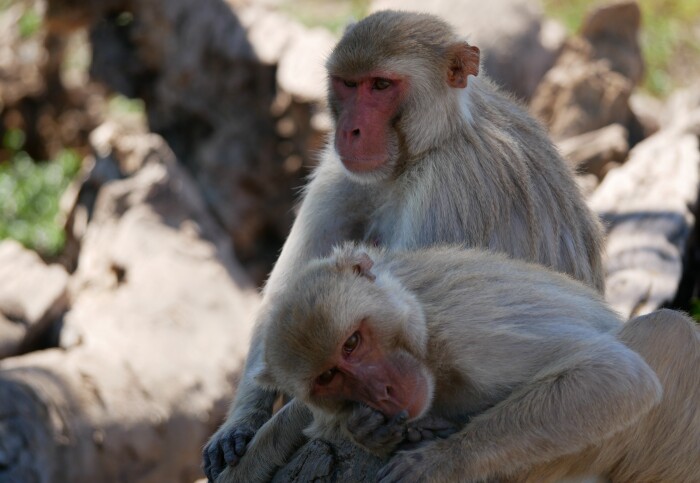
There’s quite a lot of monkey business going on in the world. In fact, of the more than 1,500 species with documented same-sex behavior, primates are among the most extensively studied. From rhesus macaques to bonobos to gorillas to orangutans to humans — primates are pretty darn bi. And a new study is helping to illuminate what’s behind all this bi behavior, and how common it is.
Recently published in the prestigious Nature Ecology & Evolution, this study, “Ecological and social pressures drive same-sex sexual behaviour in non-human primates”, was a massive undertaking. Researchers conducted a systematic review compiling data on 491 non-human primate species across 96 peer-reviewed studies. They found that 59 total non-human primate species showed same-sex behavior, an increase over the previous estimate of 51 reported in 2023. They found that same-sex behavior (which means bisexual behavior, as exclusive homosexuality is unheard of in nature) was evident in most major primate groups including lemurs (and their close relatives), New World monkeys, Old World monkeys, and apes. The authors suggested that bi behavior existing across so many primate species points to a “deep evolutionary root or multiple independent evolutionary origins.”
To shed some more light, they dug deeper into the data to cross-reference same-sex behavior with 15 environmental, life history, and social traits to see which conditions were most associated with bi behavior. They found that same-sex behavior was more likely in species that live in colder, drier, and more shaded environments, as well as environments with increased food scarcity and predators. Bi behavior was also more common in species that live longer, species where the size difference between males and females is larger, and species with more complex social structures.
The study authors also speculated that for humans, some of the genes associated with male same-sex behavior could, in females, lead to reproductive advantages. Other research on the genetics of human bisexuality has found that some of the genes associated with bisexuality give similar advantages when carried by straight people. Given how closely related all primate species are (including humans), the researchers wondered how this area of research might help us to better understand ourselves:
Younger generations tend to report more sexual fluidity and bisexuality but also elevated levels of stress and mental health challenges. Could there be commonalities across primates? In humans, it may not be food scarcity or rigid social hierarchies that drive these patterns, but rather the pressures of modern social living. Is it possible that a link exists whether consequential, causal, or correlational, perhaps mediated by mechanisms […] in which shared genetic factors influence different traits? While entirely conjectural, our findings in non-human primates may provide a framework for future hypotheses on humans.
It’s an interesting hypothesis — bisexuality as a response to stress. What seems more likely than stress changing one’s sexual orientation is that certain life circumstances may present individuals with opportunities they might never otherwise encounter or consider. As this Bi Science column has covered, we have more than enough data at this point, spanning countries, species, and generations, to be very confident that bisexuality is common and natural in every sense of the word. There is good reason to believe that most humans may, in fact, be bi, even if they fall closer toward the heterosexual end of the Kinsey scale. What we’re now witnessing and learning more about are the countless conditions that can cause people’s bi attractions, behavior, and self-identification to awaken.