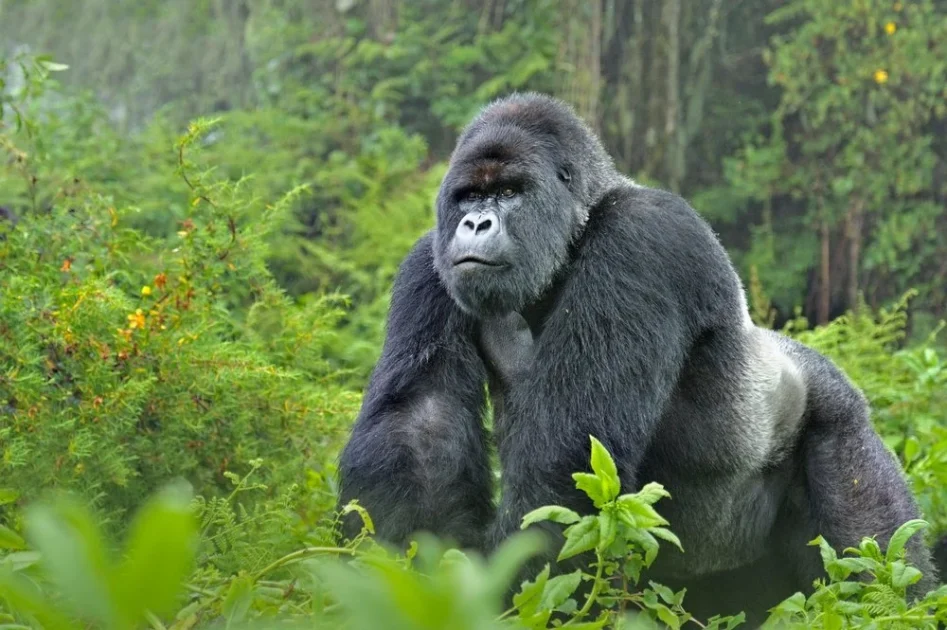
Gorillas are a source of endless curiosity. They’re hulking behemoths with incredible musculature, yet their diet consists mostly of leaves, stems, fruit, and the occasional termite. They’re the largest living primates, yet they’re the least endowed with an average manhood (apehood?) of just 1.1 inches. They’re also known for living in harems with one male and a bunch of females, yet they’re also widely documented to engage in bisexual behavior.
Gorillas number among our closest genetic relatives — we share 98% of our DNA with them — yet the differences in that 2% are astounding. Gorillas can weigh in at over 500 lbs, with a height up to six feet and an arm span over eight. And owing to their unusually high percentage of fast-twitch muscle fibers, gorillas are also far stronger than humans, even pound for pound, leading many online to wonder, “Could 100 men beat a gorilla in a fight?” Rolling Stone amusingly reached out to experts on this, and the consensus was basically, “Yes, if the humans work together and accept the fact that many of them will be killed or mangled in the process”. But for all their fearsome power and literal chest-beating, gorillas don’t actually brawl that often. They much prefer loving to fighting, with both males and females.
As Bruce Bagemihl noted in Biological Exuberance: Animal Homosexuality and Natural Diversity (1999),
Many female gorillas are bisexual, having sexual and affectionate relationships with both males and females, […] Many male gorillas are probably sequentially bisexual, spending portions of their lives having only homosexual encounters (in all-male groups), followed by periods of only heterosexual interactions, and so on.
From Japanese researchers in the 1980s observing the courtship of two male gorillas named Titus and Ahab to PhD students in the 2010s noticing male gorillas mounting one another, same-sex behavior among male gorillas has been incredibly well documented. Male gorillas typically spend a substantial portion of their lives — about six years, on average — living with other males, though for some it’s far longer. According to Bagemihl, “homosexuality occurs most commonly in all-male groups, where probably more than 90% of all same-sex activity between males takes place.” This male-on-male action takes place just about daily — including foreplay — and may exceed the amount of opposite-sex behavior over the course of gorillas’ lives. In fact, “Some males may engage in homosexual copulation more than 75 times a year in such groups, and homosexual courtship, at its peak, can take place as often as seven times an hour.” Talk about going apeshit!
But bisexual behavior doesn’t only occur when gorillas are cut off from the opposite sex. In cosexual groups (at least two males and two females) 2% of all sexual activity is between males, and 9% of all sexual activity is between females. One interesting difference between male-male and female-female sex is that males prefer mounting one another from behind, while females prefer doing the deed face-to-face. As is often the case in the study of animals, the behavior of the males seems to get more attention than the females’. Even though female same-sex behavior has been documented for over 50 years in field reports, the first formal zoological study showing female same-sex behavior was only published in 2016.
The reasons for bi behavior among gorillas appears to differ by sex. For males, it seems to mostly stem from a lack of access to females, since almost all of their same-sex behavior occurs when they’re off in guys-only groups. A common explanation offered throughout the animal kingdom is that same-sex behavior strengthens bonding and decreases in-group aggression, but as Bagemihl noted, “homosexual activity in male gorillas often results in increased rather than decreased social tension.” For females, the story may be different. They are more likely to mate with other females in cosexual groups, are more likely to develop a close bond with another individual female, and spend longer per session with females than with males. This could mean that unlike with males, female bisexual behavior is more about social bonds and sexual pleasure than a simple sexual release.
The mightiest apes are also mighty bi, but due to habitat destruction, gorillas are currently listed as endangered, though conservation efforts have made progress in recent years. Hopefully gorillas will once again be able to thrive and swing both ways in peace.