One of the most fascinating things about nature is that all life on Earth is genetically related, so when we learn about animals, we also learn about ourselves. This is true even of the tiniest and seemingly least human organisms. The extensively studied microscopic roundworm C. elegans has contributed to medical breakthroughs because even this one-millimeter nematode is a close enough relation to humans to be relevant. Even so, there are degrees to these things. There’s only so much we can glean about human nature from observing plankton or sea anemones in the wild. This is what makes primates in particular intriguing, because they’re our closest non-human relatives. And when we look at bonobos, our closest cousins of all (humans share 98.7% of their DNA with bonobos and chimpanzees), we see a version of ourselves: intelligent, highly social apes whose lives are defined by free love and bisexuality.
Bonobos share nearly all of their DNA with chimpanzees. In fact historically, they were called pygmy chimps, and it wasn’t until 1929 that they were discovered to be a separate species. The differences in their behavior are much more immediately striking than their more subtle variations in appearance.
Unlike chimps, who live in a male-dominated social structure, are known to be highly aggressive and warlike, and resolve disputes with violence, bonobos are the hippies of the primate world. Living in matriarchal groups led by females, bonobos use sex as the universal social tool for all occasions. As the renowned primatologist Frans de Waal put it, “The chimpanzee resolves sexual issues with power; the bonobo resolves power issues with sex.”
Whether they’re settling conflicts, building bridges, forming alliances, making friends, making up, or just looking for fun, bonobos have sex. And it doesn’t matter whether their partner is male or female, old or young, or whether three’s company, bonobos are, to quote a beer commercial from the 2010s, “up for whatever”. Bonobos are among the only non-human animals to tongue-kiss, engage in oral sex, make sex toys, have sex purely for pleasure, and mate face-to-face. In his wonderfully colorful Chaucerian retelling of human evolution, The Ancestor’s Tale (2004), evolutionary biologist Richard Dawkins wrote that “Bonobos use sex as a currency of social interaction, somewhat as we use money. They use copulation, or copulatory gestures, to appease, to assert dominance, to cement bonds with other troop members of any [sex].”
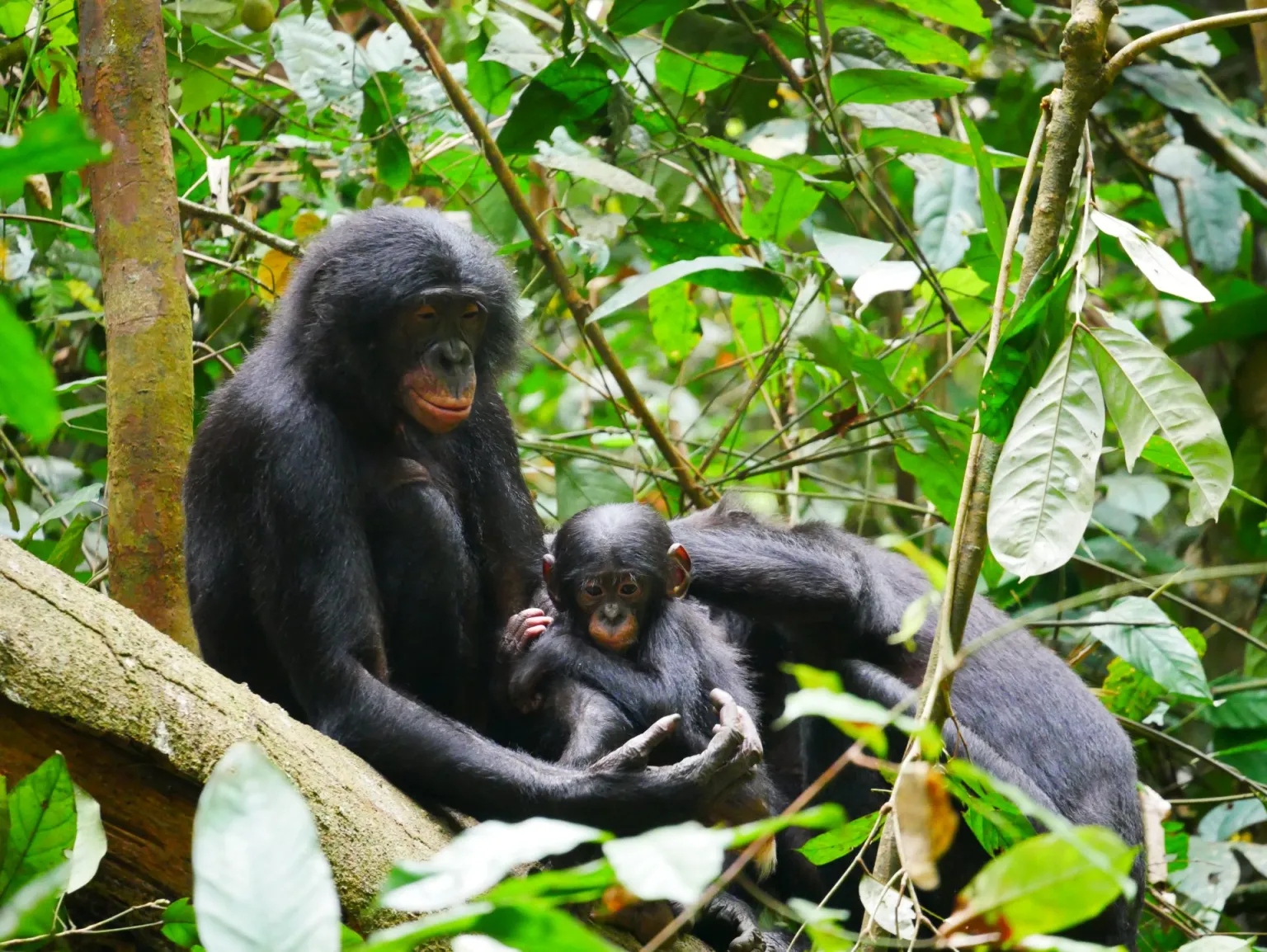
Curiously, female bonobos have stronger libidos than males. They tend to have more sex than males, and more often with other females. According to a 2019 study in Hormones and Behavior, 65% of all bonobo sex was between females. In fact, female bonobos have sex with one another about once every two hours on average! Scissor me timbers! Males also get freaky, mounting one another, performing fellatio, and even engaging in the occasional bout of “penis fencing” — aka “sword fighting”.[1] The pirate idioms really do write themselves.
Lest you think this is all just frivolous monkey business, bonobos’ sexual habits are connected to a number of remarkable traits. For one, bonobos are far less warlike than their chimp counterparts and less likely to attack humans. Recent research has shown that male bonobos in particular are more feisty with one another than previously thought, but violence between sexes is rare, and infanticide, common among chimps, is unheard of among bonobos. What’s more, bonobos are more skilled than chimps at problem-solving involving emotional intelligence. Their bisexual behavior has been linked to greater cooperation, diffusing social tension, and making sure that cooler heads prevail. This can even be numerically measured. Following sex, female bonobos have higher levels of oxytocin, known as the “love hormone”, which is associated not only with arousal but also with trust and relationship building.
Looking at these mighty but endangered apes, whose common ancestor separated from our own some five to seven million years ago (an eye-blink in geological time), we see a captivating vision of what we might have become, but also what we could still be. If there’s one thing humans can learn from our bonobo cousins, it’s that the answer to most of life’s problems may just be “f*ck it”.