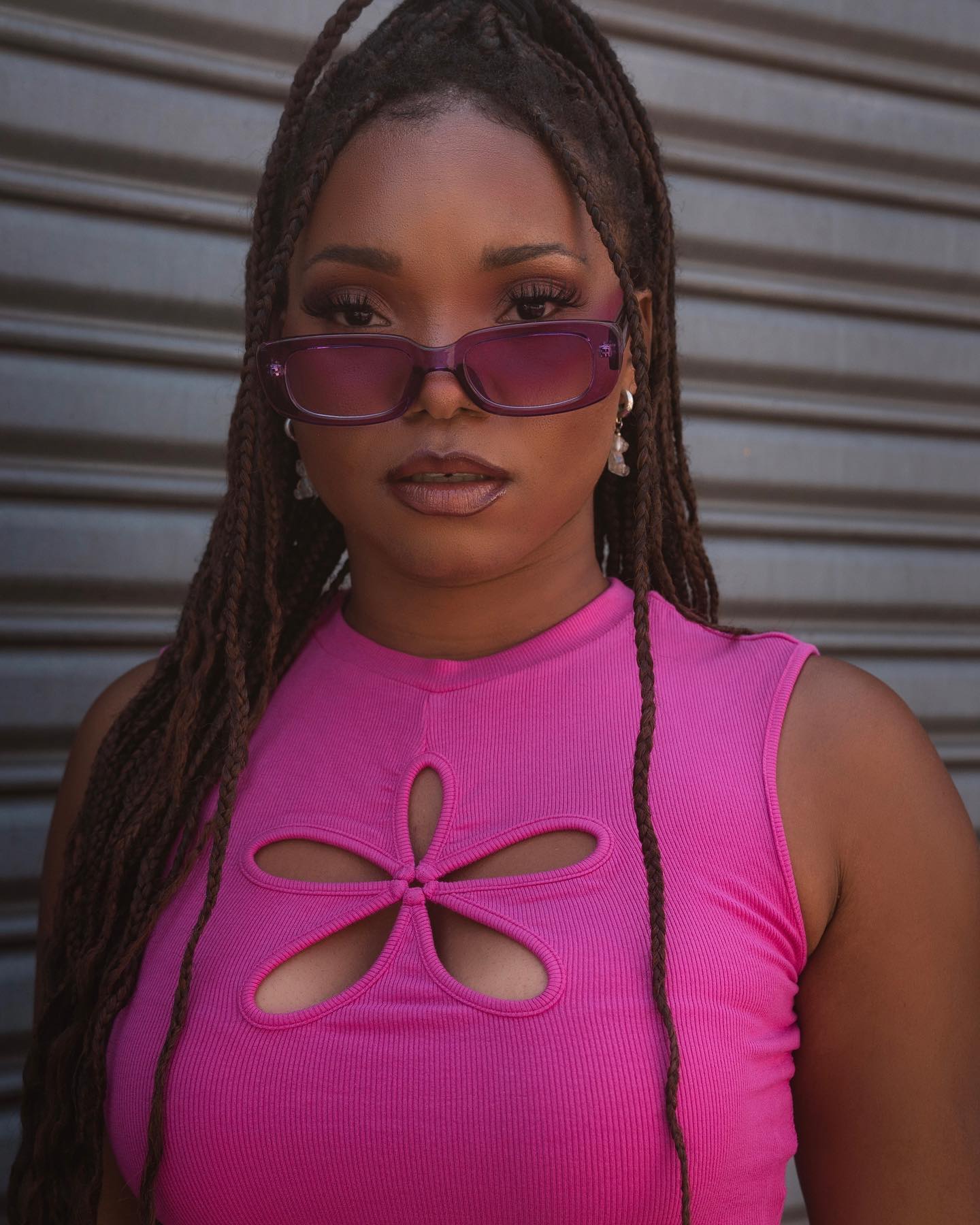
Charmeé Taylor is a creative powerhouse, bringing fresh takes on relationships, bi representation, and later-in-life coming-out stories to the forefront of TV and film. She is also the creator of the popular social media page Bi Astrology and the author of Confessions of a Bisexual: An Interactive Memoir for Baby Gays(2021). Bi.org sat down with Charmeé to get the inside scoop, from her own coming out journey, to building an amazing online community, to understanding that she is “queer enough” — and she didn’t disappoint.
Hi Charmeé! It’s so nice to meet you. Thank you for taking the time to speak with us.
CHARMEÉ TAYLOR: Hello! Thank you so much for having me. I’ve used Bi.org for my own personal research — looking up characters, actors, and shows. I feel like Bi.org has been such a resource for me, I feel so honored to be here. The fact that I get to give back with this interview and yap about being bi — I’m thrilled and elated.
In your book, you share your incredible, unique — and even a little wild — coming-out story. Could you tell us more about that experience and what it taught you?
Coming out is often framed in movies and TV as this grand moment, where everybody applauds and goes, “Wooh! Go Charmeé, you’re out!” That did not happen at all. I think coming out is very nuanced for every person. As a black femme, my journey was a rollercoaster. There were moments when I was excited to tell my family, like when I sent them an email saying, “Hey, I’m coming out. I’m queer. I don’t know what that means for me, but we’ll figure it out together.” It also was a lot of coming out to friends.
But it was also exhausting. It felt like something I had to do repeatedly — I had to constantly come out, over and over again. And then I got to a place where I was like, “You know what? Coming out is such an emotionally exhausting experience where I’m trying to answer questions I don’t have answers for.” I truly don’t. Still to this day, many of the things people ask me I really don’t know. Like, “Will you marry a man, a woman, a non-binary person?” I don’t know! I don’t have the answers. I don’t have a Magic 8 Ball of Wisdom. So yeah, coming out was very nuanced and there were lots of awkward conversations. I’m happy that I came out, but it made me realize that no one should feel pressured to come out. Not everybody has to come out if they don’t want to. Staying in the closet or coming out should be your decision.
You run Bi Astrology, an Instagram account blending astrology and the bi community. How did you get the idea for this unique fusion?
So when I first came out, I had a friend who was super into astrology, and it was really cool to understand my queerness through the lens of astrology. I found it interesting and important because, at the time, she was helping me to understand things that I’d only thought about when I was a kid. So it was fascinating to see how astrology could intertwine with my life.
The more I understood astrology, I started realizing, “Wow, this is really helpful.” But more than anything, I think the coolest part is that astrology is like a language. It’s truly and deeply a language that brings queer folks together — particularly bi folks together.
This is the way in which I met so many friends. I built my community. I started using it at queer events as an icebreaker. I’d say, “Hey, I’m a Scorpio with a Leo moon.” And they’d be like, “Got it! I’m a Leo with a Scorpio moon.” It turned into this incredible resource for forming a community.
I thought it was going to turn into this whole other thing where I could, like, “read the future.” But actually, it turned into this really good resource to build community, break the ice, and go to queer events where you could easily connect with people around, “Hey, what’s your zodiac sign?” So it’s been great to intertwine my queerness with my love of astrology, and learning and understanding new people.
Do you think astrology helped with your coming-out process?
I’m not sure it helped me come out directly, but it definitely supported the journey. Coming out isn’t a one-time thing — there are layers to it. Astrology helped me navigate those layers and build community. It made the process feel special and meaningful.
How did you realize that sharing your bisexuality online could have such a powerful impact on others?
After I came out, like I said, there were all these journeys that needed to happen afterward. I also started dating, and I had some crazy experiences. Like going to cabins in the woods with a hot girl that I had a huge crush on and met on a dating app, which turned out to be this really wacky story. All sorts of things like that began taking place.
I started sharing these personal stories online, which I thought were very specific experiences. Like not knowing how to flirt with women after being used to cis men chasing me. At queer events, I’d just stare at people, unsure how to start conversations. When I shared this online, people related to it. And turns out other people who are queer are also starting to figure out their flirting strengths and weaknesses. And it was a really cool thing to understand and explore online. I thought these experiences were unique to me, just some girl from Pennsylvania, but they weren’t — a lot of people related to it, which was really cool to see.
Like me!
Like you, exactly.
It’s so fun and refreshing to see astrology and bisexuality combined in your content. And as a fellow Scorpio, I really identify with the way you think. Can you give us a quick rundown of how different signs express themselves as bi people specifically?
Yes, I can. I think astrology and bisexuality are so fun and liberating. My favorite thing is to think about how the signs are affected through bisexuality. Okay, so there’s 12 zodiac signs. And they’re split up between earth, water, air, and fire.
I think fire signs are these big, boisterous energies. They need to let go of energy, whether that’s physical, whether that’s talking loud, or telling great stories. The fire sign bisexuals are those big, front-facing personalities. They’re for the plot. They do things for fun and adventure. They’re the adventurous bisexuals.
The earth sign bisexuals, I would say, are certainly the comfy, cozy ones. They like to grab a heating pad and snuggle up. And they’re the ones that are community building on the inside. You can have that one-on-one connection with them, in a way that’s meaningful, feeling like we’re really drilling down and getting into the nuances, because we feel at ease and comfortable with them.
The air signs are the ones that are thinking outside of the box. These are the ones that are thinking outside of monogamy, heteronormativity, and even homonormativity. They want to burn everything down to the ground and then build it back up.
And then my favorite, water sign bisexuals — I’m biased. The water sign bisexuals are going to dive deep into the emotionality of bisexuality. What does it mean, what does it feel to be a bisexual in the world? I’m a Scorpio, I love talking about the taboos of the emotionality of being bi. I think it pushes our bi community forward, because we’re really processing it. We’re all diving into the emotions of being bi.
What’s something surprising you’ve learned about your followers since you started creating content?
My followers are so smart! They feel almost like intelligent friends. They understand the nuances of TV, film, and queerness. I’ve met many of them at Pride and other queer events, and it feels like meeting old friends. We kiki all the time about the nuances that I think up late at night. More than anything, I think my followers are really diverse, really hot, and really cool. They’re people who just understand that sometimes in the world, we don’t get it, we don’t understand it, but we’re willing to fight.
Bisexuality is so rich. There’s so much culture in being bi. And my followers are like, “Let’s dive deep into the taboos of why this is important and how this affects our worldview.”It’s truly amazing.
In what ways do you think social media has changed the way young people experience and understand bisexuality?
I think accessibility is really important. I think people are able to understand that there’s queerness outside of their bubbles, which is really ironic because I didn’t have those things. Maybe the first person I ever understood to be bi was the reality TV star Tila Tequila* who was a menace on VH1. She really made me feel like being bi was this promiscuous, unhinged, drunk, sloppy, messy thing. Which, to be honest, sometimes that is also me! But I think that because people, particularly Gen Z, now have access to look at different representations of bisexuality, they don’t only have reality TV, they have access to bi series, films, books, video games, social media, and more.
It’s exciting to be able to see and be a part of it. Accessibility is the number one thing, especially for bi people. There’s a lot of discourse online, but bi people are more than that. We are human beings with backgrounds and shades of gray — and that’s important and beautiful.
To me, “baby gay” is about embracing the unknown — really understanding that you don’t understand. And that’s okay. We are all socialized in this world to be heteronormative, to be cisgender, and to feel like we can only sit into this one box. “Baby gay” is liberating because it just says, “I don’t know what’s going on. And I’m willing to explore and figure it out.”
For me, embracing that journey was just extremely liberating. I thought I had to know everything. I thought I needed to know how to have queer sex, why to have queer sex, who to find, who I liked, and who I didn’t like. And so, “baby gay” to me means: Slow down. You don’t need to know all the things at once. You can just kind of explore it as it happens.
I tried to fight the term “baby gay” for so long. But the moment I embraced it, I was like, “No, I am a baby gay.” That was the moment when I was able to admit to myself that I don’t know what I don’t know. And that’s okay. In so many ways, I’m still such a baby gay. I feel like there are all these milestones I didn’t even know I would get to — like being in my first relationship with another woman. I’m a baby gay when it comes to that. I don’t know what the heck I’m doing. And the fact that I can say that proudly feels really empowering.
Your interactive memoir has sections labeled as “Homework”, where readers have a dedicated space to reflect on their own journey. I love that there was a space for the readers to pause and think about the points that you were making. Where did the idea of doing an interactive memoir come from?
When I was building a following, I wanted a back-and-forth. I don’t like to be talked at, I like having a conversation, and I felt like the closest thing to a conversation in writing was having a space for people to process what they’re reading.
At the end of the day, I truly don’t know what I’m doing. And I want my followers and readers to know that. I want people to pause and think, “Hey, I don’t know what I’m doing either. But if I take a moment maybe that’ll be helpful in understanding myself, and adjusting whether or not this even applies to me.” I just wanted people to be able to interact and not just be spoken to.
I really liked the part where you said, “You’re going to be a co-author of this book.” I was actually already reflecting on the stuff you were going to ask on the homework before I even got to the homework.
Yes, exactly. I love it.
In your book, you talk about not feeling queer enough and not having to meet anyone’s expectations of what bisexuality means other than your own — which I found really beautiful. Could you tell us more about that?
I thought for a long time that queerness looked one way. I tried to fit a circle into a square over and over again. I genuinely was like, “I can do this. I can drink cold brew and have a girlfriend and a dog.” I thought that that’s what I needed to look like.
I went to queer events and felt lost. I didn’t fit in at all. I thought that meant I wasn’t queer enough. I realized that my queerness looked different. I’m black, I’m femme. Those are a part of my identity. When I started embracing the fact that I have these markers that are a part of my story, that’s when I really started being able to embrace that I am queer enough. “Queer enough” is defined by you, and it’s ever-changing and fluid — just like bisexuality.
In your writing, you mentioned writing a letter to your future self. Let’s turn it around a little bit. What advice would you share with someone navigating their own process of self-discovery, whether they’re just beginning or coming out later in life?
I would say don’t compare your journey to anyone else’s, define your world by what you need, and build community. A lot of people, especially in queer settings, tend to center dating: who they’re interacting with, who they’re hooking up with. Sometimes people think queerness is heteronormativity, but with gay people. That’s not what it is. I think for me, queerness has looked like building my community and researching what queer history has happened before me. Queerness takes many forms.
I would highly encourage people who are just understanding their queerness to do some research, and really understand what bisexuality means. Research people who have come ahead of you. I researched a bunch of black queer people in the 40s, 50s, 20s, etc. It made me feel so anchored in my queerness because we have lived and outlived this wave of people not accepting us. If we’ve done it in the past, we can absolutely do it in the future. Bi.org has been such a resource for me — it’s cool that this feels very full circle.
Can you talk to us about some of your future projects?
There are so many! I’m currently writing and researching for a one-woman show, which I’m so thrilled about. I’m also putting together some really cool resources to help people get involved in the community. It’s been so fun finding out what people are doing to build their communities in different cities. I’ve just been doing a lot of writing. I have a Substack right now, which is really exciting, it feels like a journal. Lots of writing, lots of performing in the future.
Where can people follow you?
People can follow me at @bi_astrology on Instagram. I also have a TikTok — it’s popping on TikTok — at @charmeeifyoudare. That’s where I get a little bit more intimate about things that are happening in my everyday life. It’s really fun on TikTok as well.
*Tila Tequila came out as bi in 2007. She later identified as a lesbian, and many years after that said that she was straight.
** This interview has been edited for clarity and length.