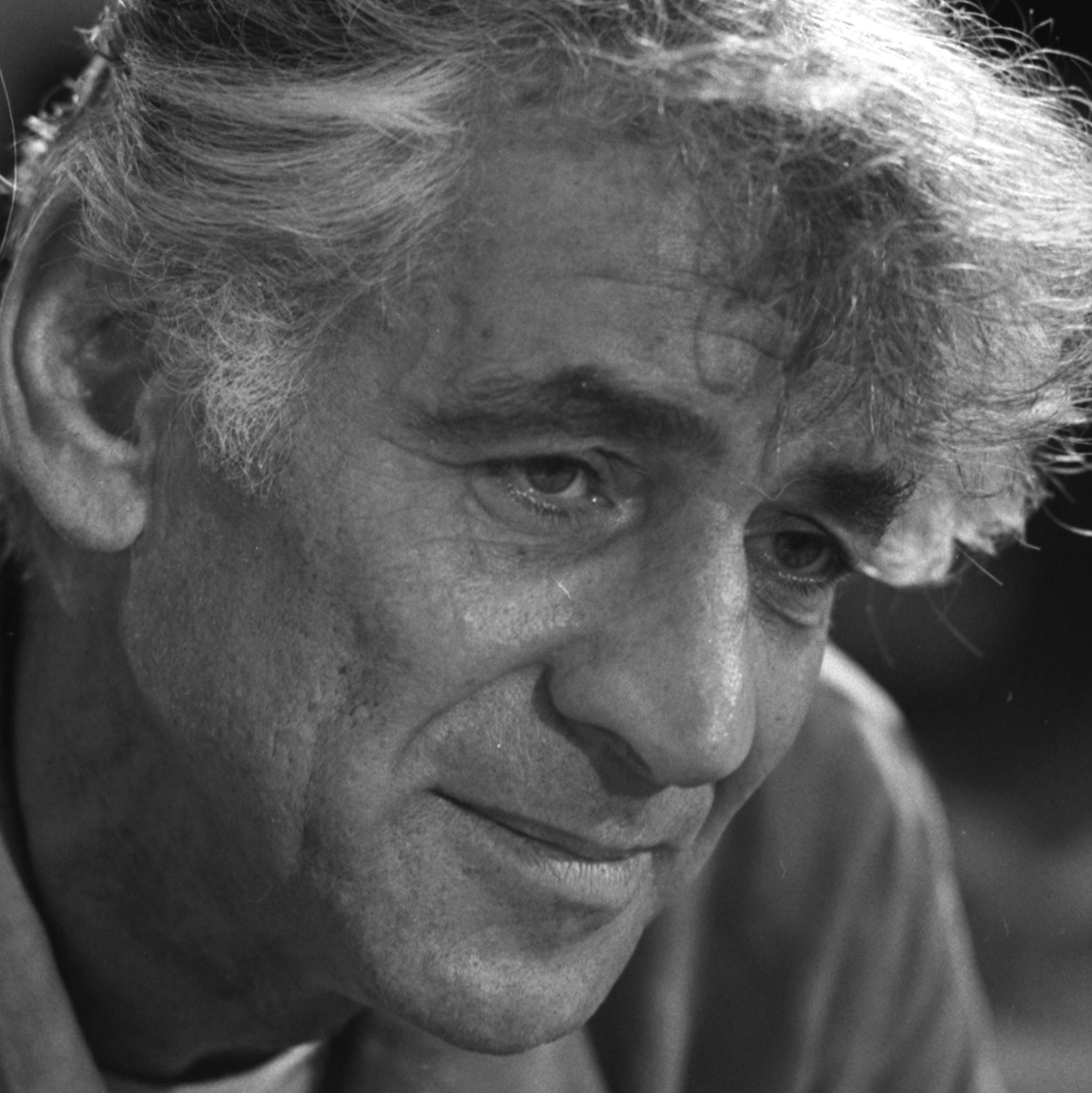
Leonard Bernstein, born Louis Bernstein, was an American composer, conductor, musician, music educator, and television personality. He was among the first conductors born and educated in the US to receive worldwide acclaim.
Born in 1918 in Lawrence, Massachusetts, Bernstein grew up in a Jewish household with immigrant parents from a region of the Russian Empire that is now Ukraine. Bernstein was named Louis at the behest of his grandmother, but was always called Leonard by his parents, and legally changed his name to Leonard at age 16.
Bernstein’s introduction to music came primarily through the Friday night services at his local synagogue, where the progressive rabbi incorporated organ music and a choir into the prayers — a large departure from traditional Jewish worship. Bernstein also described the synagogue’s cantor (who leads the prayers) as having had such a good voice that he could have been an opera singer. At age 10, Bernstein’s aunt moved her piano to their home, and young Leonard took to it at once, receiving lessons and quickly becoming skilled, though his parents had misgivings about their son’s interest in music. In the end, they came around, taking Bernstein to orchestral concerts and supporting his pursuit of music as a profession. Leonard’s first public performance was in 1934 when he was 13 years old, playing Brahm’s Rhapsody in G minor on the piano at the New England Conservatory of Music. Bernstein went on to attend Harvard University, where he also studied music. Soon after graduating, he moved to New York City in search of his big break, which came in 1943.
Having become the assistant conductor for the New York Philharmonic, Bernstein was notified that the leading conductor had fallen ill the morning of a performance. With only hours’ notice, Leonard filled in, conducting the orchestra so well that the performance made front-page news in the New York Times. He went on to become the music director of the New York Symphony, and traveled globally as a guest conductor for some of the world’s leading orchestras. A talented pianist, he became known for sometimes conducting piano concertos from the keyboard.
In addition to conducting, Bernstein also became a highly accomplished composer. Some of his best-known works include the Broadway shows On the Town, Peter Pan, Candide, Wonderful Town, and the Tony Award-winning West Side Story — later the Academy Award-winning film in 1961 (and remade by Steven Spielberg with the same musical score in 2021). Bernstein also wrote the musical score for the classic film On the Waterfront, starring Marlon Brando, as well as standalone works such as Mass.
Not only was Bernstein a trailblazer as an American composer, but he also became an ambassador of classical music to the American public. He was the first conductor to give a series of television lectures on classical music, starting in 1954 and spanning the rest of his life. He hosted the television program New York Philharmonic Young People’s Concerts and made many media appearances to help popularize and educate the public about orchestral music.
In 1951, he married the actress Felicia Cohn Montealegre, and the couple had three children together. Their marriage was, for the most part, a happy one. They hit some rough patches during the latter years, leading to a separation, but when Felicia was diagnosed with lung cancer in 1977, Bernstein dropped everything to move back in and nurse her.
Prior to his marriage, as well as during and after, Bernstein had sexual relationships with many men. At one point, his friend Shirley Rhoads Perle said, “he required men sexually and women emotionally.” His children describe him as having been bisexual.
Over the course of his career, Leonard Bernstein won 16 Grammy Awards — including 63 total nominations and a Lifetime Achievement Award — as well as seven Emmys, two Tonys, and an Academy Award. His works remain celebrated, studied, and reproduced to this day. Most recently, he was portrayed by Bradley Cooper in the 2023 biopic Maestro, which made Bernstein’s bisexuality one of the central focuses of the story.