The Color Purple is a musical film based on the novel of the same name by Alice Walker, which won the Nobel Prize in Literature and was the first time a black woman won that particular honor.
The musical, which originated on Broadway in 2005 with a 2015 revival, features music and lyrics by Brenda Russell, Allee Willis, and Stephen Bray. The musical was adapted into a screenplay by Marcus Gardley and directed by Blitz Blazawule. Of particular note is that many major players in the 1985 adaptation were on hand as executive producers, including Oprah Winfrey (who played Sofia), Steven Spielberg (who directed the 1985 adaptation), and legendary music producer Quincy Jones. Whoopi Goldberg, who starred in the 1985 adaptation as Celie, cameoed in the 2023 version as a midwife.
The Color Purple focuses on the life of Celie (Fantasia Burrano), a black woman in rural Georgia in the early 20th century, as she navigates the hardship pushing through thanks to the transforming power of love and community. Much of the story follows Celie, enduring a massive amount of abuse and servitude from the men in her life, from her purported father to her husband, Albert “Mister” Johnson, and even from Mister’s grown children.
When she first comes across a picture of Shug Avery (Taraji P. Henson), a blues singer and Mister’s longtime mistress, she shows fascination and then infatuation with her. This blossoms into an insinuated sexual relationship between the two, as Shug makes out and dances suggestively with Mister while also flirting with Celie until they kiss.
The kiss occurs at the end of a fantasy duet between the women titled “What About Love?”. It then transitions to the next scene where Shug and Celie wake up in the same bed. However, while Shug eventually dedicates a song to Celie, “Miss Celie’s Blues”, claiming Celie wrote it for her during a bath, she eventually marries a man.
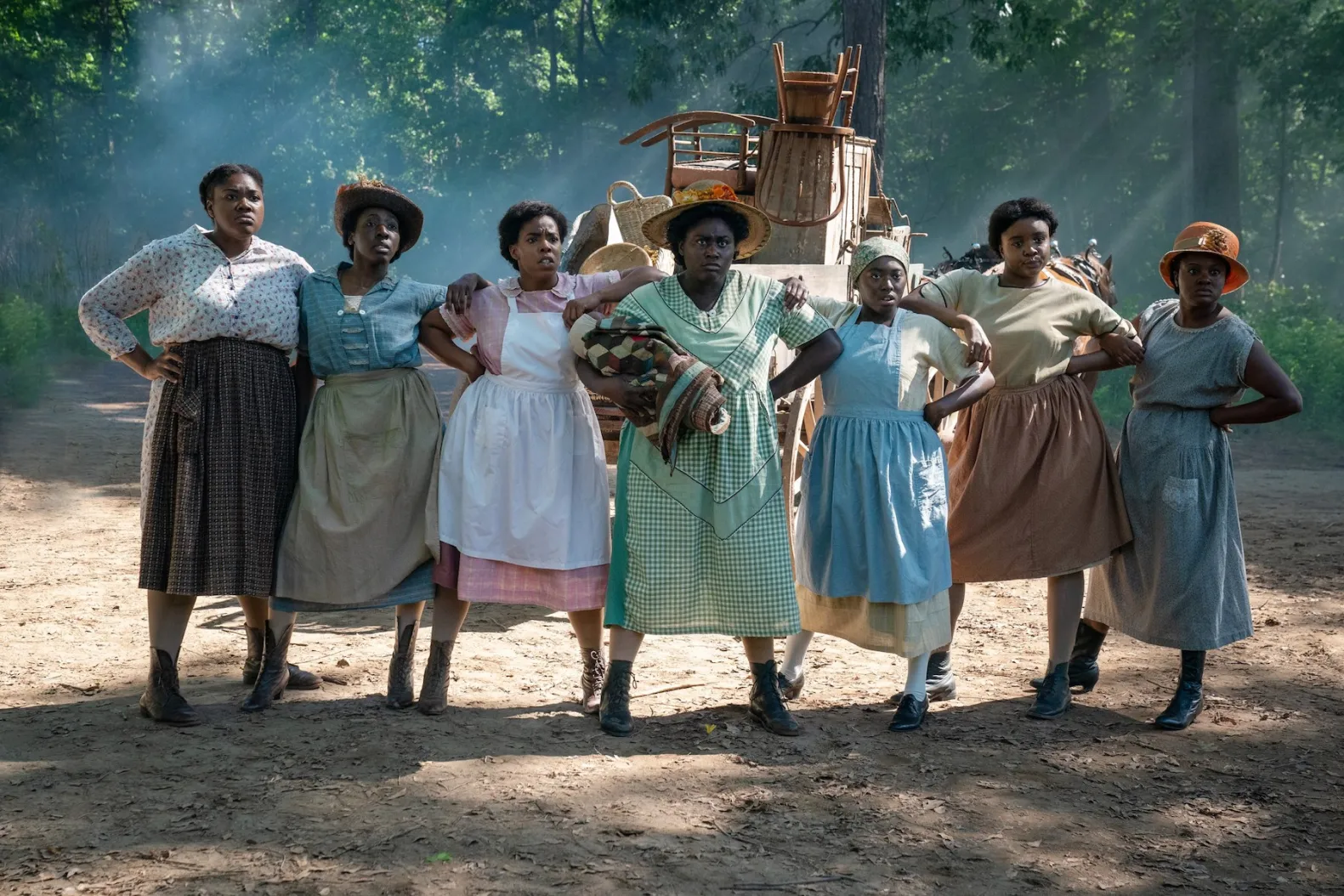
While neither Barrano nor Henson have expressed being any flavor of queer publicly, other queer creators of the project have had surprisingly disparate opinions on whether the film goes far enough to flesh out the love story between Celie and Shug. Actress Aunjanue Ellis-Taylor, an out bi woman who plays Celie’s mother, mentioned in an interview with US Weekly that the film does a disservice to black queer representation (though she gauges Shug and Celie to be lesbians rather than bi or queer women).
The Color Purple is a book about black lesbians. Whether the choice was made to focus on that or not in the cinematic iterations of The Color Purple, it’s still a movie about black lesbians. People can try to say the story is about sisterhood, but it’s a story about black lesbians. Period.
[…] I just want that part of the book to be portrayed in the films with intention, instead of it being incidental. I want people to walk away from The Color Purple thinking, ‘I just saw a movie about black lesbians.’ I don’t think that has happened.
On the other side of this argument, in response to Ellis-Taylor’s remarks, Walker noted that she was satisfied with the treatment of her characters in the film 2023. From ScreenRant, quoting Walker from The Hollywood Reporter:
I really love it that [audiences] have to take away the reality that Shug and Celie become lovers, because I think that we have really needed help there. We really needed to see that love is love. You know, that people love whoever they love, and it is their right to do that.
In conclusion, while it is pretty clear from this interpretation of the novel that Shug is bi, The Color Purple does a better job than the 1985 adaptation on the bi rep front and even seems to satisfy the authorial intent, but many in the LGBT community feel it could still have gone further.