Stranger Things is a sci-fi series created by the Duffer Brothers for Netflix. Premiering in July of 2026, the show is mainly set in the fictional town of Hawkins, Indiana, spanning 1982-1989. It centers on a group of kids and their families and friends whose lives are changed after supernatural entities connected to an alternate universe known as the “Upside Down” is discovered. The show draws mainly on 1980s pop culture, cinema, and other cultural references, blending horror, science fiction, and coming-of-age storylines that align with the era. With over five seasons, Stranger Things has become one of the most popular shows on Netflix — if not the most popular.
The first season establishes the central lore of the series following the disappearance of Will Byers in the first episode, “The Vanishing of Will Byers”. His potential kidnapping drives his friends Mike, Dustin, and Lucas to uncover secret government experiments, which leads to an encounter with Eleven, a young girl with psychokinetic abilities who recently escaped from Hawkins Lab. As Will’s mom, Joyce Byers, feels she is receiving signs from another dimension that could be her son trying to get in touch with her, town Sheriff Jim Hopper is put on the case, and accidentally uncovers a government cover-up connected to Hawkins Lab. As the season progresses, Will is revealed to be trapped in the Upside Down, haunted by a creature known as the “Demogorgon”. The season ends with a rescue mission, where Will is returned to his world, establishing that his connection with the Upside Down persists, even though Eleven sacrificed herself and closed the rift for what seems to be forever. However, it is later revealed that this may not be the case.
Although LGBT narratives are not explicitly addressed in the first season, Will is portrayed as sensitive, creative, and socially isolated at school. Moments such as classmates mocking him and his group for playing Dungeons & Dragons, Hopper asking if he’s queer to Joyce, and the constant playground bullying paint a broader picture as the series confirms his queerness in the last season.
Season 2 continues with the consequences of Will’s survival in the Upside Down. Starting a year after the last, we see Will suffering from epileptic episodes and visions, later revealed to be episodes where he gets possessed by the entity known as the “Mind Flayer”. In Episode 6 of the season, “The Spy”, it is revealed that Will is being used as a mole to observe and track Hawkins from the inside. This season also introduces a new character, Max Mayfield, whose arrival at school causes a rift between Mike and the rest of the party.
Will’s uneasiness with the opposite sex is starting to show more this season as well. While Mike, Lucas, and Dustin try to pursue romantic interests with the girls, he expresses frustration at being left behind. Meanwhile, Eleven is revealed to have survived the events of season 1 and is living in hiding with the help of Jim Hopper, now acting as her father figure. She explores her origins and who she is outside of Hawkins, leading her to escape the cabin where she is hiding and search for her mother, whom she believes is still alive. This results in her returning to Hawkins and helping fight the Mind Flayer and the “Demo-Dogs” before they attack the rest of the team.
Season 3 moves the setting toward the new Starcourt Mall in town, while introducing the Soviet and Cold War subplot that involves a secret Russian base beneath the mall, where a portal to the Upside Down has been opened, and the Mind Flayer returns in a new form, using bodies that have turned into goo to craft a new vessel. Meanwhile, Will remains emotionally sidelined. In Episode 3, “The Case of the Missing Lifeguard”, he struggles to connect with his friends, repeatedly attempting to play D&D while they pursue romantic relationships. Mike’s eventual outburst — accusing Will of “not liking girls” — is played ambiguously at the time, but gains explicit significance in later seasons. Episodes like “The Sauna Test” and “The Bite” help to up the stakes, resulting in the season finale confrontation at Starcourt Mall. This ends with the apparent death of Hopper and the total destruction of the mall. Eleven loses her powers and a father figure, and the Byers family moves out of Hawkins, adopting El as a member of the family. This season also highlights LGBT representation through Robin Buckley, Steve’s new coworker at Scoops Ahoy. In Episode 7, “The Bite”, Robin comes out as a lesbian to Steve after escaping the Russians and surviving a torturous interrogation.
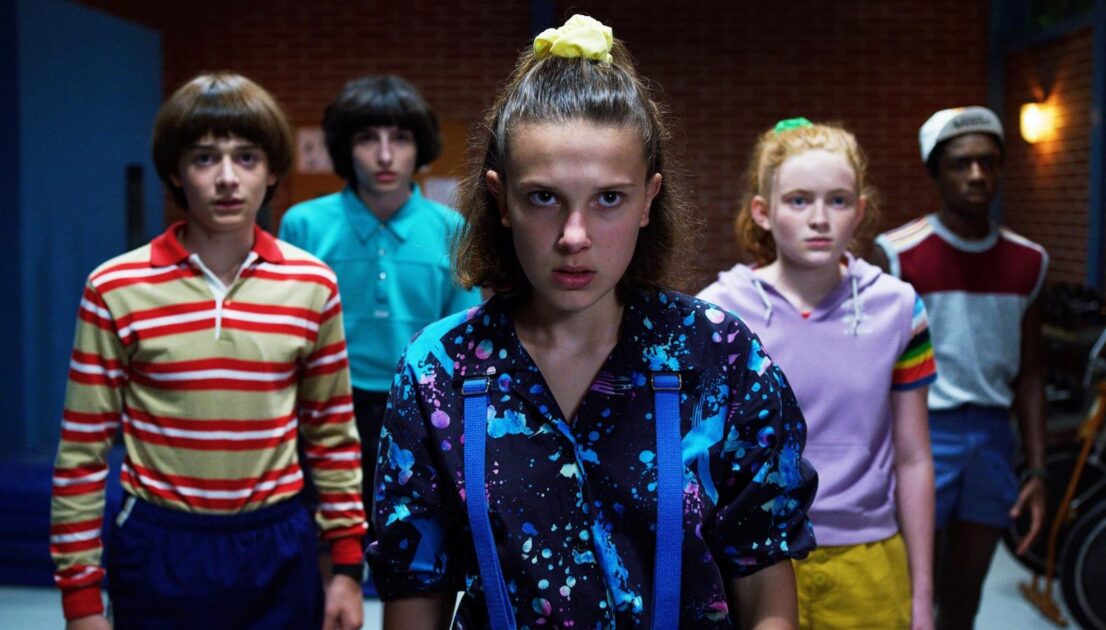
At the start of Season 4, the plot expands and splits between California, Russia, and Hawkins. In Hawkins, a new bad guy known as “Vecna” begins killing teens after hijacking their minds and using their trauma against them, starting with the death of Chrissy Cunningham in Episode 1, “The Hellfire Club”. Hawkins becomes a breeding ground for misinformation, referenced as “Satanic Panic”, culminating with everyone blaming social outcast and rebel Eddie Munson, now believed to be behind the murders due to “The Hellfire Club” being mistaken as a cult. As the team investigates these deaths, it leads them to look into the Creel family and the true nature of how the Upside Down came to be. Meanwhile, in California, Will, El (now going as Jane Hopper), and Jonathan are attending a local high school, where they are social outcasts and “losers”, getting picked on by the populars. Episodes like “The Nina Project” and “Papa” depict Will struggling to express his feelings for Mike, ultimately delivering an emotional monologue under the guise of speaking for El. His painting of the group as heroic figures becomes a metaphor for both love and longing, positioning Will’s sexuality as central to his emotional survival and that of the gang.
Vickie Dunne (Amybeth McNulty) is introduced in this season as a student band member at Hawkins High. Though initially a background character, her presence becomes more relevant through her interactions with Robin, who likes Vickie. Vickie is shown to have a boyfriend, a detail that establishes her bisexuality once she begins reciprocating Robin’s advances. Her introduction mirrors the series’ pattern of integrating queer characters through everyday settings. Season 4 ends with Vecna partially victorious, opening rifts across Hawkins in Episode 9, “The Piggyback”. The town is physically and psychologically broken, setting the stage for the final season, and with the gang reunited after Eleven restores her powers and travels back to Hawkins with Mike, Will, and Jonathan to help their families and friends fight Vecna.
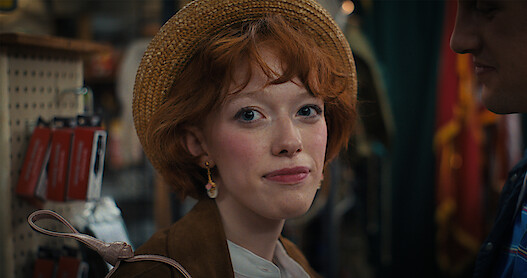
Season 5 opens after an 18-month time-jump, as we see Hawkins invaded by the military after the events of Season 4. The supernatural events are passed off as a deadly earthquake, but the audience and the group know the truth. Supernatural threats are no longer hidden, and the town’s survivors operate in a world permanently altered by the Upside Down, while also being closed off from the rest of the world, as the military has established a “quarantine” on the town and fenced off its perimeter.
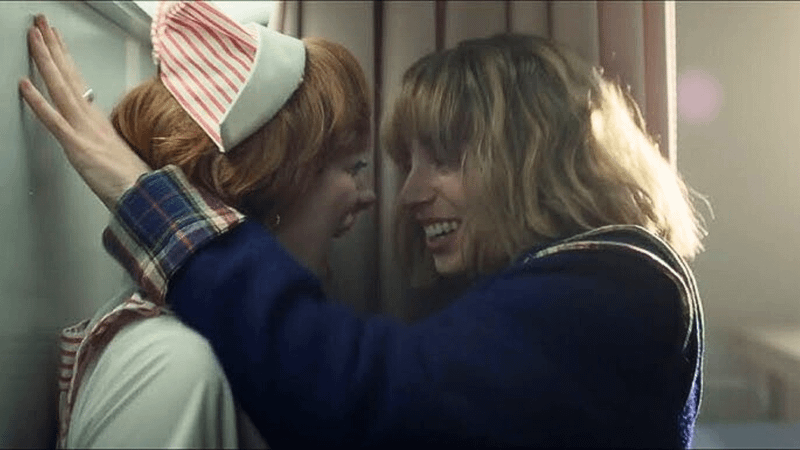
Robin Buckley and Vickie Dunne are already established as a couple at the start of the season, with little fanfare and no clear indication of how long they’ve been together. In Episode 3, “The Turnbow Trap”, they share a kiss in a hospital room, as Vickie is a “Candy Striper” volunteer. Unknown to Robin at the time, the kiss is seen by Will, who makes a noise; Robin then notices him and sees his bowl-cut head run away.
Throughout Season 5, Will’s connection to Vecna deepens as he becomes a key part of the group’s strategy to locate and stop him. His emotional struggles, long rooted in isolation, are now addressed openly with his friends, who offer support. His talk with Robin about embracing their sexuality is key as well, as this helps Will battle Vecna and unlock his sorcerer powers.
Vickie appears regularly alongside Robin across the season, establishing their relationship through shared scenes and physical affection. However, her role remains largely confined to Robin’s orbit, reflecting the series’ approach to bi representation as canon, but not explored beyond the initial on-screen confirmation.
The series finale prioritizes an emotional closure for the core group and the permanent destruction of the Upside Down, with the implied death and sacrifice of Eleven, which devastates everyone. While Will’s arc receives explicit resolution, Vickie’s remains implied. Her absence from the epilogue suggests the limits of the show’s investment in secondary queer characters, even as their identities remain canon in the narrative. Across its five seasons, Stranger Things evolves in both scale and representation. Will Byers’ journey offers one of the most sustained depictions of a gay character growing up under extraordinary circumstances, while Vickie’s represents bisexuality that is normalized but narratively closed off. Together, these arcs position Stranger Things as a series that incorporates LGBT identities within its world, even as it prioritizes supernatural mythology and ensemble storytelling over full exploration of every queer character it introduces.