Daniel Molloy is one of the recurring characters in The Vampire Chronicles, written by American queer author Anne Rice. He’s played by Christian Slater in the 1994 Interview with the Vampire film adaptation, and by Eric Bogosian and Luke Brandon Field in AMC’s Immortal Universe (from 2022 to the present).
In the books, Daniel’s story begins when he’s a nameless young journalist in the first novel, Interview with the Vampire. He’s “the boy” who interviews the main character, Louis de Pointe du Lac, and begs him for immortality.
We learn nothing about his sexual orientation or personal life in the first two novels of the series. It is only in the third novel, The Queen of the Damned, that the nameless boy-journalist finally becomes a point-of-view character in one of the most popular chapters in a whole series: “The Story of Daniel, the Devil’s Minion, or the Boy from Interview with the Vampire“. This chapter tells the story of a years-long, obsessive, and unusual relationship between Daniel Molloy and the vampire Armand and is arguably one of the first and most iconic romantic stories about two bi males in Gothic literature.
In The Queen of the Damned, Daniel is found by Armand, starved and exhausted after attempting to track down another bi vampire, Lestat, to ask him for the Dark Gift. This marks the beginning of their long and complex relationship, in which Armand follows Daniel across the globe before eventually accepting him as his beloved. The chapter ends with Daniel’s transformation into a vampire. During this story, Anne Rice makes both Daniel’s and Armand’s bisexuality obvious, particularly in the following passage, which also highlights the obsessive nature of Armand’s love:
Men and women fell in love with Arman, of course – ‘so innocent, so passionate, so brilliant!'” You don’t say. In fact, Armand’s power to seduce was almost beyond his control. And it was Daniel who must bed these unfortunates, if Armand could possibly arrange it, while he watched from a chair nearby, a dark-eyed Cupid with a tender, approving smile.
Daniel is one of the characters in the Chronicles who is depicted as having bi relationships before becoming a vampire.
However, it was lost in the first adaptation. In the 1994 film Interview with the Vampire, where Daniel is played by Christian Slater, we learn almost nothing about his sexuality, probably because it was made very close to the first novel.
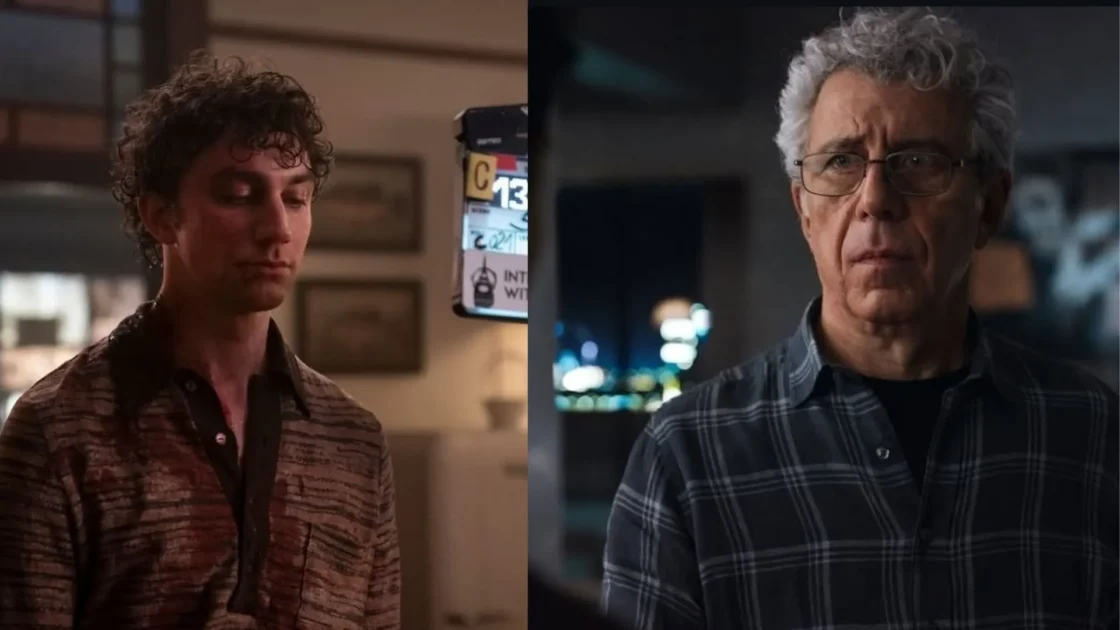
But the AMC series expands his role in the story and brings the main interview itself into the present time to reflect a contemporary social context, and makes the story more “modern”. In the show, we encounter two versions of Daniel. The older Daniel is a cynical, sharp, and clever man. He is a brilliant investigative journalist who’s now at the end of his career. He agrees to revisit his interview with vampire Louis fifty years after their first meeting and travels to Dubai to meet him. The younger Daniel (Luke Brandon Field), is portrayed as an aspiring young journalist, a poor youngster who’s struggling with drug addiction but trying to document unusual stories. In the series, Daniel is explicitly bi. Older Daniel identifies himself as bi, mentions that he has been married to women twice and divorced twice in the very first episode of the show. He speaks openly about having dated both men and women in the past. He treats the queerness of vampires’ relationships as something absolutely natural, despite having grown up in a less accepting time. Daniel is not using the word “bi”, but says that he is attracted to both men and women.
The younger Daniel can be read as a “bi boy next door” — a queer young man navigating a relationship with a dangerous and devoted partner. This dynamic may be interesting to some young bi readers. His storyline in the novels also reflects struggles with mental health and addiction, issues that can resonate with real-life experiences of bi youth.
In contrast, the older Daniel in the TV series offers a different bi representation: a successful bi man later in life, with an established career and a future — something that is still relatively rare on TV, where older bi people are invisible or portrayed as miserable folks who regret their life choices and who are obsessed with biphobia. This is why Daniel is a meaningful example of bi representation.