Hey there, my bi cinephiles! Have you ever been at an event that looks picture-perfect but was roiling with drama beneath? Like eavesdropping on a beautiful couple sitting nearby at a restaurant, then one says, “What am I to you?” and you’re locked in to hear what happens next? I was thinking about that type of situation while watching the indie romantic drama, Other People’s Bodies. But what does any of that have to do with bisexuality? Let’s find out together.
But first, a few important disclaimers. First and foremost, there will be major SPOILERS for this 2025 independent film, so forewarned is forearmed. Second, I should note some content warnings, including but not limited to: cheating, brief violence, and medical trauma. Also, if you’re not familiar with The Unicorn Scale — or just want a refresher — check out our rating metric here.
All set? Good. Let’s (swan) dive in.
Other People’s Bodies is a bi, loose reimagining of La Piscine, a psychosexual drama and French New Wave classic. Singer/programmer Seb (A.J. Shively) is married to retired ballerina Olivia (Annie Parisse). When Olivia is informed she may have multiple sclerosis, she calls Mateo (McKinley Belcher III) after a long estrangement to invite him and his boyfriend Zaki (Jasai Chase Owens) to make amends at their upstate New York house.
As the days roll on, desires and resentments begin to surface. The plot’s main concern is Seb’s past with both Mateo and Olivia. Years before, Mateo was hired to choreograph a queer opera Seb sang in, and the two men began dating. When Olivia returned from a dancing tour, Mateo asked her to come hear Seb sing, and Seb left Mateo for Olivia. Until this weekend — nearly a decade later — the trio haven’t spoken since that betrayal. But new trouble is brewing when an attraction crops up between Seb and Zaki.
What I Liked:
What I appreciate most about Seb’s portrayal is that he feels like a fully realized character, rather than someone defined solely by his bisexuality. Though the reveal of Seb’s bisexuality takes its sweet time (the screenwriting is almost all pregnant pauses punctuated by terse, charged dialogue), Seb is a more developed bi character than we normally get on film. He is a playful flirt with Olivia but also an excellent caretaker and medical advocate for her—helping with sick days, taking her to doctor appointments, and supporting her in low moments while she awaits her diagnosis. The film also showcases Seb’s talents as both a programmer and a singer/guitarist. He’s funny and smart, engaged and engaging.

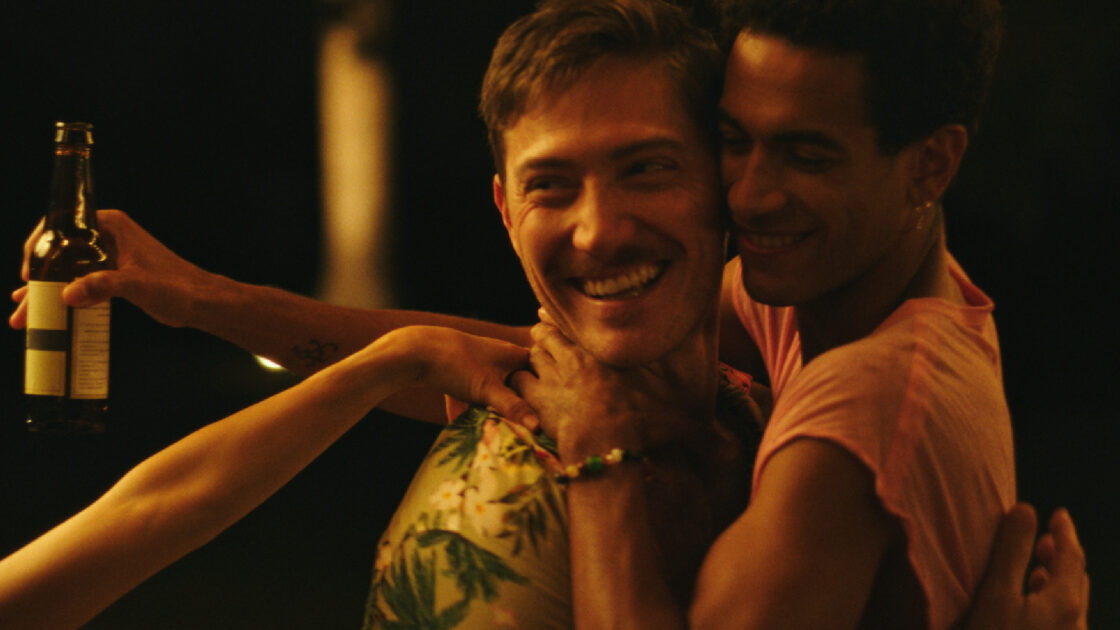
There are a few other things I liked about Other People’s Bodies: for one, the bisexual gaze is heavily at play, with tons of time dedicated to following the hungry gazes of multiple queer characters to multiple genders and lingering shots on charged touches.

Also, although the film is a loose adaptation of La Piscine, there is distinctly no murder in the pool. That may seem strange to point out, but in La Piscine the pool murder happens in the middle of the story, and then the rest of the film is about whether the murderer gets found out. So to instead have the pool confrontation be at the climax of this movie but still not kill anyone seems a deliberate choice from writer/director Alan Brown to ensure the typical plot point of killing off queer characters is totally removed from the narrative. Instead, we get a surprisingly happy, dance-filled ending for the whole cast. Now that is as refreshing as a summer dip in cool waters.
What I Didn’t Like:
Yes, Seb apologizes for cheating on Mateo. But that doesn’t mean he learned his lesson. At first, Seb turns down a pass Zaki makes. But in a second scene, it is strongly hinted that Zaki’s second pass was successful: the two men arrive back at the house from a run extra sweaty, give vague answers, and playfully follow each other into the house to get some water. Now I’ve seen the film three times, and there is plausible deniability that Seb cheated, but it’s heavily implied they hooked up on their run.
This entanglement comes under fire in the climactic pool scene. As Seb tries to get a drunk Mateo back inside, tensions escalate when Seb shoves him into the pool. Seb then asks where Zaki is, prompting Mateo to suggest that Zaki must be with Seb because the two had slept together. Mateo then bitterly remarks that Seb doesn’t do that anymore, alluding to their own past relationship.
And that’s the crux of the fight. No, Seb doesn’t rise to the bait and confirm he had sex with Zaki. What pushes him to fight with Mateo is bi erasure from a previous lover. Anyone who’s gone through this slight knows how hurtful it is. Honestly, this part of the film was lost on me during the first viewing due to a lot of technical factors — Mateo’s slurring makes it very difficult to understand him, and the sound design is loud enough to drown out this crucial dialogue. It was only while rewatching with subtitles that this part clicked — which is heinous considering it is what drives the emotional climax of the film.
Now, I am not a fan of Seb’s cheating whatsoever. That characteristic is one of the major flaws often assigned to bad bi or villainous bi characters. I am not condoning it. However, the world of Other People’s Bodies lives in an ethos of vagueness or less strict rules than a typical film, with a lot of questions going unanswered. We never find out if Olivia gets a diagnosis. There are flirtations and fondling across multiple marriages, not just Seb’s. And Zaki gets upset at Mateo for hinting he and Seb had a past despite the fact Zaki made a pass at Seb earlier that very day!
It seems the main conflict is clearing the air between Seb, Mateo, and Olivia, and the film accomplishes that in an unusual and surprisingly tender way (I don’t usually apologize whilst lying naked next to a former lover after a knock-down, drag-out fight in a pool). The film even ends with everyone dancing on a patio at night while surrounded by sparklers — it’s very “all’s well that ends well.” But the story only answers the questions it wants to. As a viewer, that left me unsatisfied, like Brown was trying to have his bi cake and eat it, too.
Also, use “bi”! Filmmakers, it’s okay to use the label — especially when the whole damn story hinges on the importance of Seb’s bisexuality!
The Rating:
By most measures, Seb isn’t a paragon of great bi male representation, and by the end of this film’s intense weekend, the characters feel resolved and content, despite being pretty damn messy all around. Casual queerness is common and accepted by pretty much everyone in this friend group without much of a “discovery” storyline, which is great to see. The conflict comes less from orientation and more from conduct (but even that seems murky or hypocritical at times). For me, the film almost sticks the landing, but falls just short. I would have given it half a unicorn more if someone, anyone, had used any term under the bi umbrella — I’m OK with having complex bi representation, but let’s call a spade a spade.
Despite looking like it is an inviting pool of deceit and delights, Other People’s Bodies doesn’t dive into the depths I thought it would. But it certainly makes a splash along the way.