The Good Vampire’s Guide to Blood and Boyfriends is a young adult paranormal rom-com written by American queer author Jamie D’Amato. Although the novel isn’t an actual guide, the storytelling is excellent. It’s a love story about a human falling in love with a brooding, lonely vampire. Sounds familiar, doesn’t it? It draws on many classic vampire tropes from stories like Twilight and The Vampire Diaries. But Brennan Brooks, the vampire in this story, is not your old Edward Cullen, who is more than a hundred years old. Brennan is young, modern, and unapologetically bi. He says it himself several times throughout the novel. For a young adult vampire novel centered on teenage romance and brooding vampires — a genre that is often more hetero-centric than adult Gothic fiction — it’s relatively uncommon to find a story that places bisexuality at its center.
Now, SPOILER ALERT, because it is impossible to talk about the bi representation in this book without going into some plot rabbit holes.
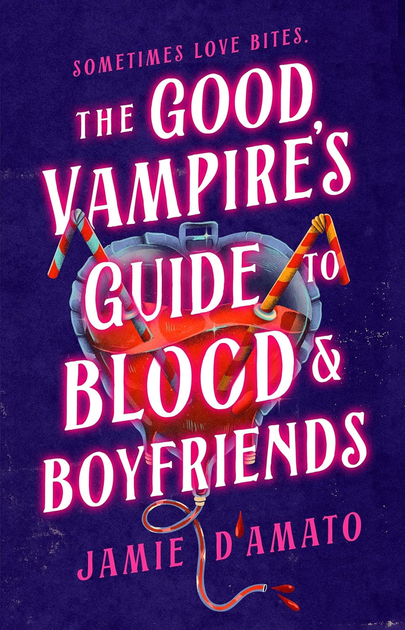
Brennan Brooks is a 19-year-old university student whose life has finally started to feel somewhat stable after years of depression and a suicide attempt. Then, tragically, he is turned into a vampire. As he struggles with bloodlust and the rules of vampire society, he also develops feelings for Cole, a gay librarian who catches him drinking human blood. Instead of exposing Brennan, Cole accepts him and helps him find a way to live as a vampire without hurting people. Their relationship eventually develops into a romance, while Brennan also has to confront his ancient vampire sire, Travis, who wants to expose vampires to humanity.
Travis seems like a good guy at first, but he turns out to be a lonely monster. And Brennan’s bigger fear is becoming a monster just like him: losing contact with his humanity, becoming isolated and permanently grieving. But Brennan was scared of being different long before he was turned into a vampire. It goes back to his human life and is partly connected to the fact that he was an unpopular, sad kid who was scared to come out as bi.
We learn that Brennan is bi in Chapter 4, “Orientation”, when he meets other vampires from the same good-vampire group I mentioned before. What immediately struck me was the way he compares discovering other vampires with discovering bisexuality. He also compares being bi to having depression and anxiety:
It [meeting other vampires] gave Brennan the strange warm feeling in his stomach he’d gotten when he first learned about bisexuality, then depression, and then anxiety. The deep comfort and the deep-seated dread of not being alone in the world.
This is one of my main problems with Brennan: he puts bisexuality on the same list as depression and anxiety, two mental health conditions that can cause genuine suffering regardless of how accepting society is of them.
There’s an important distinction here. Bisexuality itself doesn’t cause suffering; the stigma, discrimination, and bullying bi people experience do. If bisexuality were universally accepted, a bi person wouldn’t have to worry about being bullied or marginalized for their sexuality. Depression and anxiety, on the other hand, can still cause suffering even in a society that fully understands and accommodates people living with them. Their effects don’t simply disappear with greater social acceptance.
In other words, bisexuality isn’t inherently a problem to be overcome or accommodated. The problem is how society treats bisexual people. Depression and anxiety are different because they can be difficult to live with in and of themselves.
But poor Brennan is really bad at accepting himself, and he often doesn’t let other people accept him either. He assumes he will be rejected even before it happens. He is scared to love, and he is scared to be openly bi, not because of his actual experience, but because of his mental health struggles. Actually, Brennan is quite lucky with his experience of coming out. Unlike Cole, who has homophobic parents, Brennan has a supportive mother.
I was lucky my mom’s a New England radical liberal, but I didn’t come out until college. I was unpopular enough in high school without the bisexuality adding a fun new slur to people’s vocabularies.
He says this to Cole, explaining that he was afraid of making an already difficult adolescence even harder. But Brennan also tries to push Cole away because he’s a vampire, and this is where vampirism becomes a bigger allegory. Even though Brennan is not hiding that he is bi in college and some people already know about his bisexuality, he still doesn’t try to come out to his roommate Tony because he is afraid of rejection. Brennan is openly bi, but at the same time doesn’t know how to speak about being bi.
Of course, there is no rejection. Tony is absolutely fine with Brennan being in love with a boy, even though he had previously assumed Brennan was straight. Not just Tony. It seems like all the college is fine with Brennan being bi. He has a very public and very awkward moment of talking about love and relationships in the library in front of a bunch of students, and all of them are absolutely fine with the fact that he and Cole are queer. Nobody seems particularly bothered by it. His friends also accepted him being a vampire. This is one of the things I found particularly interesting about the book. Brennan spends a lot of time worrying about rejection that never actually happens. His fears are real, but the danger he imagines is often much bigger than reality. That works particularly well with the vampire metaphor because he fears being a monster and being different, even when the people around him are willing to accept him.
The Good Vampire’s Guide to Blood and Boyfriends is not just a vampire romance with humor and satire about the modern vampire genre. It also has a lot of well-meaning humor about sad bi kids who are too scared to live and be themselves. It’s a story about expectations and overthinking, and about how the things we fear may never actually happen. More importantly, it’s about living fully and being yourself, including being fully and unapologetically bi if you are bi.
The book manages to use familiar vampire ideas about secrecy, desire, isolation, and being different without turning bisexuality itself into something dangerous or tragic.
I think almost everything about this book’s bi representation worked really well. I would only have liked to see more of Brennan recognizing that his fears about being openly bi are not based on his actual experience, and I would have liked to learn whether he ever faced biphobia, particularly before coming out in college.
Brennan is the brooding vampire, and readers love brooding vampires. But he isn’t hiding in a castle because he has lived for hundreds of years and lost everyone he loved. He is just a bi teen. This makes him a brooding vampire readers can not only romanticize, but also relate to. For anxious, overthinking bi youth, his story offers a reassuring idea: sometimes the rejection you fear never happens, and being bi can help you find people who understand you.