You may have heard of fake dating, but what about a fake ex? That’s the situation high school senior Imogen Scott finds herself in when she visits her best friend, Lili, at college in Becky Albertalli’s 2023 YA novel Imogen, Obviously. Lili, who’s recently come out as pansexual and was embarrassed about her lack of romantic history, has told her college friends that Imogen is her (amicable) ex. Imogen might’ve pulled off the ruse — except Lili also claimed Imogen is bi, while Imogen, according to the book’s jacket, is “hopelessly heterosexual”.
Or so she’s always assumed. As Imogen spends time with Lili’s queer college friends — especially Tessa, a charismatic lesbian — she begins to question whether she’s as straight as she believed. What unfolds is a layered story about friendship, growing up, and coming out, set against the backdrop of a college weekend filled with trivia nights, group chats, and eye-opening conversations.
SPOILER WARNING: It’s impossible to discuss Imogen, Obviously meaningfully without spoilers, so turn back now if you’d prefer to stay unspoiled! You can also read our Bi Media entry about this novel, if you’d like a quick summary.
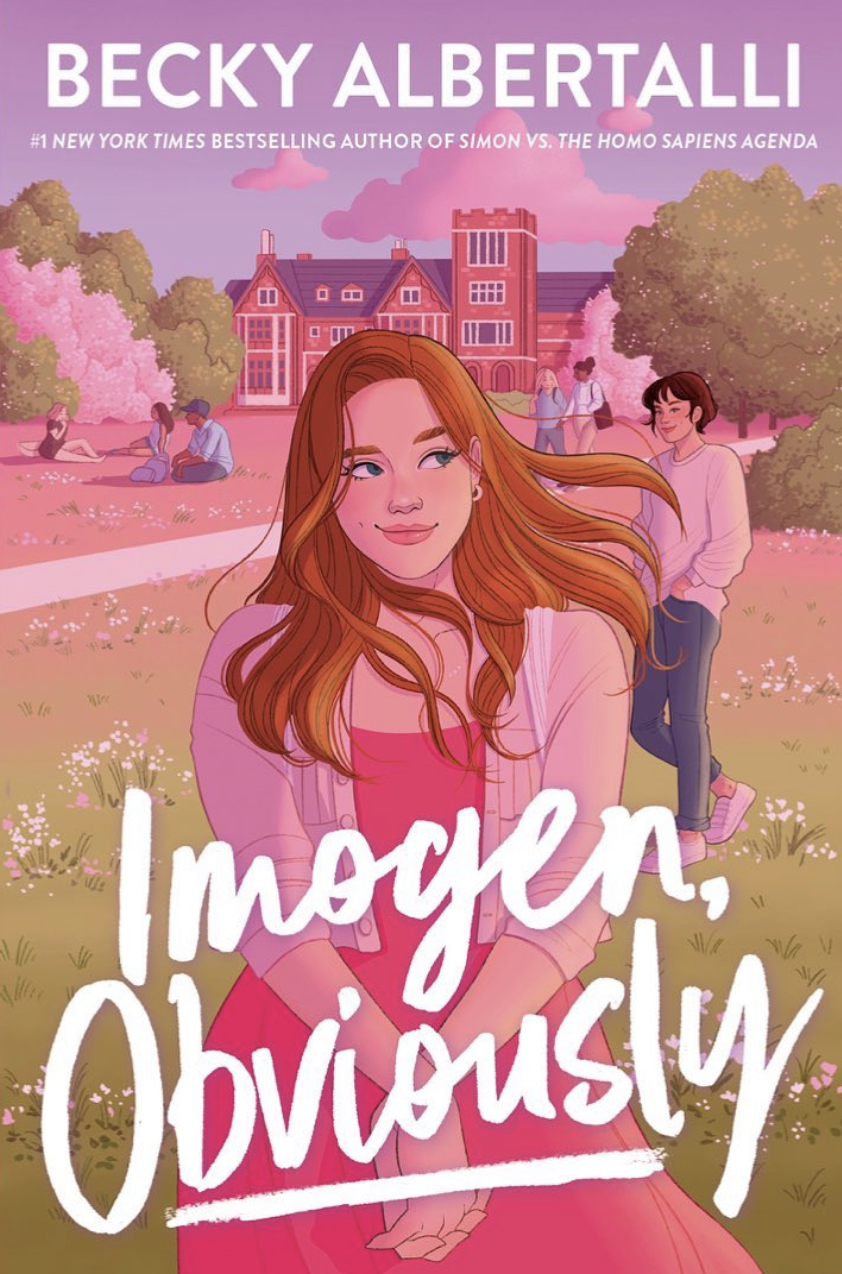
Much of the novel lives inside Imogen’s head, exploring biphobia, allyship, peer pressure, and the spectrum of queer identity through her introspective narration. This creates a poignant sense of isolation, even amid bustling social scenes, as Imogen grapples with the chasm between who she’s always thought she was and who she might truly be. Her internal monologue is achingly earnest, brimming with over-analysis that’s in turn relatable and heartbreaking. Unsurprisingly, much of this spiraling centers on sexuality, identity, and people-pleasing, culminating in Imogen’s dawning realization that she’s bisexual.
While Imogen’s anxieties are finely wrought, what resonated most deeply with me was her crumbling self-trust as her queerness came into focus. She cycles through the same questions again and again: How did I not know before? How did I miss this? They were the very questions I asked in my mid-20s, reeling from decades of overlooked signs. Thanks to larger societal pressures like compulsory heterosexuality and bi erasure, I assumed everyone was a little gay — it couldn’t be that I, specifically, was bi. I wrote off confusing, intense female friendships as platonic. I attended queer events, read queer books, and was drawn to queer people because, like Imogen, I was an ally. And then, like Imogen, I had what was undeniably a queer crush.
That’s where our paths diverge: I never doubted the crush itself. When I knew, I knew. What terrified me was other people’s reactions. My inner dialogue shifted from How did I not see this? to What if I’m wrong about everything else, too? What if this upends my entire life? Growing up, I’d had so few crushes that when I finally liked a boy, I’d clung to the relief of fitting into heterosexuality — proof I wasn’t broken or lagging. As an adult, admitting a queer attraction felt like stepping out of a safe but suffocating box, even as I began to recognize how ill-fitting it had always been.
Albertalli handles Imogen’s self-exploration with nuance and kindness. Though the novel educates through character dialogues, it never feels didactic. I wish I’d had this book before coming out, if only for its frank exploration of compulsory heterosexuality and biphobia. Would it have accelerated my epiphany? Maybe not — but it would’ve offered a roadmap for the messy, open-ended question: How does one even begin to examine their sexuality? While Imogen is fictional, her story echoes Albertalli’s own coming-out experience, as revealed in the author’s “Dear Reader” note on the publisher’s blog. Knowing the real-life parallels might’ve nudged me to scrutinize my history sooner.
Beyond Imogen’s internal struggles, the novel tackles external pressures and evolving friendships, primarily through Gretchen, Imogen’s other best friend — a proudly bi teen who always seems to understand herself effortlessly. Where Lili is warm and flexible, Gretchen is rigid and judgmental, occasionally veering into toxicity (a flaw other characters confront — no spoilers here). Their dynamic is crucial, giving Imogen — and readers — room to explore conflicting queer discourses and the ways friendships shift as we grow.
In many ways, Imogen, Obviously feels like the YA counterpart to Haley Jakobson’s adult novel Old Enough. Though their themes differ, both books examine how friendships reveal our changing selves, sometimes painfully. Real-time growth is hard to perceive, but friendships act as mirrors, highlighting the gaps between who we were and who we’re becoming — a truth that resonates for Imogen, Jakobson’s protagonist Sav, and, undoubtedly, for readers too.
Imogen, Obviously is a coming-out story that celebrates queerness in all its complexity, with particular tenderness for those questioning their sexuality later than the “expected” timeline. Imogen and her friends remind us that identity is a spectrum, and there’s no expiration date on self-discovery.