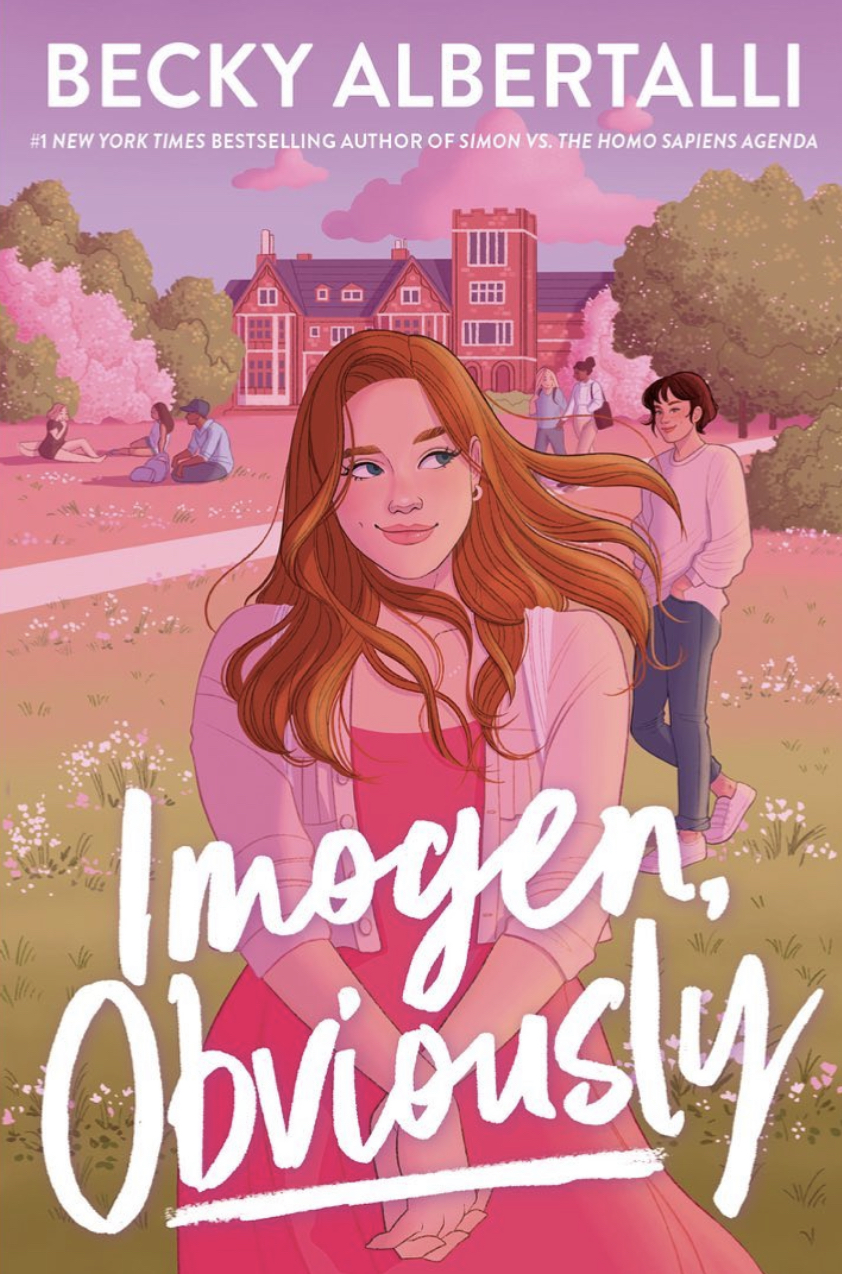
Imogen, Obviously is a YA coming-of-age romance by Becky Albertalli, author of the New York Times bestseller Simon vs. the Homo Sapiens Agenda. Published in 2023 by Balzer + Bray (a HarperCollins imprint), the novel became a NYT and indie bestseller, won the Kentucky Bluegrass Award, and was a finalist for the Stonewall awards, deemed an “Honor Book”.
Titular character Imogen Scott is thrilled — if slightly nervous — to visit her best friend Lili at college during spring break. As a high school senior, she’s eager to impress Lili’s cool new friends, but her composure unravels when Lili drops a bombshell: recently out as pansexual, Lili had lied to her college circle, claiming she and Imogen used to date.
For Lili’s sake, Imogen reluctantly agrees to go along with the lie, despite identifying as a “raging hetero.” Yet her certainty about her straightness wavers as she spends time with Lili’s queer friends — especially Tessa, a witty, chaotic lesbian. What unfolds is a tender exploration of friendship, romance, and growing up.
The novel prominently features bi-spectrum representation: Lili is pansexual; Imogen’s other best friend, Gretchen, is openly bi; and two of Lili’s friends, Kayla and Declan, are also queer. Imogen herself realizes she’s bi over the course of the story, grappling with external pressures like compulsory heterosexuality, but this also serves as the backdrop to her confronting more internal, personal fears and confusion.
At its core, Imogen, Obviously is a coming-out narrative that thoughtfully examines biphobia, queer discourse, and the messy process of understanding one’s sexuality. A standout moment occurs when Imogen confides in her younger sister, Edith (a lesbian), after a fraught dinner where she’s partially outed. “What if I only ever fall for one girl?” Imogen asks. Edith’s reply is immediate: “Then you’re bi.” When Imogen presses, “What if the girl I like is kind of… boyish?” — Edith reaffirms: “Sounds pretty bi.” This exchange crystallizes the novel’s message: there’s no “right” way to be bi, and Imogen’s identity remains valid even amid her uncertainty.
Though fictional, Imogen’s journey mirrors Albertalli’s own. The author has stated that writing Leah on the Offbeat led her to question her sexuality amid online scrutiny about her “straightness.” Of Imogen, Albertalli noted, “She’s an ally. Or she thinks she’s an ally. But the truth is, she’s boxed herself in, just like I did.” The novel serves as an “unboxing”, one that resonated critically, earning starred reviews from Publishers Weekly, Kirkus, and School Library Journal. Booklist hailed it as “A masterpiece that will be cherished by anyone who has felt they might not belong.”