Although China has a long written tradition, it can be hard to piece together what the day-to-day lives of people looked like in its premodern history. There is however tantalizing evidence that bisexuality was widely practiced among the men and women of Ancient and Imperial China.
There doesn’t seem to have been a concept of sexual orientation as an identity in ancient Chinese culture; instead, we have histories and stories that feature same-sex lovers without any moral judgment — men with both male and female lovers where the only tensions seem to come from jealousy, not orientation. Finding evidence of bisexuality is made even more complicated by the fact that Chinese love poetry tends to use gender-ambiguous pronouns. It is often unclear if the “beautiful person” in a poem is male or female. There are, however, a few stories that have been passed down through centuries, partly as history and partly as folklore, that make it clear that men, at least, were unafraid to express sexual or romantic attraction toward each other.
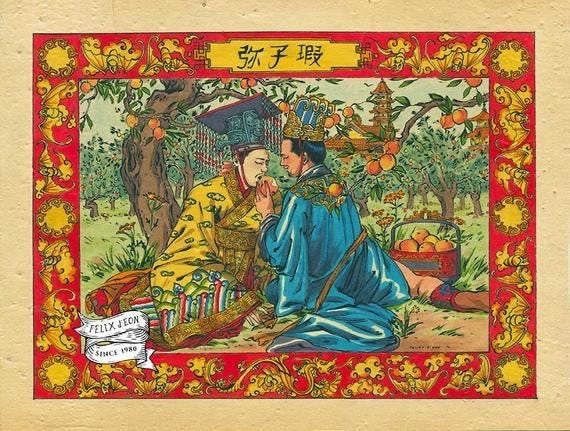
The story of the bitten peach is perhaps one of the most famous tales featuring male lovers. Duke Ling had two children with his wife Lady Nanzi. He was also a man of the Zhou Dynasty along with his friend Mizi Xia. The Duke admired Mizi Xia for his beauty and showered him with favors. When his mother fell ill, Mizi Xia forged an order to borrow the ducal carriage to rush to see her. Instead of punishing his lover, the Duke praised Mixi Xia’s filial duty. On another occasion, the two were walking, and Mixi Xia took a bite out of a delicious peach and gave the rest of it to the Duke. The Duke praised Mixi Xia for sharing this gift. However, once Mixi Xia’s looks faded and he fell out of favor, the Duke claimed that the carriage had been stolen and the gift of a half-eaten peach was an insult. It’s unclear whether or not Mixi Xia actually existed or whether the story was only meant to teach us about the impermanence of youthful beauty, but the tale never remarks on the fact that the lovers were of the same-sex, that fact is seen as irrelevant, making it appear as though relationships like these were pretty commonplace.
Later, in the Han Dynasty, the story of the cut sleeve similarly makes it seem common for men to take each other as lovers. It tells of Emperor Ai, who woke up from a nap one afternoon only to find his lover, Dong Xian, still asleep on the emperor’s sleeve. Rather than wake the man, the emperor cut off his sleeve. In addition to protecting his lover’s rest, Emperor Ai made Dong Xian one of the most powerful courtiers of the time. The emperor punished other nobles who questioned Dong Xian’s rapid advancement and made it clear that his “favorite” was above reproof. After Emperor Ai’s sudden death, forces moved quickly to impeach Dong Xian. Dong Xian and his wife committed suicide rather than face the punishments likely in store for them.
The Han Dynasty is the period with the most written records about emperors and their “favorites”, both male and female. These favorites amassed significant, if precarious, power and were largely tolerated. The emperors were expected to marry and have children, but also had concubines of both sexes. It’s doubtful that the entire line of Han emperors was bisexual, but it seems likely that a substantial number were.
Although subsequent centuries are less well-documented, there is reason to believe that plenty of emperors in later centuries seem to have been bi as well. In the early 17th century, the Tianqi Emperor even kept two separate harems — one for his male lovers and one for his female lovers.
In his book Passions of the Cut Sleeve (1990), historian Bret Hinsch looks at sources beyond literature and poetry, demonstrating that even jokes from that period show that it wasn’t just emperors who were allowed to have same-sex lovers:
From the Zhou dynasty to the end of imperial history, the relatively erudite media of history, poetry, and novels dealt with homosexuality. But these jokes comically illustrate a detailed knowledge of homosexual life among all levels of society. Homosexual love was not limited simply to the privileged elite, but could be found among the working poor as well.
One such joke describes a woman complaining to her mother about her husband’s lover. The (male) lover has basically become a member of the family. At one point the mother sees a man at their daughter’s home and asks “which relative is he?” The wife responds, “he is my husband’s husband.” The wife isn’t mad about the sex of her “husband’s husband”, only that she’s being neglected.
The wives aren’t always overlooked or jealous in these stories. In a story in Liu I-ch’ing’s A New Account of the Tales of the World (5th century), a wife convinces her husband to allow her to watch him through a peephole as he cavorts with his two friends:
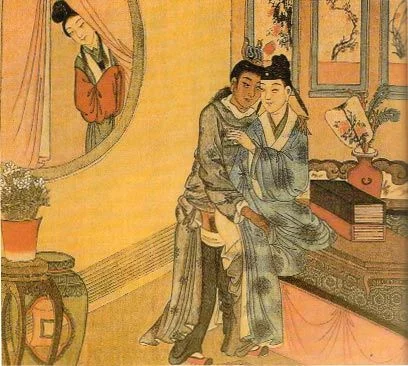
His wife said, ‘In antiquity Xi Fuji’s wife also personally observed Hu Yan and Zhao Cui. I’d like to peer at these friends of yours. Is it all right?’.
On another day the two men came, and his wife urged Shan to detain them overnight. After preparing wine and meat, that night she made a hole through the wall, and it was dawn before she remembered to return to her room.
When Shan came in he asked her, ‘What did you think of the two men?’ His wife replied, ‘your own ability is in no way comparable to theirs. It’s only on the basis of your knowledge of men and your judgment that you should be their friend.
Basically, her assessment was that it’s a good thing you’re so wise, because these other two men have you beat in the sack.
European visitors were routinely shocked by how accepted same-sex male relationships were. In the 16th century, Galeote Pereira wrote “the greatest fault we do find [among the Chinese] is sodomy, a vice very common in the meaner sort and nothing strange among the best.
It seems likely that it wasn’t just the men living their best bisexual lives, although there is substantially less written about women or their sexual preferences in Chinese history. One can only imagine that with many women stuck in a palace with a single emperor and some eunuchs, there were probably shenanigans, but it’s hard to speculate on what that says about the sexual orientation of the women. There are plenty of artworks of women having sex, but this may have been pornography for men rather than documentation. There are also tales of women performing together for the pleasure of men, but again, it is unclear whether the women are meant to derive pleasure from these acts. And there were a few accounts of women who formed same-sex marriages.
In Passions of the Cut Sleeve (1990), Hinsch wrote:
The most carefully documented of the female marriages are the ‘Golden Orchid Associations’ of southern China. […] Within the group, a lesbian couple could choose to undergo a marriage ceremony in which one partner was designated as ‘husband’ and the other ‘wife.’ After an exchange of ritual gifts, the foundation of the Chinese marriage ceremony, a feast attended by female companions served to witness the marriage. These married lesbian couples could even adopt female children, who in turn could inherit family property from the couple’s parents. This ritual was not uncommon in the Guangzhou area.
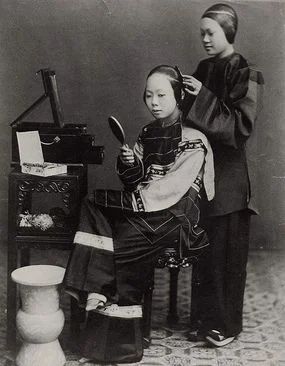
These marriages occurred almost exclusively in one region of China, but perhaps indicated a larger understanding of same-sex female attraction.
It wasn’t until the rise of the Qing dynasty that homosexuality became increasingly regulated by the courts, culminating in 1740 when homosexual intercourse was declared illegal. It’s unclear how strictly this law was enforced, as it carried a punishment of one month in prison and 100 blows with heavy bamboo, which was surprisingly a light punishment in the Qing dynasty. A greater importance was placed on obedience to social order, which meant not only social class, but also strict gender roles, which made same-sex relationships less acceptable. Over time, Western cultures also imported their own homophobia and the “passion of the cut sleeve” moved largely underground.