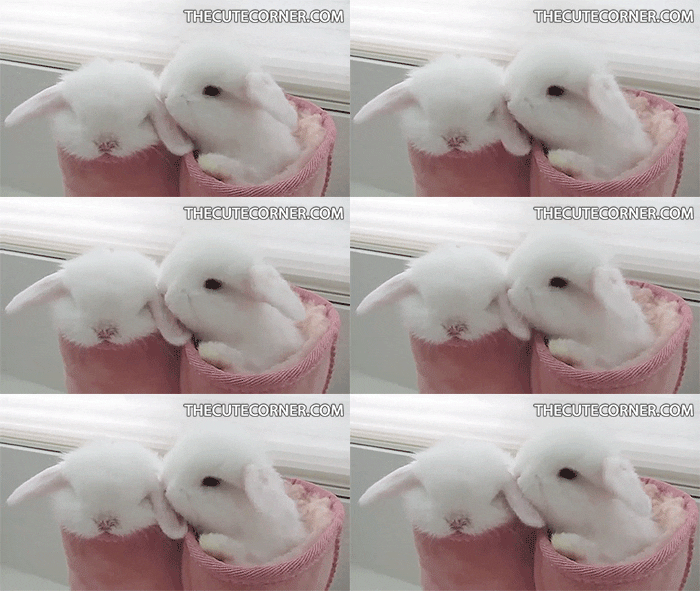
For millennia, rabbits have been seen as symbols of fertility, abundance, rebirth, and even resurrection. The fact that rabbits, well, breed like rabbits, was hard to overlook. In the age before proper science, when life was often nasty, brutish, and short, the incredible rate at which rabbits reproduce — as the science communicator Neil DeGrasse Tyson pointed out, “Left unchecked, 1,000 rabbits in five years become seven billion” — must have seemed miraculous. There’s a lot of bunny love going on out there, and rabbits don’t limit themselves to just one sex.
People have known about rabbit bisexuality for thousands of years. In fact, in addition to being symbols of reproduction, rabbits were seen as representing same-sex love and even gender-bending. In the ancient Roman comedy Eunuchus (161 BCE), a character with bisexual proclivities is poked fun at by being called a hare. (Hares are closely related to rabbits, but are classified as a different genus. Back in the day, though, hares and rabbits were seen as the same animal.)
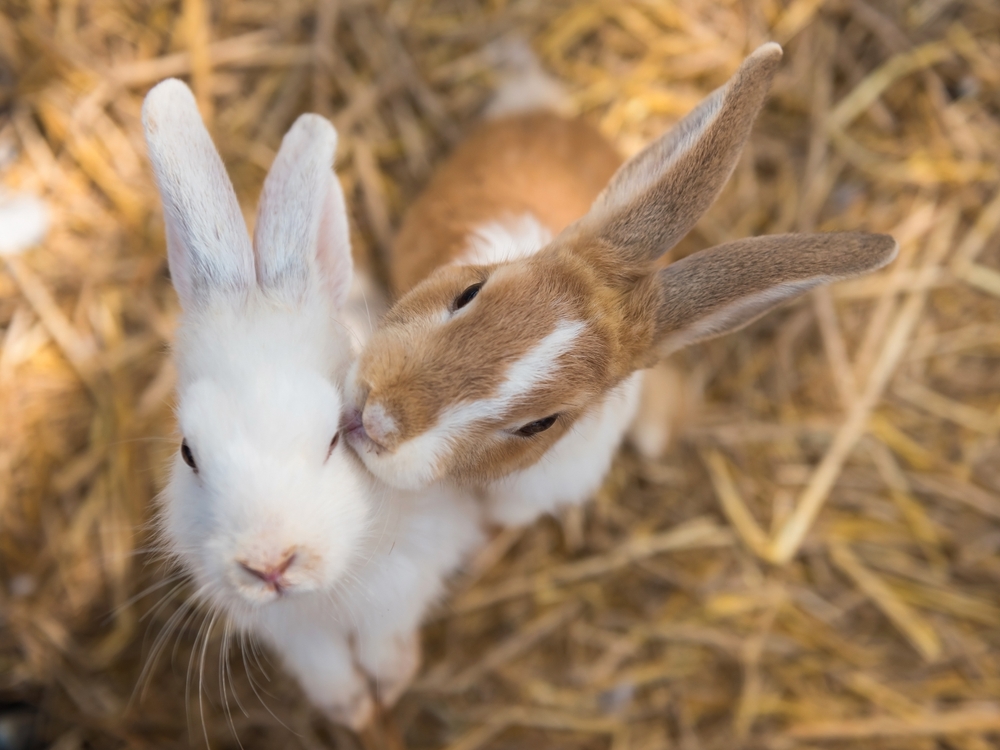
Similarly, scientists have been documenting rabbit bisexual behavior since at least the mid-20th century. In 1955, Japanese zoologist Masao Kawai noted that homosexual behavior was a common feature in male groups of free-ranging rabbits. In 1964, researchers H.M. Marsden and N.R. Holler observed cottontail and swamp rabbits engaging in same-sex courtship displays such as the “jump sequence”, where males take turns darting toward and hopping over each other. And this isn’t only a pattern among males. Studies have also found that female rabbits will also mount one another, which in some cases can even lead to “pseudopregnancy”, when a female’s body enters a pregnancy-like hormonal state without any embryos being present.
Some researchers link rabbit bisexual behavior to hormones, noting that higher testosterone levels can cause some males to become highly sexually aggressive toward other males. This flies in the face of popular notions about high testosterone making males “less gay.” Other studies document same-sex mounting among female rabbits but conclude that hormones do not appear to be the cause. Some research has found that rabbits can be induced into bi behavior with special diets that alter their brain chemistry, and still others chalk up same-sex behavior to dominance displays within social groups.
What is clear, looking at the evidence, is that whatever the exact reason for rabbit bisexual behavior, rabbits are, in fact, very bi. In a way, it makes sense. Very few animals are more overflowing with love — if not in the romantic sense, at least the sexual one. It’s only natural that so much energy could never be confined to just one sex. Rabbits, like humans and so many other species, have discovered the grass is always greenest on both sides of the fence.