Well hello there, my beautiful bi bibliophiles! Do you feel set in your ways, or are you looking for ways to expand your horizons? Is the idea of discovering more about yourself thrilling, or terrifying — especially if what you’re pondering isn’t exactly in a straight-and-narrow avenue of interest? Well, that’s what Australian sex historian, author, and site favorite Dr. Esmé Louise James aims to examine in her debut feminist novel, Becoming Venus. Touted by the author as both a modern take on the famously bi erotic novel Fanny Hill and “Fifty Shades of Grey with a sapphic twist.” Color me intrigued!
But before I get too far gone, I should briefly go over a few disclaimers. First and foremost, there will be SPOILERS for the 2026 Australian erotic novel, so forewarned is forearmed. I should also note the book contains explicit language, graphic descriptions of sex scenes, and a lot of scenes of kink and BDSM power dynamics — but hey, this is an erotica novel, so that’s to be expected. Just one last particular note for American audiences: the C-word is used in the book. This is more commonly used in Australian vernacular, so don’t be too shocked when you come across it on these sordid pages.
All set? Then let’s strap in, darlings.
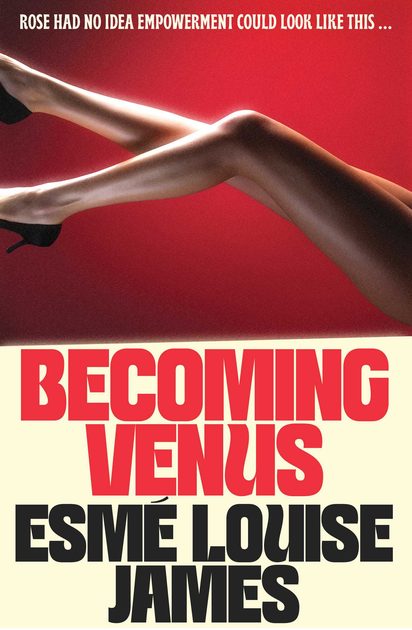
Becoming Venus focuses on Rose, an Australian academic and PhD candidate in literary modernism, writing her dissertation on “the fragmentation of desire.” After a breakup with her long-term boyfriend, Sebastian, Rose is delighted to have an erotic run-in with Adrian, a hot architect whose dalliance five years ago left a sexy impression burned into her brain. When she reconnects with him, Adrian unveils an erotic world of Melbourne’s underground sex clubs, where Rose enters a masked journey of sexual self-discovery and dons the secret code name, Venus. Soon, Rose discovers that empowerment can take many forms, and she explores new parts of her identity strictly on her own terms.
What I liked about Becoming Venus is that Rose isn’t new to being bi. On the contrary, within a few chapters we see her have different sexual entanglements with both Adrian and Phoebe, a nonbinary drag king (which gets super-meta-bi because they bond over how Rose worships their thigh tattoo of Virginia Woolf). No, what stands out about the book is Rose discovering her bisexuality can fold into her newfound interest in the kink world. In Chapter 6, she realizes this during an exhibitionist display between Adrian and Sappho at the sex club Nocturne (before lustfully joining them onstage):
A strong pang of jealousy claimed my chest — for whom, I couldn’t say. It burned within me as they [Adrian and Sappho] fell into a kiss that, even as the feeling gnawed at me, I couldn’t look away. In that moment, I could truly have been convinced I was staring at two gods of ancient times. There had never been two more beautiful beings together.
I also appreciated that the other lead characters — Adrian and new lover/teacher, Sappho — are both queer and totally affirming of Rose’s bisexuality. In fact, it was a chance encounter when Adrian saw Rose on the street with Phoebe that led him to invite her to explore Nocturne, which he enjoys (and helps fund). In fact, the chief instructor of exploring new desires and fantasies is mostly Sappho, who is a consent queen and both affirming of Rose’s boundaries and empowering her during her explorations. The book has tons of feminist themes and is queer to the core as Rose both learns from, desires, and sexually engages with people all across — and beyond — the gender spectrum.
It’s also cool that Dr. James fleshes out Rose’s character far more than Fanny Hill’s. Rose has hopes, fears, desires, and dreams. She’s brilliant, funny, observant, considerate, but also has flaws, triggers, and justified bouts of anger. Despite the focus of the book, she does not exist in a vacuum or simply as a bi character of sexual self-discovery. Rose has a family and is a loving daughter, a robust social life and friends unrelated to her bouts at Nocturne, and she works on finishing her dissertation throughout the novel. Indeed, Rose’s academic and sex life influence each other — the themes of desire from her studies of Woolf, Stein, and other female literary modernists play out at Nocturne, and the freedom of expression she gains from her lurid dalliances helps her find the emotional drive her dissertation needs to make her a better writer.
Now, this is not to say I don’t find fault with Becoming Venus. This is a book review, after all. First, it does bother me that in the year of our Lady Gaga 2026, there can be a whole-ass book about being bi and kinky without anyone saying they are bi or queer! Yes, the main characters are bi/queer in practice, but in all of this exploration, no one uses these labels? It just irks me a bit — especially considering the material!
I do also find part of the conclusion naive, with Rose proposing to quell the tension between herself, Sappho, and Adrian by forming a throuple. She doesn’t give much serious consideration to the dynamics needed in that (including all participants agreeing to the structure, which Sappho clearly rejects outright). But although polyamory is a great relationship style that works for many, it does also track that this character would suggest it as a major solution to the plot. (Speaking of plot — there isn’t a whole lot of it. There are a few key plot points, but this is not that kind of page-turner. I don’t mean this as an insult; more of a heads-up.) At this point, however, Becoming Venus follows in the footsteps of its predecessor Fanny Hill; not every character needs to be tricked into getting lost on the South Seas for a book to be worth reading.
And worth reading Becoming Venus very much is! It’s fun, cheeky, deeply sexy, and despite not using the label, it’s very, very bi. It follows in the footsteps of D.H. Lawrence’s tawdry Lady Chatterly’s Lover as being sensual and groundbreaking to the point of revolutionary. I recommend it to any readers mature enough to control their blushes and guffaws while reading it on the subway. This is high, elegant erotica for the intellectual bi reader.