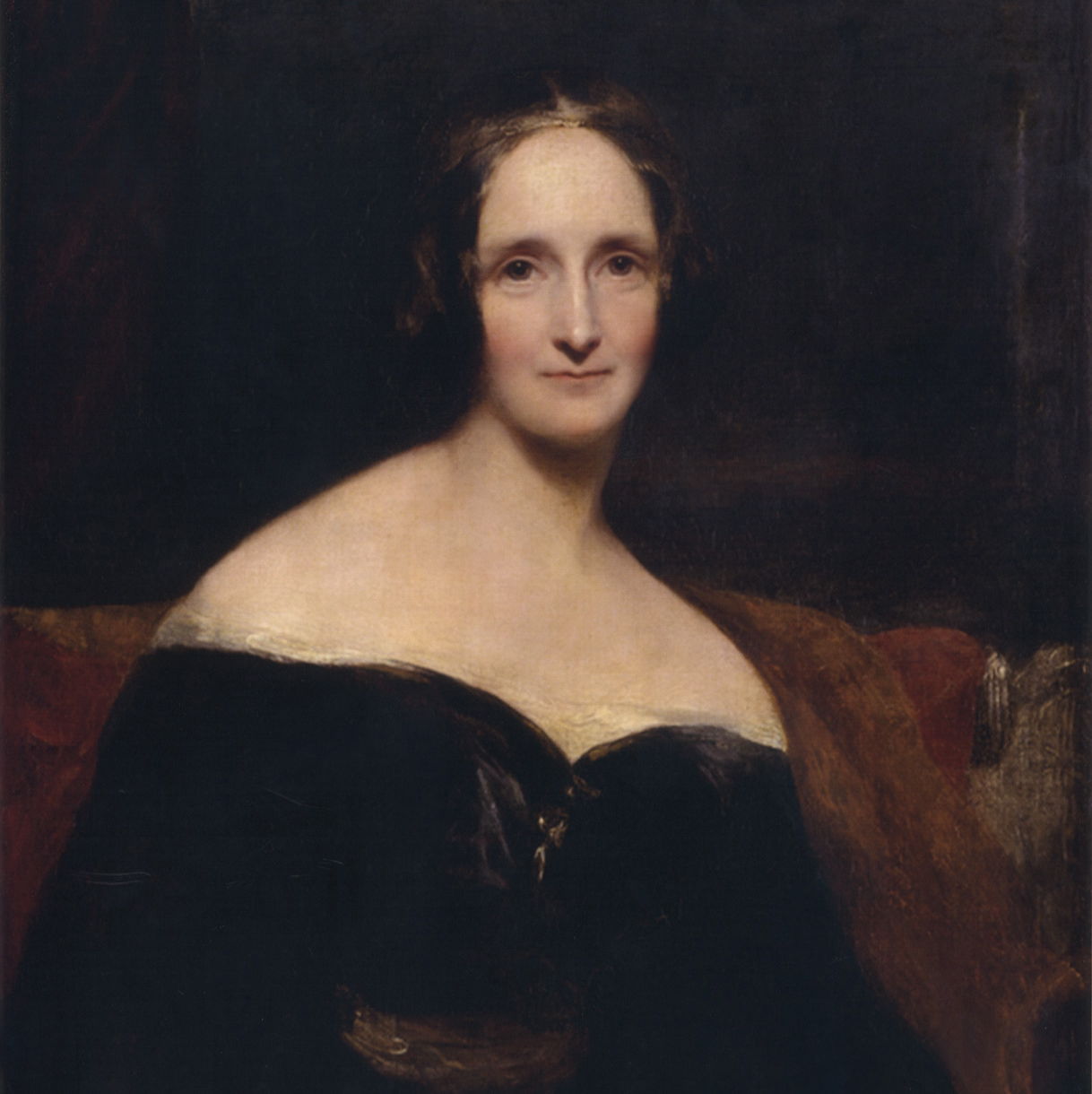
Mary Wollstonecraft Shelley was an English novelist best known for writing Frankenstein; or, The Modern Prometheus, and pioneering the science fiction and gothic genres.
Born in 1797 to famous parents — the writer and philosopher William Godwin and the celebrated feminist philosopher Mary Wollstonecraft — Shelley’s childhood was a troubled one. Wollstonecraft died from a post-partum infection just eleven days after giving birth to Shelley. Godwin remarried, and Shelley was raised in a large and unhappy stepfamily that was constantly on the verge of financial collapse.
Mary’s unhappiness may have been what propelled her into the arms of Percy Bysshe Shelly, a 21-year-old aristocrat and poet who, though married with a pregnant wife, still offered to rescue her family from their debts when Mary was only sixteen. The story goes that Mary lost her virginity to Percy on her mother’s grave, setting goth standards for centuries to come, before running away to continental Europe with him and bringing her step-sister Claire along for the ride. When Percy’s first wife committed suicide two and a half years later, he and Mary were wed.
Mary, Percy, and Claire took several long trips around Europe over the years, escaping creditors, angry fathers, and the stigma of unwed pregnancy. The most significant of which involved joining Lord Byron’s “disaster bisexual” road trip, as he fled from both sodomy charges and taking responsibility for the child he’d had with Claire. During a long, hot, wet Italian getaway in the summer of 1816, Mary wrote her most famous novel, Frankenstein, about an ill-fated scientist who assembles a man-like creature from various body parts and brings it disastrously to life with the vague use of electricity. The book revolutionized the horror genre, helped define the fledgling gothic genre, and invented modern science fiction in the process. She went on to pen seven novels in total, along with two travel narratives.
Mary Shelley’s status as one of the pioneers of the Gothic genre comes not only from her command of the written word, but also from just how Gothic her life was. Despite her achievements, Mary’s life was marked by tragedy. During their time in Europe, all but one of her and Percy’s children died. Mary herself nearly bled to death from a hemorrhage related to a particularly violent miscarriage. Percy put her in an ice bath in an attempt to stanch the bleeding, which a doctor later told them had indeed saved Mary’s life.
After her elopement to Europe, Mary’s father, who had previously showered her with adoration, refused any contact with her until Percy’s first wife died and her relationship could be legitimized through marriage. Then, not long after her near-fatal miscarriage and during a period of strife in their relationship, Percy drowned on a boating trip on Lake Geneva. When one of his friends rescued his calcified heart from the funeral pyre, Mary made her second legendary goth lifestyle choice, wrapping it in a sheaf of his poetry and keeping it on her desk for the rest of her life.
After Percy’s death, Mary grew significantly closer to Jane Williams, whose husband Edward had drowned alongside Percy. Jane, Edward, William, and Percy had been involved in a complex set of romantic relationships prior to their husbands’ deaths, and while the two women hadn’t been involved with each other before, many scholars believe they began a relationship for some time after. This mutual loss was a source of intense bonding between the two women, and after Jane’s return to England, it led to exchanges of passionate and loving letters that many experts believe indicate a romantic and likely sexual relationship.
In a letter to her friend Edward Trelawny, Mary wrote,
I was so ready to give myself away — and being afraid of men, I was apt to get tousy-mousy for women.
“Tousy-mousy” is an archaic and little-known slang term for the vagina and vulva, and used like this, it clearly refers to an erotic desire for other women.
While Mary never openly admitted to an affair with Jane in any sources we still have, what we know paints an illuminating picture. Given Mary’s correspondence, coupled with the fact that same-sex relationships were intensely shunned and scarcely ever spoken openly about, and that Shelley was no stranger to flouting the sexual mores of her era, there is good reason to suspect that Mary Shelley and Jane Williams got “tousy-mousy” together.