In 2019, UK member of parliament Dawn Butler made headlines when she claimed that “90% of giraffes are gay”. Butler had been arguing in support of LGBT rights and pushing back on the notion that people are “taught to be gay”, but once taken out of context by the press, the remark sparked debate not about human rights, but about giraffe sexuality. It turns out, Butler’s claim isn’t quite true.
For one, almost all of the documented same-sex behavior among giraffes occurs between males, so that “90%” figure is misleading (more on this later). More glaring is that it overlooks the fact that, as the UK’s Natural History Museum notes, “most giraffes will mate with the opposite sex if given the chance”. In other words, most male giraffes aren’t “gay” — they’re bi.
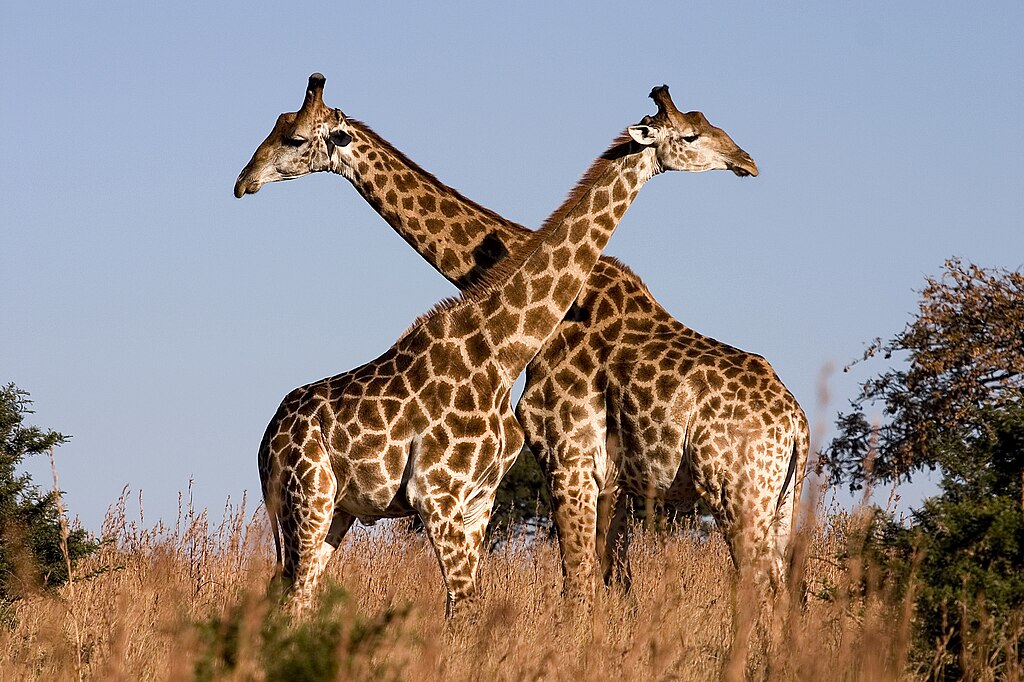
Much of what we know about giraffes we owe to Anne Innis Dagg, one of the first biologists to study giraffe behavior in the wild. Called “the Jane Goodall of giraffes” despite having conducted her groundbreaking research years before Goodall’s, her 1958 paper, “The Behavior of the Giraffe”, gave us the first detailed look into the fascinating lives of these long-necked behemoths in a state of nature. In the paper, Dagg observed that “Homosexual behaviour is much more in evidence than heterosexual behaviour.” This usually occurred within the context of a practice known as “necking”. In Dagg’s words, necking is “the gentle rubbing of one male’s head or neck on another male’s head, or along his neck or body, [which] is very common and frequently arouses a male to the extent that he will stand behind and mount [other] males.” She goes into a lot of graphic detail from that point, but I think you get the picture.
The biologist Bruce Bagemihl in his 1999 book Biological exuberance: animal homosexuality and natural diversity, noted that “In Giraffes and other species, these types of activities sometimes involve multiple animals interacting simultaneously in near ‘orgies’ of bodily contact.” There’s a mental image that’ll stick with you.
There has been some debate among experts about what precisely necking signifies. Is it sexual or an aggressive act to assert dominance? The fact is, researchers tend to have a double standard when it comes to evaluating same-sex versus opposite-sex behavior in giraffes and other animals. As Bruce Bagemihl explains:
When a male Giraffe sniffs a female’s rear end — without any mounting, erection, penetration, or ejaculation — he is described as being sexually interested in her and his behavior is classified as primarily, if not exclusively, sexual. Yet when a male Giraffe sniffs another male’s genitals, mounts him with an erect penis, and ejaculates — then he is engaging in “aggressive” or “dominance” behavior, and his actions are considered to be, at most, only secondarily or superficially sexual.
A 1967 study from the Journal of Zoology put it in refreshingly blunt terms: “In giraffes, the erection of the penis, mounting and even possibly orgasm leaves little doubt as to the sexual motivation behind these actions.” It also echoed Dagg’s finding that same-sex behavior was virtually entirely male-on-male. In fact, a study of giraffes in Tanzania that involved a staggering 3,200 hours of observation found that 94% of all documented sexual mounting was between males. This seems to be the origin of the misstated “90% of giraffes are gay” notion. But since observed same-sex behavior between female giraffes has been very rare, it’s not accurate to apply this to giraffes as a whole. Other research has found that giraffe same-sex behavior also occurs more often among younger animals, with more heterosexual behavior as they get older.
What exactly is going on here? Why is same-sex behavior so common among male giraffes? Could it be the result of too few females? It appears not. As Bagermihl notes, “in Giraffe populations with more than 60% females, male homosexuality still occurs”.
Even more remarkable, “In Giraffe populations with a majority of males, for instance, females are not swamped with heterosexual attentions, and mating opportunities with females are sometimes even bypassed in favor of homosexual mounting and other activities.” The heart wants what it wants.
The Journal of Zoology study mentioned before found that male necking and same-sex behavior “is strongly suggestive of a sexuo-social bonding mechanism” that introduces young males to their sex drives, strengthens group cohesion, helps males avoid serious fights with one another, and functions as a kind of sorting process where the most sexually energetic males go on to enter female groups and mate. According to a study from Penn State in 2021, male giraffes have closer social connections with one another than females have. When you’re a proud male who’s 18 feet tall and 4,200 pounds, and you spend most of your time in the company of other proud giants, tensions can run high — and clashes can be deadly.
The best way to smooth things over is perhaps nature’s most time-tested strategy for de-escalating conflicts: sex. Given the choice, most choose to be bisexual lovers rather than fighters