Barry Diller may not be a name most everyday people know, but it’s a name that has been universally recognized among movers and shakers for over half a century. He’s one of the most successful and influential businessmen in the history of television. The networks he founded, the formats he created, and the shows and films produced under his control have reached the lives of nearly every living person on the planet. And Diller has a persona to match his résumé. Oprah Winfrey once said, “I’ve never been more intimidated by anybody in my life, with the exception of maybe Nelson Mandela.”
Diller’s reputation as an intense leader, a bold visionary, and a strategic showman still precedes him in all the corridors of power. His personal life, however, has long been shrouded in mystique and the assumption, to the point of being an open secret, that he was gay. As it turns out, Barry Diller is bi.
Born in 1942 in San Francisco, California, and raised in Beverly Hills in an upper-middle-class Jewish family, Diller became enamored of the business side of the entertainment industry from a young age. College, however, was not for him. He dropped out of UCLA after just three weeks and got an entry-level job in the mail room of the William Morris talent agency instead. From there, Diller worked his way up in the industry, eventually becoming the Vice President of Development for the ABC network in 1965, where he created the “movie of the week” format and revolutionized the way television movies were made, marketed, and featured.
From there, the world was Diller’s oyster, and his ventures and opportunities branched out in every direction. He was the CEO of Paramount Pictures from 1974 to 1984, during which time he greenlit hit shows such as Laverne & Shirley (1976–1983), Taxi (1978–1983), and Cheers (1982–1993). He also oversaw an array of hugely successful films, including Saturday Night Fever (1977), Grease (1978), Raiders of the Lost Ark (1981), Indiana Jones and the Temple of Doom (1984), Terms of Endearment (1983), and Beverly Hills Cop (1984).

In 1986, Diller created the Fox Broadcasting Network along with Rupert Murdoch, where he gave the go-ahead for iconic shows including Married… with Children (1987–1997) and The Simpsons (1989–). At various points over his career, he held highly influential positions at a variety of networks and companies, including QVC, the Sci Fi Channel (now SyFy), IAC, Expedia, and Coca-Cola, and owned the USA Network and the Home Shopping Network for a time. Diller’s powerhouse wheeling and dealing rubbed off on his protégés as well — nearly everyone he mentored went on to become a force to be reckoned with, known collectively as the “Killer Dillers.” Later on, Diller became involved in the business end of theater producing, racking up eight Tony Award nominations and two wins. As of the time of writing, Forbes places Diller’s net worth at $4.6 billion.
Throughout his illustrious career, Barry Diller kept his personal life quiet. That he had sexual relationships with men was essentially public knowledge. Yet he never came out as gay. Instead, he maintained what he calls looking back a “personal bill of rights”:
I would live with silence, but not with hypocrisy.
I would never pose or pretend.
I wouldn’t do a single thing to make anyone believe I was living a heterosexual life.
I wouldn’t tell, and I wouldn’t allow myself to be asked.
I would live my life within these constraints, and I would never do a single thing to delude anyone.
I would never bring a man as a date to a heterosexual event — not that there were many guys I was serious enough about to bring — but I’d never bring a woman as a ‘beard,’ either.
But it wasn’t just social pressures and stigma that kept him from coming out as gay. As Diller’s recent bombshell New York Magazine essay explores, Diller isn’t gay, he’s bi. After having had minor sexual experiences with girls in high school, Diller lived his life, up until his mid-30s, only sleeping with men. It wasn’t until he met the Princess-by-marriage but newly separated Diane von Fürstenberg in 1974 that a new world seemed to open up for him. The two became friends, and then an inseparable couple who couldn’t keep their hands off of one another. As Diller wrote:
I have never questioned my sexuality’s basic authority over my life (I was only afraid of the reaction of others). And when my romance with Diane began, I never questioned that its biological imperative was as strong in its heterosexuality as its opposite had been. When it happened, my initial response was ‘Who knew?’
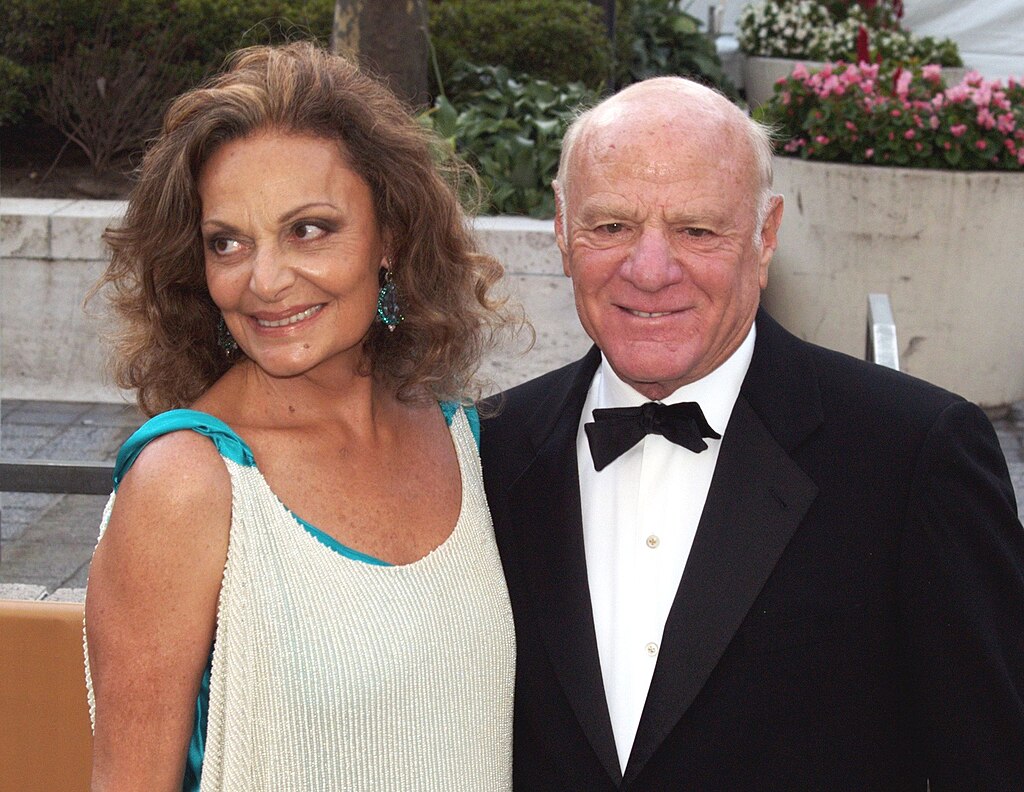
The two had a rift in 1981 and spent 10 years apart, reuniting in 1991 and marrying in 2001. All the while, no one quite knew what to make of the couple, or of Diller’s sexuality. Shortly after his marriage, New York Magazine ran a piece emblematic of the confusion. One passage read: “While Diller is often referred to as bisexual, he has lived most of his adult life as a more or less openly gay man.”
In his 2025 essay, Diller sets the record straight — or rather, bi — once and for all:
I’ve lived for decades reading about Diane and me: about us being best friends rather than lovers. We weren’t just friends. We aren’t just friends. Plain and simple, it was an explosion of passion that kept up for years. And, yes, I also liked guys, but that was not a conflict with my love for Diane. I can’t explain it to myself or to the world. It simply happened to both of us without motive or manipulation. In some cosmic way we were destined for each other. At that time the Europeans had a wiser attitude about this than us provincials. And today, sexual identities are much more fluid and natural, without all those rigidly defined lanes of the last century. I’ve always thought that you never really know about anyone else’s relationships. But I do know about ours. It is the bedrock of my life. What others think sometimes irritates but mostly amuses us. We know, our family knows, and our friends know. The rest is blather.
Even now, however, outfits like the New York Times still run op-eds that describe him as being “bi with Di”, as though Diller is in truth a gay man with this one messy little hiccup we all wish we could overlook in order to more neatly categorize him where he belongs. The situation isn’t helped by the fact that Diller had concertedly avoided the bi label. But a thing is what it is, no matter what you call it. Barry Diller’s truth is bisexual — bi any other name.