Hi, fellow unicorns! As the colder months settle in and my streaming queue grows dangerously long, I found myself diving into a new twist on the Sherlock Holmes universe — one where the mastermind detective is gone, and the medical mysteries are just getting started. That’s right: I stumbled onto Watson (2025-), and along with the puzzles and pathos, I also found a delightful bit of bi representation hiding in the halls of the Holmes Clinic.
So kick up your feet and get comfy, because I’m about to dish all the juicy deets from Seasons 1 and 2. Consider this your official spoiler alert — proceed only if you’re ready for the tea.
In the post-Holmes landscape of CBS’s Watson — where Sherlock may be gone but his absence haunts the Holmes Clinic — the show sets itself apart in several ways: instead of a regular cop-and-detective storyline, it sets itself up as a medical mystery procedural where there is drama between former spouses, patients, and coworkers.
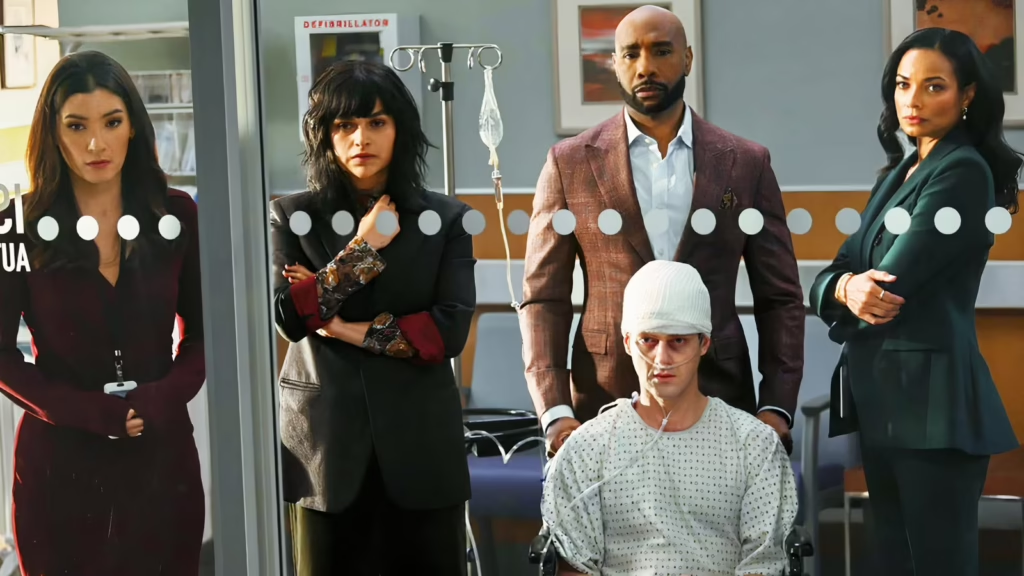
What makes Watson interesting isn’t just that it has a character who identifies as bi, but how that identity is presented. It´s not sensationalized, not problematized, and not reduced to a storyline device. Here’s how Watson stacks up on The Unicorn Scale — from the bi visibility it gives us to what it could have done with more narrative space.
If this is your first time reading a Unicorn Scale review or you’d like to refresh your memory, you can check out more details here. You can also browse our Bi Media Entry for the show if you’re looking for a quick summary!
What I liked:
Watson does a good job of folding Mary Morstan’s bisexual identity into the core of its central story rather than making it the thing the story stops to examine. From the pilot onward, Mary is shown as the clinic’s steady hand — she performs emergency surgery in the “Pilot” (S1 E1) to save Autumn when Watson can’t call in his usual surgeon, establishing her authority and competence. That characterization continues through episodes like “Wait for the Punchline” (S1 E3), where Mary is simultaneously confronting Watson’s declining health and hospital politics, and “Take a Family History” (S1 E9), which gives a flashback of Mary as a junior assistant who makes a desperate ethical choice to protect a patient — both moments that deepen her agency and make any mention of her private life feel natural rather than performative.

Mary’s bisexuality is first confirmed in Season 1, Episode 5, and the show handles it as an elegant understatement that feels refreshing. While catching up with Dr. Carmen Li (Rosalind Chao), Mary mentions a former partner named Elise. Li casually assumes Elise is a man, and Mary gently corrects her with, “She wasn’t a he. I don’t put gender on heartbreak.” It’s a blink-and-you’ll-miss-it exchange, but that’s what makes it effective: the moment is treated as completely ordinary, woven into the conversation instead of spotlighted as a revelation. There’s no dramatic pause, just two professionals talking like adults. The show trusts the audience to understand who Mary is without announcing it in neon.
Her connection to Elise resurfaces in Episode 7, when Elise becomes a patient at the Holmes Clinic with a degenerative neurological disorder. The episode blends the medical case with an emotional storyline that reveals the depth of their history. Their reunion is warm but understated — affectionate glances, half-smiles, old jokes spoken quietly in the exam room. Flashbacks outline the contours of their relationship, revealing a partnership built on mutual respect and genuine tenderness. Their breakup wasn’t the result of betrayal, but the slow erosion caused by two demanding careers pulling them in different directions: Mary anchored to the clinic, Elise working abroad. Instead of leaning into tragedy, the episode treats their past with nuance, giving viewers a same-sex relationship that ended not because it had to, but because life is complicated. Kudos to that.
What I didn’t like:
The biggest grievance is also simple: Watson gives viewers reason to care about Mary and then often sidelines her bi-ness. The show provides several strong, character-defining scenes — the Pilot operation (S1 E1), Watson’s hallucination and Mary’s revelation about the lost pregnancy, and the flashbacks in “Take a Family History” (S1 E9) that explain her past choices — but none of these scenes explicitly dramatize romantic relationships with women or depict a sustained dating storyline. The episode summaries confirm important personal moments for Mary, but they don’t show a correspondingly explicit bi narrative playing out on screen.
Part of the gap comes from the show’s commitment to traditional television procedural rhythms: each hour has to move through diagnostics, ethics, and a case’s emotional fallout (for instance, “The Man with the Glowing Chest” (S1 E5) centers on an ethically-fraught cure and team conflict, leaving limited time for extended personal arcs. That’s understandable, but it means viewers often have to rely on subtext to confirm Mary’s bisexuality rather than seeing it play out as scenes of her dating, grieving the breakup, or forming a new relationship on screen. The result is a form of representation that’s real but light as hell — present, yes, but barely…yikes on bikes.
The rating:
When all is said and done, Watson earns a 2 out of 4 unicorns. The series gives us a bi lead whose identity is treated as an integrated part of her life rather than a plot twist, but the issue of consistency leaves us wanting more. Mary’s bisexuality is handled well in the episodes that spotlight it, but the show sometimes lets long stretches go by without deepening that part of her character or giving her ongoing romantic arcs that carry emotional weight.
When the representation shows up, it’s excellent — but it appears less frequently than a bi lead deserves.
Still, Watson delivers something rare on television: a central character whose bi-ness is acknowledged, respected, and woven into her personal history without being tokenized. For that alone, it’s absolutely worth celebrating.