If someone asked you to name the biggest bisexual, who comes to mind? Maybe Halsey, Alan Cumming, Billie Eilish, or Billie Joe Armstrong? Perhaps Megan Fox? All fine choices. The consensus answer across the web is probably Lady Gaga, and for good reason. She is, after all, a global megastar. But if we’re talking about size, the true title of “biggest” bisexual from the most titanic bi creatures to ever live on Earth: whales.
Whales aren’t just enormous, they’re also enormously bisexual — something we’ve known for decades, but which, until just the past few years, we haven’t had a ton of direct evidence for. As giants of the ocean deep, whales can travel as much as 11,500 miles per year, covering vast distances at depths that are difficult for humans to track. There is so much about these majestic animals that we still don’t know, because keeping up with them requires large and very expensive expeditions, equipment, and vehicles. Bit by bit, however, we are piecing together a fascinating picture of what whale life is like. And under the sea, things are, well, fluid.
Just in 2024, researchers captured the first documented images of male humpback whales living up to their names. The photo of a male humpback whale penetrating another male with its two-meter-long penis is certainly a picture you can’t unsee. But it’s not just humpbacks. Same-sex behavior has been documented among killer whales and beluga whales (also known as white whales). More than that, same-sex behavior has been found to be especially common among males. Both beluga and white whales were found to spend most of the time — and have most of their sex — with other males. In a study published in Polar Research, scientists spent 800 hours observing 910 “thrusting events” of white whales in the wild. Sounds like a real whale of a time. They found that 59.7% of thrusting events were male-on-male, with 40.3% as male-on-female. In fact, “Non-conceptive sexual behavior” (sex not intended to produce offspring), including same-sex behavior, has been documented in at least 35 species of cetaceans, the category of marine mammals that includes whales.
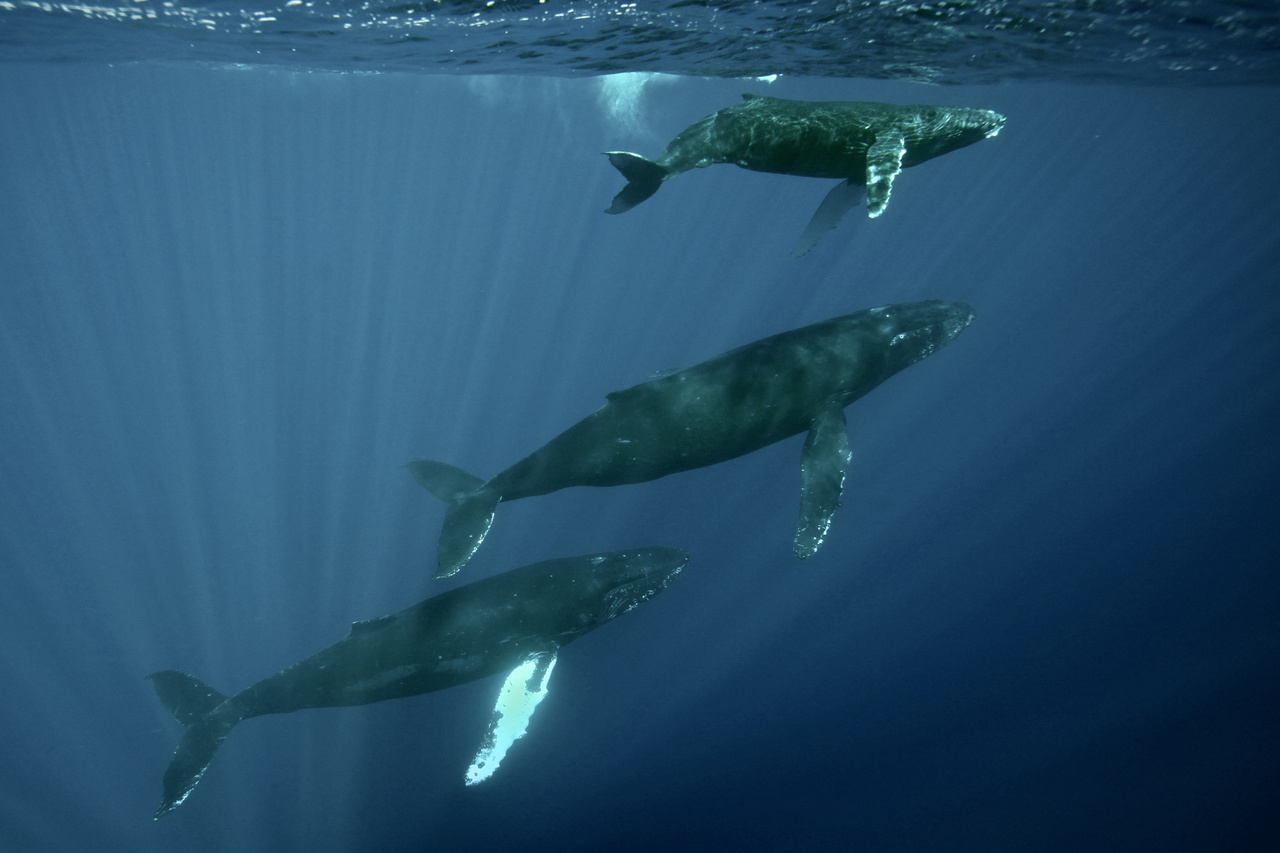
One area of whale behavior that is still largely murky is same-sex behavior between females, which occurs, but is less well documented and tends to get overshadowed by the, shall we say, more extravagant displays of male-on-male action. As an article in The Guardian quotes:
Dr. Conor Ryan, an honorary research fellow at the Scottish Association for Marine Science, notes: “It’s easy to visibly identify male ‘homosexual’ sex when an extruded penis can be two metres long. It is less easy to diagnose when female sperm whales are seen ‘cuddling’.
Given how intelligent and social whales are, scientists have suggested a number of important functions that same-sex behavior can serve, including communication, pleasure, bonding, dominance, or simply a type of play. The fact that whales often live in large pods, live very long lives, and are, for the most part, too big for most (non-human) predators to bother with, means they have ample opportunity to get up to all sorts of underwater shenanigans.
It’s a bit ironic that whales are the largest animals to ever live — the colossal blue whale is bigger than any dinosaur or prehistoric sea monster — and yet we know so little about them. But the more we learn, the more wondrous, complicated, sophisticated, and, yes, freaky whales become. Sadly, whale populations are in decline around the world, due to collisions with ships, poaching, and humans transforming the planet’s oceans into a toilet. Meanwhile, the world’s biggest bisexuals just want to glide across the world, eat krill by the ton, and get down with their mates. As the old slogan goes, “Save the Whales.” Or, perhaps a more fitting phrase from the ‘90s that now has a whole new meaning: Free Willy.