Hello, my unfathomably beautiful bi Unicorns! I hope everyone is taking good care of themselves out there and eating their Wheaties. Or, if you have a gluten sensitivity, a bowl of something that’s nourishing for your tummy. Come to think of it, I’ve never even tried Wheaties. I just remember seeing them around. Maybe I should explore that.
Speaking of revisiting the past, today’s subject comes from a faint memory of college-age Jennie. It’s 2004. At the sexuality class at my liberal college, bisexuality was barely touched upon. The bi support group at the university I tried to attend met in a new, secret location each week to avoid getting attacked. Needless to say, I was firmly bi but desperate for queer representation.
But one day that year, I opened up the newspaper to come across a review of a new romantic drama starring Charlize Theron (hubba hubba) called Head in the Clouds. All I remember from the article was a picture of Theron wearing a fedora in a bathtub, and the rare appearance of describing her character as “bi”. My mind seized onto that and, when I couldn’t grab a ride out to the local arthouse to catch the screening, I scoured my local video store to try to find a copy, to no avail.
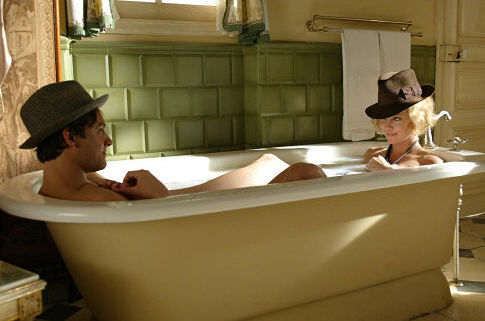
I didn’t watch it for over a decade. But I never forgot the name (or that image) and promised myself for years I would watch this movie someday, if only to satiate little college-era me of her curiosity. A few days ago, on a whim, I checked my local library catalog and found they had a DVD copy, and immediately asked if I could cover it for this space.
So before we get going, I should go over a few disclaimers. First and foremost, this review will contain SPOILERS for the 2004 film. I should also throw in a few content warnings, up to and including but not limited to: war, some blood and disturbing images, and domestic abuse. Finally, if this is your first time joining us here at the Scale (welcome!) and you’re wondering about the metric we’re using, you can learn all about it here.
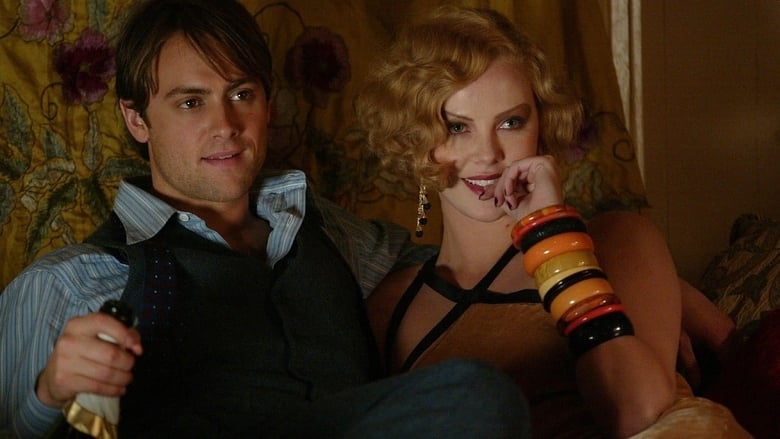
Head in the Clouds is a World War II drama focusing on three characters — Guy (Stuart Townsend), an English scholar who falls for and follows effervescent socialite Gilda (Theron) to Paris, where they share an apartment with Mia (Penelope Cruz), an aspiring nurse. As the Spanish Civil War and the Second World War approach, the three must decide if they should join fighting the forces against fascism or try to rise above it.
What I Liked:
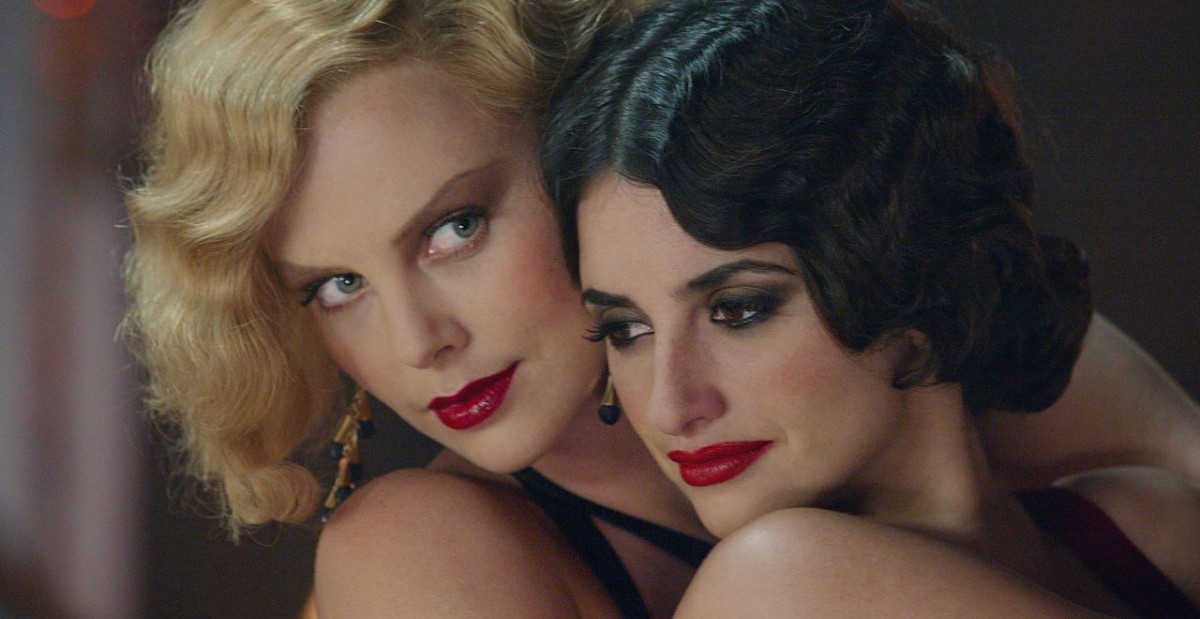
Since two of the three main characters are bi, it’s pleasant to see them given plenty of time to get fleshed out beyond their sexuality but not without having that be an essential part of their identity. Gilda is a woman full of joie de vivre, viewpoints, fears and hopes, and makes enough decisions to avoid getting pigeonholed as a 1930s version of the manic pixie dream girl. Mia, a wholly realized muse, former striptease dancer (and possibly sex worker), also gets enough agency to make choices both about how she goes about following her life’s purpose and dealing with an unconventional relationship.
Unlike many other movies from this decade, Head in the Clouds doesn’t leave the bi relationship between Gilda and Mia merely hinted at or just satisfied at a few choice moments ideally suited for the male gaze. At first I was worried about that, as Mia made a snide comment that Gilda holds full conversations in her sleep in multiple languages. However, we’re not just left with a sensual tango and longing looks (though those are there, too), and instead get a passionate kiss and Mia later spelling out that she and Gilda were lovers.
What I Didn’t Like:
Yeah, I know, this is where I write that I’m annoyed that no one uses the term “bi.” And I am. I always am.
But what I’m more annoyed about is that Head in the Clouds still kept pushing forward some stereotypes that I’m just so very over. Gilda, while enjoying some unconventional relationship setups, is still a rather oversexed, insatiable nymph who until the last act seems to be completely selfish and — wait for it — perishes due her mistaken perception of being a harlot with Nazis purely to get by when she was actually seducing them for information for the resistance. Then we have Mia who is surprisingly passive when Guy comes into the picture — in a way that seems removed from her own identity and actions as an envelope-pushing artist as well as a revolutionary. And literally in the next scene after Mia confirms that she and Gilda were lovers, she dies. I mean this is #KillYourGays writ large and made it real hard to watch, as the most boring (by far) character gets to walk away telling their tale.
I felt robbed — especially since in those between-war years in bohemian Paris it would have been a perfect setup to have the three set up a queer, poly V or even a triad (since Guy says he knew Mia and Gilda were together “deep down” and doesn’t seem to have minded.)
The Rating:
This film sits as a mostly-forgotten war epic from the 2000s, but I don’t think it necessarily deserves that fate. While it was a critical and commercial failure for its time (which I blame in part on WWII movie fatigue, as there were a bunch of these genre films in the ‘90s and early ‘00s), there is still some merit in seeing these types of characters on the silver screen.
Though they are imperfect queer characters, I think seeing movies like this from this era (including others from the same time such as Kinsey) helped pave the way for more nuanced, fuller bi representation we get to enjoy today. At the very least, it still makes me wish College-Era Jennie had gotten to rent a copy from her local video store and enjoy some faulty but flowering bi characters.