Well hello, my bodacious bi bibliophiles! I hope everyone is doing well, turning gripping page after gripping page. Who doesn’t love a good mystery? I sure do. What most people don’t think about with noir is that it has had a very steady home as a genre in sunny Los Angeles for nearly a century running. From the classic Raymond Chandler books following around hardboiled detective Philip Marlowe (like The Big Sleep) or Easy Rawlins of the Mosley novels (like Devil In A Blue Dress), noir has nestled into the Hollywood hills since the City of Angels became a sprawling metropolis. So I found myself excited to come across a book with a supposedly bi lead character in what was billed as a “neo-noir” in All-Night Pharmacy by Ruth Madievsky. So when I got my hands on the book, I knew I had to share my findings with you, dear readers.
First and foremost, there will be SPOILERS for the 2023 debut novel. Next, I really have to slap on a ton of content warnings here, including but not limited to: drug abuse, toxic relationships, sexual violence, and historical atrocities.
All good? Then let’s saddle up.
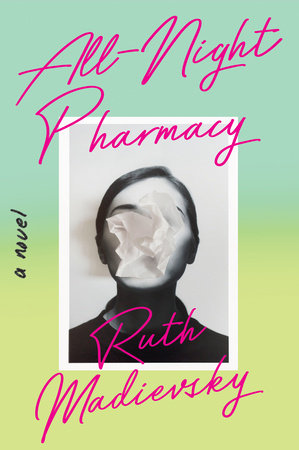
All-Night Pharmacy follows the dark misadventures of an anonymous narrator, a young woman starting on the night of her high school graduation and following her through a series of benders and misadventures for the next half-decade. She is intrinsically and toxically bound to her sister Debbie, a beautiful wild child and manipulative agent of chaos, with the two sharing a devastating family history of both Soviet-Jewish Holocaust survivor tragedy and modern trauma. Debbie both charms and wreaks havoc wherever she goes – usually with some form of illicit pharmaceuticals coursing through her bloodstream, which the narrator often struggles with saying no to as well. But when Debbie goes missing, the narrator has to navigate finding her — or decide if she even wants to.
One of the things I liked about All-Night Pharmacy is how immediately Madievsky makes it clear that her hero narrator is bi. We soon see her involved with barfly-with-a-heart-of-gold, Ronnie, but also hearing about her memories of covertly ogling the women in the strip club when she visits her sister backstage. This is not the only instance of the narrator’s queerness, as she later gets involved with Sasha, a psychic who claims to be her “amulet” and guides her (very loosely) towards finding her missing sister. One of my favorite examples of this was deep in the novel in Chapter 26, when the narrator and Sasha have flown to Moldova (where Sasha emigrated from) to visit her ancestors’ graves. Noting that Sasha was at peace with being a lesbian:
She [Sasha] wore her sexuality like an afterthought. The less she tried, the more she undid me. She knew it [did], too.
We also see the narrator flirting with other women and men throughout the novel to varying levels of seriousness, but her attractions seem clear-cut. The narrator does seem at peace with herself and her bisexuality, though she is not necessarily out to everyone in her circle — certainly not her mother or grandmother, but to her sister and other people who flit in and out of their orbit, like an Uber driver in Chapter 24. In some form or another, she does seem to be at peace with her queerness and pursuing her attractions — especially since it’s far down on the litany of things she needs to worry about in this narrative.
All-Night Pharmacy is also very darkly funny in passages. In Chapter 10, the narrator describes some louts hanging about her and her sister as self-described “abdicated Icelandic princes — even though I was pretty sure that country was a democracy.” When things turn south between her and her sister in the scene, the princes “looked at each other like: ‘We gave up our throne for this?’”
It is clear that this dark humor is genetic when she later visits her grandmother, who is serving sour cherries:
My mother’s recipe. She used to say that if I ate too many, that I would become a sour cherry. As if life hadn’t made the women in our family sour cherries already.
Not necessarily related to her queerness, but Madievsky does capture elements of the sprawl and seediness of L.A. well in her prose. It’s hard to point a finger at it, but she hits a certain level of David Lynch-esque description and insight into the darker parts of this city I have witnessed. And they come all wrapped up in distinctive Angeleno flourishes, like finishing a description of a canyon on Mulholland Drive with a surprise detail of the sweet smell of night-blooming jasmine.
With all of these things said, I had a lot of quibbles with this book. Not necessarily on the bisexuality front — it’s that the narrator is bi and acts on her queer attractions. But I will say that labeling this as a neo-noir like the marketing did feels misleading. Debbie doesn’t go missing until nearly halfway through the book, and then the narrator doesn’t even initiate a search for her sister until maybe the last thirty pages. If anything, it seems more like the real search for the narrator is to find meaning for herself in a pitch-black coming-of-age novel. So if you’re looking for a more typical detective fiction entry here, you will be sorely disappointed.
I’m also coming to a place of cognitive dissonance with my assessment of All-Night Pharmacy. Yes, it’s very well-written. Yes, there is definitely exploration of queerness in a genre that rarely gets that treatment. But I can still conclude that it’s a well-written book while still kind of … hating it. Despite the sisters coming from tragic backgrounds and behaving atrociously during their drug addictions and recovery, I get the feeling they were never really pleasant characters to begin with. So my empathy for them — and thus, my stake in their stories – ended up with diminishing returns. They start off as unlikeable, remain unlikeable, and hurt a ton of people along the way, ultimately blowing past any delicate investments we have in antihero characters and going straight into disgust.
All-Night Pharmacy is a tough read, even for those who have a high pain tolerance like myself. Yes, there is absolutely queerness at play here, but it goes beyond the “messy bi” arena and veers into dangerous tropes, shooting into the villainous bi stratosphere — even after the narrator’s recovery. Read it, but while wearing a ton of emotional armor, and don’t expect to love any character by the end of the day — or an all-night bender.